“As close as lips and teeth” is how Mao Zedong famously described China’s ties with North Korea.
President Xi Jinping’s visit to Pyongyang was a reminder that the old saying — which captures shared history and geographic proximity — still holds. But it also revealed something else: North Korea has become a far more difficult partner for China to manage.
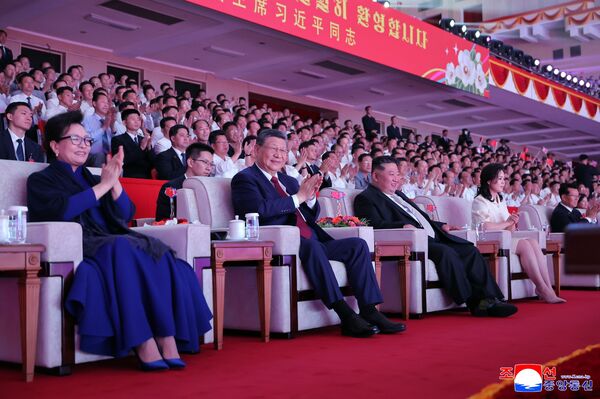
The Chinese president arrived to an elaborate welcome on Monday, complete with a 21-gun salute and soldiers chanting wishes for his good health. Kim Jong Un and his wife greeted Xi at the airport — but beyond the pomp and pageantry is a much bigger question: How much influence does he still have over the North’s mercurial leader?
There is no doubt that Kim remains the weaker partner. China is thought to account for over 95% of North Korea’s trade, and despite closer links with Moscow, Beijing is still Pyongyang’s main diplomatic partner and an important buffer against international sanctions over its nuclear weapons program.
But compared with Xi’s last visit in 2019 , Kim is in a significantly stronger position. He has a growing nuclear arsenal, a deepening military alliance with Moscow, and far more room to resist pressure from Beijing to return to the negotiating table on denuclearization — a goal China has long supported .
“Kim is kind of full of himself right now,” Mike Chinoy , a nonresident scholar at the 21st Century China Center at UC San Diego’s School of Global Policy and Strategy, and author of a forthcoming book on North Korea, told me. “He’s no longer satisfied to play the dutiful fraternal socialist little brother to big brother China — and he’s very much going to go his own way.”
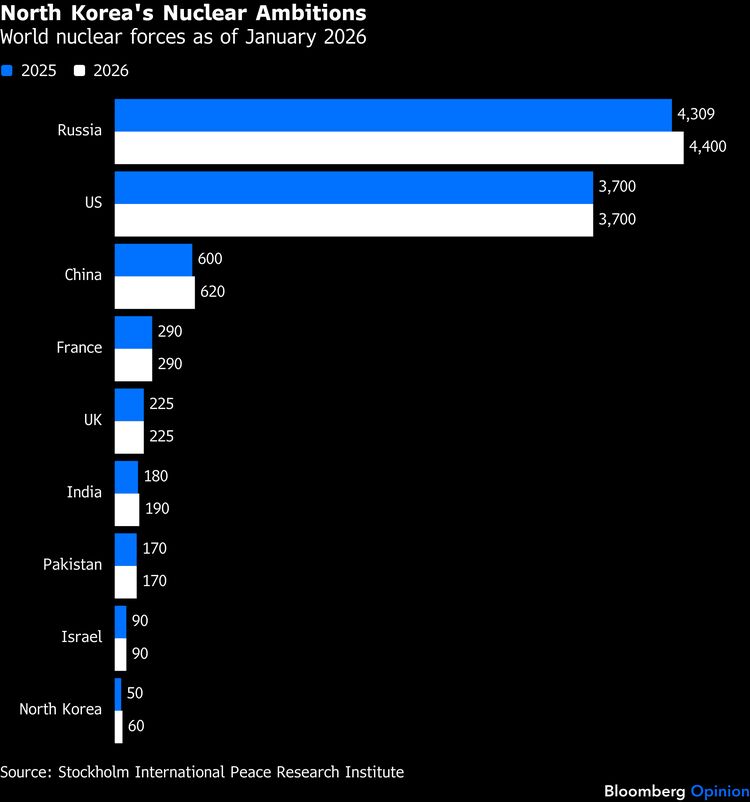
You only need to look at the rapid advancement of Kim’s nuclear weapons program to see where that confidence comes from. The regime now has around 60 nuclear warheads and enough fissile material to build at least 30 more, according to the Stockholm International Peace Research Institute. Earlier this year, South Korean President Lee Jae Myung warned that Pyongyang can now produce enough weapons-grade material for up to 20 nuclear weapons a year. Within a decade, its arsenal could surpass those of Israel, Pakistan and the UK.
Denuclearization increasingly looks off the table, a reality that I have argued we should accept sooner rather than later. Nothing about the regime shows that it’s preparing for a return to negotiations. Just a day before Xi’s arrival, Kim’s sister Kim Yo Jong vowed that Pyongyang would steadily increase its capabilities — a message to Beijing and the rest of us that North Korea’s nuclear future is not up for discussion.
Behind this newfound boldness is Russia: Their relationship has been transformed by a 2024 defense pact and the integration of North Korean troops to fight in Ukraine. A South Korean security institute estimates Kim may have supplied Russia with up to $14 billion worth of soldiers and weapons, with much of the compensation believed to come in the form of sensitive military technology. Pyongyang gets access to missile , air-defense and drone capabilities, while its forces have acquired valuable battlefield experience.
Xi's visit, then, was in part an effort to remind the North of China’s importance. But Kim’s closeness with Moscow has already yielded potential changes to Beijing’s approach. The official readout of their visit contained no mention of nuclear weapons or denuclearization — simply a reaffirmation of their strong ties. For years, China has publicly championed denuclearization as the cornerstone of its North Korea policy, even if it hasn’t done much to advance it. The omission suggests that Beijing may now be willing to tolerate Kim’s nuclear ambitions in exchange for preserving its influence over an increasingly unpredictable partner.
A North Korea that feels more secure is also likely to be less restrained — which means that the Korean Peninsula is becoming more dangerous. Seoul and Pyongyang remain technically at war . In May, North Korea revised its constitution , formally defining the two sides as separate states, and abandoning decades-old language that left open the possibility of eventual reunification.
Kim appears convinced that nuclear weapons and his closeness with Moscow are guaranteeing his regime’s survival. Washington, Seoul and Beijing should focus less on reviving failed negotiations and instead work to manage a country that is richer in options, stronger militarily and more confident than at any point in recent years. Even halting the expansion of Kim’s arsenal would be an achievement at this stage.
Xi also has an opportunity to position China as the indispensable broker in any future talks between President Donald Trump and Kim, a prospect the US leader has repeatedly signaled that he’s interested in pursuing. There’s a chance for Xi to do this on the sidelines of APEC later this year, which China is hosting .
Beijing’s influence isn’t just about managing an unpredictable neighbor. It’s about ensuring that any diplomatic breakthrough on the peninsula runs through China.
More From Bloomberg Opinion:
- North Korea’s Military Is More Advanced Than You Think: Karishma Vaswani
- America’s Foes Are Uniting . Its Friends Should, Too: The Editorial Board
- America Deserves Donald Trump. The World Doesn’t: Andreas Kluth
Want more Bloomberg Opinion? OPIN <GO> . Or you can subscribe to our daily newsletter .