New York City’s current obsession with a group of men collectively known as the Knicks can be traced back to Oct. 26, 1809. “Distressing,” began the notice printed that day on the bottom of Page 3 of the four-page New-York Evening Post . It continued:
Left his lodgings some time since, and has not since been heard of, a small elderly gentleman, dressed in an old black coat and cocked hat, by the name of KNICKERBOCKER.
The notice went on to ask that any information concerning the missing senior citizen be left at the Columbian Hotel, where he had been staying, or the newspaper’s office. A letter to the editor a couple of weeks later reported that “a person answering the description” had been seen standing forlornly on a roadside a month earlier near Kingsbridge in what is now the Bronx. A few days after that, Columbian Hotel proprietor Seth Handaside wrote in to say that Knickerbocker had left behind in his room “ a very curious kind of a written book ” (italics his), and that “if he does not return soon and pay off his bill for boarding and lodging, I shall have to dispose of his Book to satisfy me for the same.” At the end of the month, notices appeared announcing that the book was to be published soon.
A History of New York from the Beginning of the World to the End of the Dutch Dynasty , by Diedrich Knickerbocker, came out on Dec. 6, 1809, St. Nicholas Day. In truth, though, there was no old man named Diedrich Knickerbocker, no Seth Handaside and no Columbian Hotel. The whole saga had been a publicity scheme cooked up by the true author of the work, young New Yorker Washington Irving, and some friends. It was a sensational publicity scheme — the book, a “haphazard” (Irving’s own judgment several decades later) but mostly endearing mix of parody, political commentary and some actual history, was a huge success.
History remains a success, in the sense that it’s still in print more than two centuries after publication. Two later stories that Irving attributed to Knickerbocker, “Rip Van Winkle” and “The Legend of Sleepy Hollow,” have even more cultural currency . But it is the imaginary historian of Dutch descent himself who has been most ubiquitous in New York since his unveiling in 1809.
Within a few months of the book’s publication, newspaper writers began using “Knickerbockers” as a collective noun. As historian Elizabeth Bradley tells it in her 2009 book Knickerbocker: The Myth Behind New York , in the 19th century it most often described a particular sort of New Yorker with deep, usually Dutch, roots in the city. The (still-extant) Knickerbocker Club, for example, was founded in 1871 by snooty New Yorkers concerned that the admissions policies of the city’s first such institution, the Union Club, had grown too lax. “Old Knickerbocker families” were a key element of the “ Four Hundred ” that social arbiter Ward McAllister famously deemed acceptable as guests at Caroline Schermerhorn Astor’s parties in the final decades of the century. Elements of this understanding survived in the society column by a succession of authors that ran in New York newspapers from the 1930s through the 1960s under the pseudonyms Cholly Knickerbocker and then Suzy Knickerbocker.
But as Irving himself approvingly noted in 1848, the name was also “used to give the home stamp to everything recommended for popular acceptation, such as Knickerbocker societies, Knickerbocker insurance companies, Knickerbocker steamboats, Knickerbocker omnibuses, Knickerbocker bread, and Knickerbocker ice.” The Knickerbocker Base Ball Club of New York, founded in 1845, was a prominent early baseball team . At some point in the mid-1800s, the word came to describe baggy breeches reminiscent of those supposedly worn by 17th century Dutch settlers, then women’s underwear of similar shape, with the word later often shortened to “knickers.” In the early 1900s, Yorkville-brewed Knickerbocker Beer was the best-selling beer in America. And in 1907, the failure of the Knickerbocker Trust Company brought on the financial crisis that led to the creation of the Federal Reserve.
Over time, the elderly Dutchman even became associated with progress and change. In the 1870s, editorial cartoonists began depicting “Father Knickerbocker” as the personification of New York, clad in colonial garb while doing battle against political machines and other self-interested factions. Civic leaders enlisted him as mascot of their successful late-1890s push to consolidate New York with Brooklyn, Queens and Staten Island, and in the 1930s and 1940s the city Department of Health published weekly “Dr. Knickerbocker Says” articles on topics such as how to avoid colds. Knickerbocker Village , completed on the Lower East Side in 1934, was the first federally funded housing project. The 1938 Broadway musical Knickerbocker Holiday — music by Kurt Weill, book and lyrics by Maxwell Anderson — was set in 1600s New Amsterdam but intended in part as a libertarian critique of the New Deal of President Franklin Roosevelt, himself a descendant of early Dutch settlers.
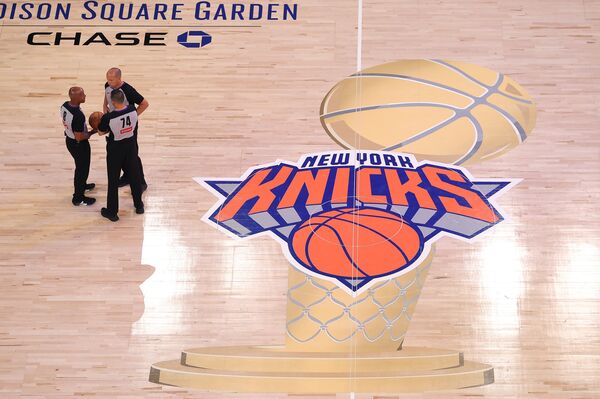
The common thread, in Bradley’s telling, was that Knickerbocker became “shorthand for the New York experience,” with the understanding — dating to Irving’s History — that this experience was unique in the nation and the world. So when journalist-turned-sports-promoter Ned Irish made plans to organize a New York professional basketball team in 1946, it was no big stretch to christen them the Knickerbockers. “The name came out of a hat,” longtime Irish deputy Fred Podesta reportedly said. “We were all sitting in the office one day — Irish, [publicity man] Lester Scott and a few others on the staff. We each put a name in the hat, and when we pulled them out, most of them said Knickerbockers.” The original Knicks logo was a cartoon of Father Knickerbocker dribbling a basketball.
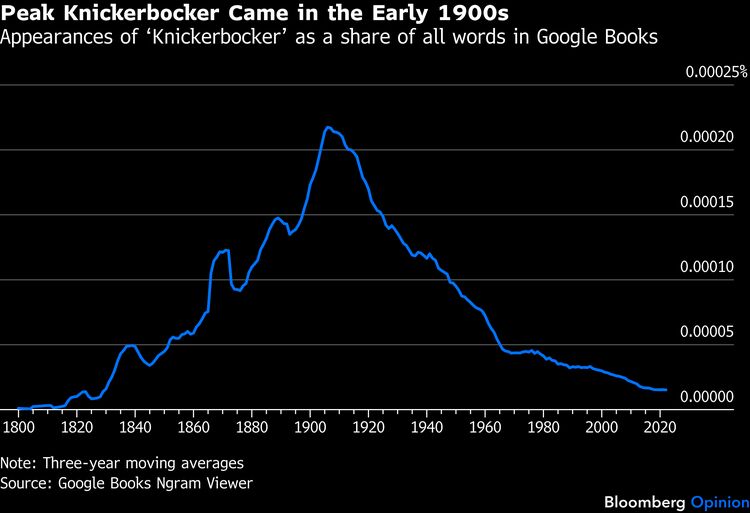
In the mid-1960s, the team removed Father Knickerbocker from the logo, and it has since for the most part dispensed with the “-erbocker.” Going by the Google Books Ngram Viewer , use of “Knickerbocker” has now been in decline for more than a century — although I like to think that’s more an indication that it was overused in the early 1900s than that it’s on the way out now. Because it really is a great name, pleasing to the eye and ear and with a pedigree murky enough that no New Yorker should feel excluded by it.
Irving, who also gave New York the enduring nickname “Gotham,” consciously chose not to give his narrator a familiar-to-New-Yorkers Dutch surname such as Stuyvesant, Schermerhorn or Van Cortlandt. Instead, he took inspiration from Herman Knickerbacker, a young lawyer from Schaghticoke, northeast of Albany, who had just been elected to Congress and whose name Irving had probably seen in the newspaper (the two became friends, but my impression from reading a lot of Irving’s letters is that this didn’t happen until after the book came out). Knickerbacker was descended from a man now known as Harmen Jansen Knickerbocker who emigrated to upcolony New York in 1674 and according a Wikipedia entry that appears to be written mostly by members of the family may not have used the surname during his lifetime. For reasons unclear his descendants did , sometimes spelling it Knickerbocker, sometimes Knickerbacker and sometimes Knikkerbakker, among other variants.
Literally translated from the Dutch, Knikkerbakker means marble-baker (marble as in the child’s plaything, not the metamorphic rock). Before glass marbles became ubiquitous, they were often baked from clay, but this was most likely something potters did on the side , not a full-time occupation. There are no Knikkerbakkers (or Knickerbackers or Knickerbockers) now living in the Netherlands, according to the family-name register maintained by the Dutch Center for Family History, and in the National Library of the Netherlands’ Delpher database none of the three words appears in Dutch newspapers or books from before Irving’s History .
It seems at least possible, then, that the very surname Knickerbocker is as much a New York invention as Irving’s Diedrich Knickerbocker, which makes it even more perfect as a synonym for New Yorker. “I’m from New York, sweetheart,” rapper A$AP Rocky told a reporter last week. “I ain’t no Knicks fan, I am a Knick.” He’s absolutely right.
More From Bloomberg Opinion:
- It’s Time for James Dolan to Sell the Knicks: Adam Minter
- Mamdani and Trump Would Love This Heroes’ Garden: Frank Barry
- NYC Has an Assault Problem. One Reason Sticks Out : Justin Fox
Want more Bloomberg Opinion? Terminal readers, head to OPIN <GO>. Or subscribe to our daily newsletter .