Oracle Corp. bonds rallied on Thursday even as its shares tumbled , after the database giant calmed debt investors by saying it doesn’t expect additional bond issuance this calendar year and outlining plans to raise $40 billion of debt and equity in the current fiscal year.
The spread for the company’s 3.65% note due 2041 narrowed 0.15 percentage point to 2 percentage points, according to Trace data as of 12 p.m. Eastern time, while Oracle’s 6.9% bond due 2052 tightened 0.12 percentage point to 2.09 points.
In the credit derivatives market, the cost of protecting the company’s debt against default for five years fell as much as 0.034 percentage point to 1.557 points, according to ICE Data Services. Falling credit default swap prices signal growing investor confidence in a firm’s credit quality.
“With AI funding coming in every flavor right now, the market is rewarding issuers that are explicit on their forward funding plans,” said Mark Clegg, senior fixed-income trader at Allspring Global Investments. “The last thing investors want is open-ended balance sheet expansion. Ambiguity is what widens spreads.”
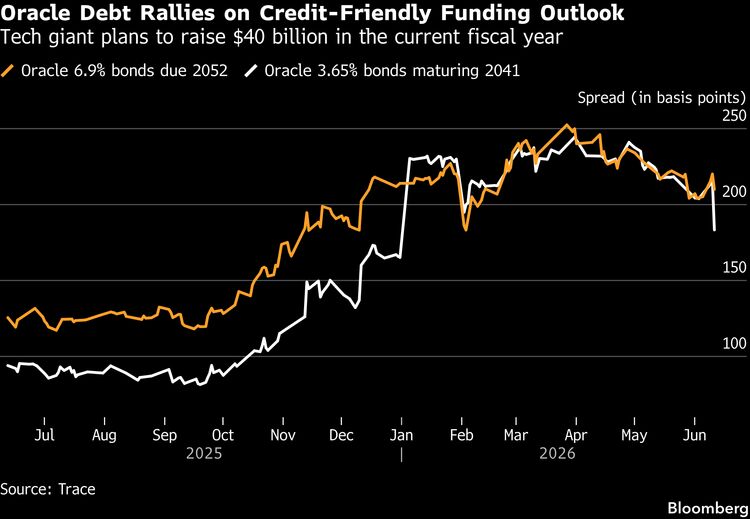
Oracle said Wednesday that the $40 billion of debt and equity it plans to sell during its new fiscal year will include a previously announced $20 billion of at-the-market stock sales. Because the company’s fiscal year ends in late May and it doesn’t anticipate selling additional debt in calendar 2026, fiscal 2027 bond issuance is expected to come in the first five months of next year.
The company sold $25 billion of US investment-grade bonds in February. It now has about $117 billion of bonds in the Bloomberg US high-grade corporate bond index, making it the biggest issuer outside of the financial sector.
“Everyone has been holding their nose as these big tech deals flow through the market, so any sign you can breathe a little on a given name is a relief,” said Scott Kimball, chief investment officer at Loop Capital Asset Management.
Oracle is among the big tech companies known as hyperscalers borrowing globally at an unprecedented pace as they race to finance massive artificial intelligence projects. Its shares dropped as much as 13% on Thursday after the company reported higher-than-expected quarterly capital expenses, raising investor concerns about the profitability of the AI infrastructure business.
The firm’s capital spending, largely a measure of data-center outlays, was about $16.5 billion in the period ended May 31. That put Oracle’s fiscal-year total at $55.7 billion, above the firm’s $50 billion projection. Net capital expenditures in this new year are expected to reach around $70 billion, Chief Financial Officer Hilary Maxson said during Wednesday’s earnings call, amid prepayment for some components.
The increased use of prepayments to fund or offset capital spending as well as customers bringing their own compute — or graphics processing units — is a constructive signal for credit as it will reduce Oracle’s cash needs, according to John Lloyd, global head of multisector credit and a portfolio manager at Janus Henderson Investors.
“Even with cash capex in line with expectations, this approach reduces near-term borrowing needs and meaningfully de-risks the company’s funding profile,” said Lloyd.