Zambia’s world-beating local debt may be poised for further gains after the government’s success buying back a potentially costly dollar bond.
The move to repurchase the $1.36 billion of notes from investors will save the nation some $275 million, money it plans to channel into electricity grid improvements. The swap adds to a string of positive developments in a country already benefiting from booming copper export revenues and inflows from investment funds seeking alternatives to the war-affected Gulf region.
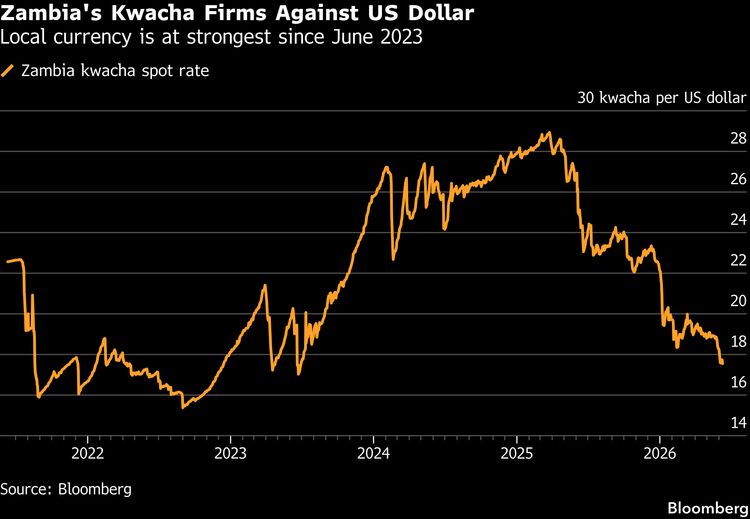
Those funds have been well rewarded. Holders of local-currency Zambian bonds have enjoyed returns of 39% so far in 2026, more than twice the gains delivered by Hungary, the next-best performer across emerging markets. The rally has been underpinned by a 120 basis-point slide in debt yields, and sweetened by a record rally in the kwacha currency.
In the week the buyback was announced, the kwacha leapt more than 4% against the dollar, extending its year-to-date gain to 24%.
While the debt exchange may not directly impact kwacha-denominated bonds, “sentiment wise, it is still probably a net positive from the perspective of investors involved in local markets,” according to Samir Gadio, head of Africa strategy at Standard Chartered Plc. Bumper hard-currency inflows from copper exporters should continue to support the kwacha, he expects.
Read: Zambia’s $65 Million Sweetener Wins Support for Bond Buyback
Investors initially flocked to Zambian bonds for their high yields and the backdrop of surging copper prices, the country’s biggest export earner. But the rally gained momentum after January , when authorities eased limits on non-resident participation in debt auctions.
“The central bank lifting the cap on how much fixed income investments your offshore players can invest in the primary market from 5% to 23% is actually what caused a huge inflow,” said Mutisunge Zulu, chief risk officer at Zambia National Commercial Bank.
While the central bank hasn’t released fresh data on foreign ownership, Zulu noted that bond auctions held immediately after the decision had been hugely successful. Almost half the securities offered at the Feb. 13 sale were taken by non-residents, the central bank governor said at the time.
An upcoming auction on June 26 could prove a key test of foreign demand.
For overseas funds, the key lure is high yields. The Bank of Zambia paid a 14.25% yield on two-year notes at the April auction, while 15-year borrowing rates were at 17.59%. In addition, kwacha appreciation has pushed inflation to eight-year lows below 7%, enabling the central bank to cut interest rates for the third successive meeting last month, among a handful of countries still in policy-easing mode.
The question for investors is how much further the trade could run. Carlos de Sousa, a portfolio manager at Vontobel Asset Management, noted that the kwacha’s real effective exchange rate — a measure of a currency’s value against trade partners after adjusting for inflation — is at the highest in more than 20 years. Another hurdle is the bond market’s small size - it’s total value is just $10 billion.
“Getting in and out is costly and can’t be done in large size,” de Sousa said. “So that imposes certain constraints for large investors.”
Sign up here for the daily Next Africa newsletter and subscribe to the Next Africa podcast on Apple , Spotify or anywhere you listen .