Ben Cohen wants to free the ice cream maker from its owner, Magnum, which he says is holding it back from supporting social causes.
By Akshat Rathi and Oscar Boyd | Updated on Jun 12, 2026 at 05:00 AM
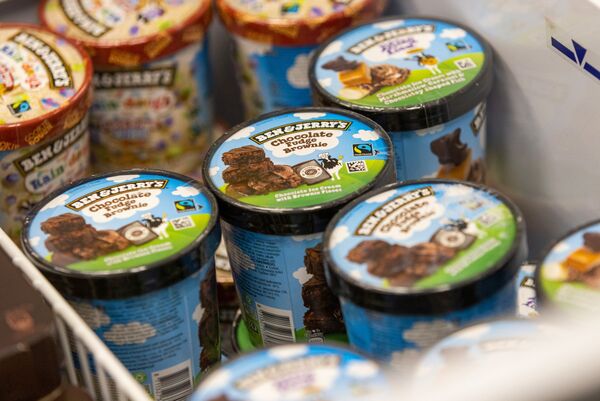
Ben & Jerry’s isn’t just known for ice cream, but also its support for social causes. With over $1 billion in sales last year, it’s an asset for its owner Magnum. So why has one of its founders quit, and the other launched a campaign to make Ben & Jerry's independent ?
Bloomberg’s Akshat Rathi sits down with co-founder Ben Cohen to ask about the Free Ben & Jerry’s campaign, why businesses should pursue social causes, and the future of ice cream on a warming planet.
Listen now, and subscribe on Apple , Spotify , or YouTube to get new episodes of Zero every Thursday.
Our transcripts are generated by a combination of software and human editors, and may contain slight differences between the text and audio. Please confirm in audio before quoting in print.
Akshat Rathi
Welcome to Zero, I’m Akshat Rathi. This week: The ice cream wars.
Ice cream is my guilty pleasure and I’m glad to report that today I get to talk about it on this climate podcast. Because there’s currently an ice cream war raging and it involves Ben Cohen the co-founder of Ben & Jerry’s.
Ben Cohen
Put simply, the very values-led business structure that's made Ben & Jerry's into the brand it is today, is precisely the thing that Magnum is in the process of destroying.
Akshat Rathi
The best introduction to Ben & Jerry’s is, well, their ice cream flavours: Cherry Garcia, Phish Food, Cookie Dough, Half Baked. And the list goes on.
For this episode though, the history of Ben & Jerry’s is probably more relevant: The company was founded in 1978 by Ben Cohen and Jerry Greenfield in the US state of Vermont, and quickly grew to be a nationwide brand, known for its chunky ice cream and support for social causes: refugees, LGBTQ communities and climate justice
And just a decade after the business was founded, Cohen and Greenfield were named “U.S. Small Business Persons of the Year” by President Ronald Reagan at a ceremony at the White House.
Now fast forward to 2000, the company gets bought by global food giant Unilever, with a promise that Ben & Jerry’s can continue its social mission. And, as you’ll hear in the interview, Unilever did support the social mission until 2021.
That’s when Ben & Jerry’s decided to halt its distribution in the West Bank – as an act of solidarity for the people of Palestine – and Unilever took steps that angered the founders Ben and Jerry. Before those issues could be resolved, in July 2025, Unilever spun its entire ice cream division out into the Magnum Ice Cream Company, with Ben & Jerry’s as one of its leading brands.
The way Unilever acted since 2021 has caused Ben and Jerry a lot of grief. Jerry quit the company last year. And Ben started a campaign to spin out Ben & Jerry's as an independent company. Magnum says Ben & Jerry’s is not for sale and that the brand is thriving under its ownership. Ben disagrees.
So I sat down with Ben Cohen at the recent South By South West festival in London, to ask about the Free Ben & Jerry’s campaign, why he thinks it is important for businesses to pursue social causes, and what the future of ice cream is on a warming planet.
Listen to the end for a full response to Ben’s comments from Ben & Jerry’s the brand and from its owner Magnum. Also, if you’d like to watch a video version of this episode you can do that on YouTube, we’ve put a link in the show notes.
Akshat Rathi
Ben, welcome to Zero.
Ben Cohen
Hi, good to be here at Zero.
Akshat Rathi
So over the years, Ben & Jerry's has stood for a number of progressive causes, including acting on climate change. And this is a climate podcast, so we will touch on climate issues, but let's just start with why you got a company involved in social causes in the first place. Because most people will say that the role of a company, what it's set up for, is to provide returns to shareholders, not to work on social stuff.
Ben Cohen
What we discovered is that it's possible to do both. You know, this idea that companies can't be responsible, can't care about the community, can't work to repair problems, economic or social justice or the environment, is just false. Businesses are incredibly powerful. They're the most powerful force in our society. And if business isn't going to be paying attention to the problems, they ain't never going to get solved.
Akshat Rathi
So Ben & Jerry's was created in Burlington, Vermont, in 1978. And since the 1980s, you're really known for not just the ice cream, but all the social causes that you've supported over the years. Until 2000, Ben & Jerry's was very much run by you and Jerry, but then it was bought by Unilever.
Ben Cohen
Yep.
Akshat Rathi
Now, at the time, Ben & Jerry's was a public company and Unilever was trying to take over. You and Jerry did not have a controlling stake, so you couldn't stop the takeover from happening. It sort of happened against your wishes, is what you've said.
Ben Cohen
That's correct.
Akshat Rathi
It happened because Ben & Jerry's was a public company. Do you regret taking Ben & Jerry's public in the first place?
Ben Cohen
You know, I guess considering what happened, yeah, I do regret that. We thought that we had legal controls in place that would have prevented that from happening, but apparently we didn't. I think there's other mechanisms that now exist, like B-corporations and steward ownership models that would have prevented what happened. But yeah, I do regret it.
Akshat Rathi
So despite selling the company to Unilever, at least until recently, Ben & Jerry's continued to push its social mission. And that was because of this unique place in which Ben & Jerry's ended up: Inside a giant corporation, but with this independent board of directors that you say has legal authority over the company's social mission in perpetuity. How exactly did you convince Unilever, a giant corporation, to create this structure? Because, you know, I cover companies for my job, and I really cannot think of a company that would look at this structure and be okay with the liabilities that would come with it. How did you pull it off?
Ben Cohen
Well, what happened was that Unilever and Nestle were the two global ice cream players. They were arch competitors. And Nestle bought Haagen-Dazs, so they had a super-premium ice cream, and Unilever didn't. So they really wanted to have one, and Ben & Jerry's was one. And so they wanted to acquire it. As you said, Jerry and I were very resistant to that.
And we were resistant because we thought that the values would, you know, would disappear, that the social mission would, you know, would essentially evaporate. And so Unilever kind of understood that and said: well, we can write the social mission into the contract, into the purchase and sales agreement. And when we tried to do that, we realised that you couldn't do that, because the social mission needed to evolve and change with the times.
So what was set up is that the structure that was purchased was… became a wholly owned, independent subsidiary. So the way it was explained to me is that, well, before we had thousands of shareholders, and now it would be just the same, except we'd only have one shareholder. But our concern was that Unilever didn't have the same social mission. So if the owner doesn't, then, you know, we figured it would go away and we couldn't write it in. And the solution was to form this independent board of directors for the wholly owned subsidiary inside Unilever, that has legal authority for the social mission and the quality of the ice cream, the use of the trademark and a few other things.
Akshat Rathi
But you did not have much of an ownership stake at the time. So what was your leverage to make Unilever create the structure at all?
Ben Cohen
Well, there were, you know, when you have a public company and another company makes an offer to buy it, then the company becomes what they call ‘in play’. And other companies can then make offers to buy it. And there were other companies making offers, and Unilever wanted to make the best one. So I think that's why they came up with this, why they agreed to this independent board.
Akshat Rathi
So beyond the social mission, in a way, resistance to large corporation is also something that has been part of Ben & Jerry's work. So talk me through the very first resistance campaign that you and Jerry ran against Pillsbury, “What's The Doughboy Afraid Of? What was that about?
Ben Cohen
Sure. So, you know, in the early days, Ben & Jerry's was just starting to sell its ice cream over state lines.
Akshat Rathi
Beyond Vermont.
Ben Cohen
Right, beyond Vermont. And so we sold into New Hampshire and Maine. And then we went into our first major market, which was Boston. And when we went into Boston, what happened was that Pillsbury had purchased Haagen-Dazs. And both brands, Haagen-Dazs and Ben & Jerry's were being distributed by the same distributors. They, you know, distributed about 20 different brands of ice cream. And the Pillsbury guys came to our distributors and said, if you continue to sell Ben & Jerry's, we're not going to sell you Haagen-Dazs anymore. So, you know, and the distributors came to us, they said, ‘hey, Ben, Jerry, we really like you guys. It's really good ice cream. But, you know, Haagen-Dazs has been around a long time. It's the biggest selling thing we have on our trucks. And they said, we can't have both. And so we're going to have to drop your ice cream.’
And, you know, the problem was that we had just had an in-state Vermont public stock offering. So we had sold shares in our company to our neighbours. One out of every hundred Vermont families had become an owner. And so here was this existential threat to the company because if we couldn't sell to a distributor who was already carrying Haagen-Dazs, we really couldn't sell to any decent distributors all around the country, because they were all carrying Haagen-Dazs.
So, you know, we realised that, you know, it's a restraint of trade under federal antitrust law. But we were this little company and Pillsbury was this huge company with a lot of lawyers that they could afford to spend a lot of money on. And we didn't. So we figured what we would do is we would let the public know what's going on. And, you know, so we started the What's The Doughboy Afraid Of campaign. We had aerial banners flying over the sports stadiums in Boston saying, What's The Doughboy Afraid Of?
And we had, you know, signs on the sides of the buses that showed these two pudgy white hands coming out from behind the sign, squeezing Ben & Jerry's saying, ‘Don't let Pillsbury's dollars strangle Ben & Jerry's ice cream. What's the Doughboy Afraid of?’ And, you know, we were making a little headway. And then we thought, you know, who really cares if Ben & Jerry's goes down the tubes? We said, Well, it must be our customers. So we put an 800 number on our pine containers with a sticker. And, you know, 800 numbers were new at the time. And you call it up and you get an answering machine with tape. They were new at the time, too.
And when you call it up, you got a recording from Jerry and myself telling the story of what was going on and asking people to leave their name and address for a doughboy kit. And we would mail them What's The Doughboy Afraid Of bumper sticker for their car and a write-in letter to the chairman of the board of Pillsbury and a chance to send in ten dollars and get a T-shirt that said Ben & Jerry's Legal Defence Fund major contributor.
Akshat Rathi
And so it worked in the end?
Ben Cohen
It did. You know, the media started to pick it up. Well, what happened was because of that 800 number, we started getting several hundred calls a week, mostly between the hours of midnight and 3 a.m., which is when people are eating our ice cream, I guess. And the media picked it up. And the Pillsbury Doughboy was getting such a black eye that Pillsbury relented.
Akshat Rathi
And you've used this, essentially, customer love for the brand to try and get a lot of your social mission also heard and fought for. Now, under Unilever, there was an interview of yours for the podcast ‘How I Built This’ by Guy Raz in 2017. Under Unilever from 2000 until 2017, it seemed you and Jerry were quite happy with how Unilever had managed the company because it continued to support social causes like Occupy Wall Street as a corporation going against other corporations or, you know, even the climate change ice cream that you'd put out.
What changed? Because right now you're running a campaign against, well, Unilever is part owner, but Magnum Corporation, which has spun out of Unilever. What changed between 2017 and now, that you don't think what Unilever or Magnum is doing is right?
Ben Cohen
The major change that happened was in 2021 when Unilever and the independent board of directors of Ben & Jerry's and the management of Ben & Jerry's, after a lot of study, all agreed that Ben & Jerry's should stop selling in the occupied territories in the West Bank of Palestine. And so we announced that we were pulling out. And what I'm told is that the head of Israel called up the head of Unilever and said: if you don't get that ice cream back here, we're going to kick out all the Unilever businesses from Israel. And they had quite a few there.
So, you know, Unilever on its own sold off the rights to Ben & Jerry's to an Israeli. And that was something that Unilever wasn't allowed to do, that that was the purview of this independent board of directors.
Akshat Rathi
So Unilever has since then gone even one step further. It's spun out its entire ice cream division, including the Ben & Jerry's brand under Magnum. Now for Magnum, it is now a €9 billion company and something like 10% or 15% of all its sales are down to the Ben & Jerry's brand. So it's very valuable as a brand to them.
But Magnum has also made it clear to you that they are not selling the brand because it's so valuable. You are now running a campaign to try and free Ben & Jerry's from the Magnum brand. How is that campaign going? How will you succeed?
Ben Cohen
I think the campaign is gathering more and more traction. There's over 130,000 people that have signed petitions and letters to Magnum. Our supporters want to do more than that so they've been kind of infiltrating the Magnum social media with saying, ‘Free Ben & Jerry's.’
And that's been going so well that Magnum has changed their settings. So if you tag Magnum, it doesn't show up on their social media anymore. So now you have to actually go to their page and comment. And in terms of media coverage, there's more and more attention being paid to it.
Akshat Rathi
After the break, I ask Ben Cohen whether people really buy Ben & Jerry’s for its social impact, or because they just like the taste. And if you’re enjoying this episode and everything we do at Zero, please take a couple of minutes to write us a review on Apple Podcasts, Spotify or YouTube, where you can watch a full video version of this conversation.
Akshat Rathi
But getting 130,000 signatures, you know, an important achievement. But the way I understand, if you're going to remove or free the Ben & Jerry's brand from a giant corporation like Magnum, you're going to have to convince the shareholders who own the company to allow this kind of thing to happen, right?
And so far, I've only seen like one letter. It was dated May 1 this year from a set of shareholders who own about €1 million worth of shares in the company asking questions of Magnum. ‘What is it doing to respect the independent social mission of Ben & Jerry's?’ That's roughly 0.01% of the company's total value. So you have a long way to go to convince shareholders. What are you doing to convince the people who own the company to let Ben & Jerry's be free?
Ben Cohen
Yeah, I think that the decision making body is actually their board of directors. And that's who we're trying to influence. And we're making two major points from a fiduciary point of view.
One is that they ended up charging their shareholders quite a bit of money for the Ben & Jerry's brand and that by not allowing the brand to actualise its social mission, especially today, when Trumpism is essentially the biggest attack on the values of Ben & Jerry's since the company was founded. And Magnum has said, you cannot criticise Trump. You cannot do things that Trump doesn't, you know… you can't criticise things that Trump likes. And that kind of makes Ben & Jerry's pretty hypocritical. And I think it really damages the brand.
And so, put simply, the very values-led business structure that's made Ben & Jerry's into the brand it is today, is precisely the thing that Magnum is in the process of destroying.
Akshat Rathi
But this is, in a way, you're trying to convince the shareholders that the reputation of Ben & Jerry's, the thing that makes them sell Ben & Jerry's and earn so much money, is at stake. But Magnum doesn't think so. And sales of Ben & Jerry's continue to do well. So do you think people are really buying Ben & Jerry's for the social mission or they just like the ice cream?
Ben Cohen
Well, I mean, some people are just buying it because of the ice cream and some people buy it because of the ice cream and the social mission. And if you think about how traditional companies do advertising and marketing, I mean, mostly it's about making up funny stories or emotional stories to get people to like the brand. But it's a pretty ephemeral connection.
And for Ben & Jerry's, the relationship that it has with its customers is based on shared values, which is a very, very strong and deep connection. So I think that's what's at stake here. And, you know, the destruction is going to happen gradually. It's not going to happen overnight. People remember the things that it used to do.
Akshat Rathi
So one thing you can do in making this business case is go to the shareholders who are people who run other businesses, right? I was looking at the top 20 shareholders in the Magnum Corporation and you have the big names. You have BlackRock, you have Vanguard, you have Goldman Sachs, you have Wellington Management. You even have the Norwegian Sovereign Wealth Fund in there. Have you tried to make a case to them that the social mission of Ben & Jerry's is what is providing them with the returns that they are gaining right now, and that is under threat?
Ben Cohen
We have not. But especially when you mentioned the Norwegian Sovereign Wealth Fund, my understanding is that they've got some social values. We should probably talk to them.
Akshat Rathi
So take a step back and you've run a business that has had a social mission. There are not that many businesses. You talked a few about B-corporations, they're growing in number. But really, if you think of a recognisable brand that continues to have a social mission and generate returns, Patagonia is the other name that comes to mind. What is holding back more companies from having social missions of working the way you have to show that the people who buy it, buy it with that care and then they come back to support the types of causes that you are fighting for? Why is it that more companies aren't doing it?
Ben Cohen
I think that the traditional business model is that the purpose of a business is to maximise short-term profits. And that's what they do. That's what they learned in business school. And the people that are running them don't understand that it's really possible to combine both things.
It's easier to just hire an advertising agency and a PR agency to make up stories that people like, that make them feel good about it. I think a lot of businesses and business people are concerned about taking a stand on something where not everybody is going to agree with it.
And what I've always said is that if you're going to take a stand on something and everybody already agrees with it, you didn't need to take a stand on it to begin with. But the other thing to understand is that no business has 100% market share. You don't have to appeal to everybody. You have to appeal to a few, a percentage, a lot. And I think by having a social mission, by having this relationship based on shared values, you do appeal to people a lot.
Akshat Rathi
And so Ben & Jerry's has been around for 50 years. You've seen this change in how business is done over those 50 years. Do you think this recent backlash against environmental, social governance factors, the things that would make companies go towards having a social mission and building a company around not just profits, but also providing services that people want, do you think that backlash is a trend and that it'll reverse at some point? Or do you see that this is a real rupture from what was in the past that was helping more companies have a social mission?
Ben Cohen
I think companies that were just following the trends, maybe they thought it was fads, following the market. You know, the market says Black Lives Matter. Okay, we're going to say Black Lives Matter. The market says diversity, equity, and inclusion matters. Okay, we're going to do diversity, equity, and inclusion.
And then the president comes into the White House and says diversity, equity, and inclusion is bad. So they jettison diversity, equity, and inclusion. The issue is that they were just kind of tacking these things on. It was not part of the mission of the company. It was not part of the purpose of the company. So they just thought, well, this is the latest trend. I'm going to do it. Now it's not the latest trend. I'm not going to do it.
Akshat Rathi
So one of the things that is core to Ben & Jerry's is relying on dairy.
Ben Cohen
Yes.
Akshat Rathi
Dairy, as you know, is a big contributor to climate change.
Ben Cohen
You're talking about cow farts.
Akshat Rathi
Indeed. Well, a lot of the emissions are actually cow burps rather than farts, but the farts always make people laugh.
Now, it is something that not just Ben & Jerry's, but other ice cream brands have to deal with. What is the way in which, if a company is not just fighting for social causes, but also has to act on them? You know, Ben & Jerry's has gone down the renewable energy path, but dairy isn't something that it's been able to address. What can be done for ice creams to cut their emissions to zero?
Ben Cohen
Well, we have come out with non-dairy, quote-unquote, ice cream. It's other sorts of creams. I think we're using oats, and the product tastes great. And, you know, if people buy more of that, we're going to make more of that, and less of the stuff with dairy. But the reality is that real milk and cream tastes really good and you don't need to use artificial ingredients. You don't need to use chemicals if you're using real milk and cream.
I mean, you know, it's the same issue as, say, butter. I mean, I hope we're not saying that butter should not exist or that milk should not exist. You know, yes, I mean, any business has a negative environmental impact. It has a footprint. And yeah, dairy is one of our footprints.
Akshat Rathi
And is it something that you've been able to do with Ben & Jerry's where you educate the people in the choices that they are making? Can you help change the types of choices people are making as a company?
Ben Cohen
Well, all Ben & Jerry's has done is provide an alternative, which is the non-dairy frozen desserts that we make. We have not gone out and said that milk and cream have a negative environmental impact.
Akshat Rathi
Should you?
Ben Cohen
It's a good question. You know, I don't know.
Akshat Rathi
When all these changes to the business were happening that weren't things that you liked, did you ever consider starting a company that is, I don't know, Jerry & Ben's and just coming up your own counter brand to show what your brand used to really stand for?
Ben Cohen
You know, people have suggested that. But, you know, starting a new company is a whole lot of work. And, you know, Jerry and I were 26 when we started Ben & Jerry's and had, you know, had a lot more energy than we currently do. And starting a new company from scratch is, you know, not something that I've thought of doing. I mean, I think that the important thing is the power of Ben & Jerry's because it's gotten to be such a large company and its reputation is so good and it's well known in a large section of the world. So starting one from scratch, trying to do that… you know, it took 50 years to build Ben & Jerry's. It would, you know, it would probably take another 50 to do that.
And the other, there's two other factors, which is the reason why I've decided to put all my energy into freeing Ben & Jerry's. One is that Ben & Jerry's is one of the leaders of the socially responsible business movement. And if we lose that, if we neuter Ben & Jerry's, it loses that leadership and it's a real setback, I think.
Akshat Rathi
So in this process, you have this campaign that's been running for some time now. You've also had a partner throughout this period in Jerry Greenfield. You and Jerry have been friends for life and you continue to be friends now, but Jerry has quit. In September 2025, he stopped being part of the resistance campaign. You continue. Why did Jerry quit?.
Ben Cohen
He resigned in protest. You know, Jerry is an amazing guy. He's my best friend, incredibly compassionate and kind and loving, smart. Everything you'd want in a friend. But by his own admission, he's extremely conflict averse. And I mean, I don't particularly like conflict myself, but I can take it. And, you know, this is a conflict situation. It's kind of a battle and it's not the kind of thing that Jerry could do.
Akshat Rathi
Thank you, Ben.
Ben Cohen
You bet.
Akshat Rathi
And thank you for listening to Zero. For a full video version of this conversation, search for it on YouTube, or find the link in the show notes.
We reached out to the Magnum Company for comment, a spokesperson said “Ben & Jerry's is not for sale and is thriving as part of The Magnum Ice Cream Company. Ben & Jerry’s continues to advocate for a range of causes and is a bold voice for social justice. It has recently spoken out on ICE, on the conflict in Iran, on freedom of speech, on migrant and refugee justice, in defence of democratic processes, and in support of No Kings Day in the US. The brand sales grew 3% last year, with market share gains in the US and Europe. ”
A separate spokesperson for the brand Ben & Jerry’s said: “We are grateful to Ben Cohen and Jerry Greenfield for all they have done to inspire and build this company. Their vision and activism have shaped our mission for almost 50 years, and we continue to steward that mission forward. The company's program for dairy farm workers in Vermont, the Netherlands, Germany and the UK has worked for nearly two decades to advance climate-smart farming practices, support farmer livelihoods and farmworker rights, promote strong animal welfare standards, and reduce the environmental impact of dairy production.”
If you enjoyed this episode, please take a moment to rate and review the show on Apple Podcasts, YouTube, and Spotify. This episode was produced by Oscar Boyd and Meaghen Olsen. Our theme music is composed by Wonderly. Special thanks to Charlotte Hughes-Morgan, Kieron Banerji, Callum Baker, Sommer Saadi, Laura Millan, and Sharon Chen. I'm Akshat Rathi. Back soon.