
At Providence Saint John’s Health Center in Santa Monica, California, a humanoid robot in a plastic Dodgers helmet roams the hallways. It pulls up outside an oncology lab, where a technician walks over and retrieves a package from one of three drawers beneath its torso. The technician thanks the robot, named Moxi, which then blinks, pivots and heads off for the elevator.
Moxi and its twin, Roxi, complete dozens of such tasks at the hospital each day, including delivering lab samples and medications and transporting supplies and spare clothing. The company behind the machines, Diligent Robotics Inc., a startup in Austin, has deployed them in more than 25 health systems across the country. Moxi and Roxi represent the promise that many technologists see in human-shaped robots, which can function in a world designed for humans. But the pair are shaped differently from humans in one notable way: They have wheels instead of legs.
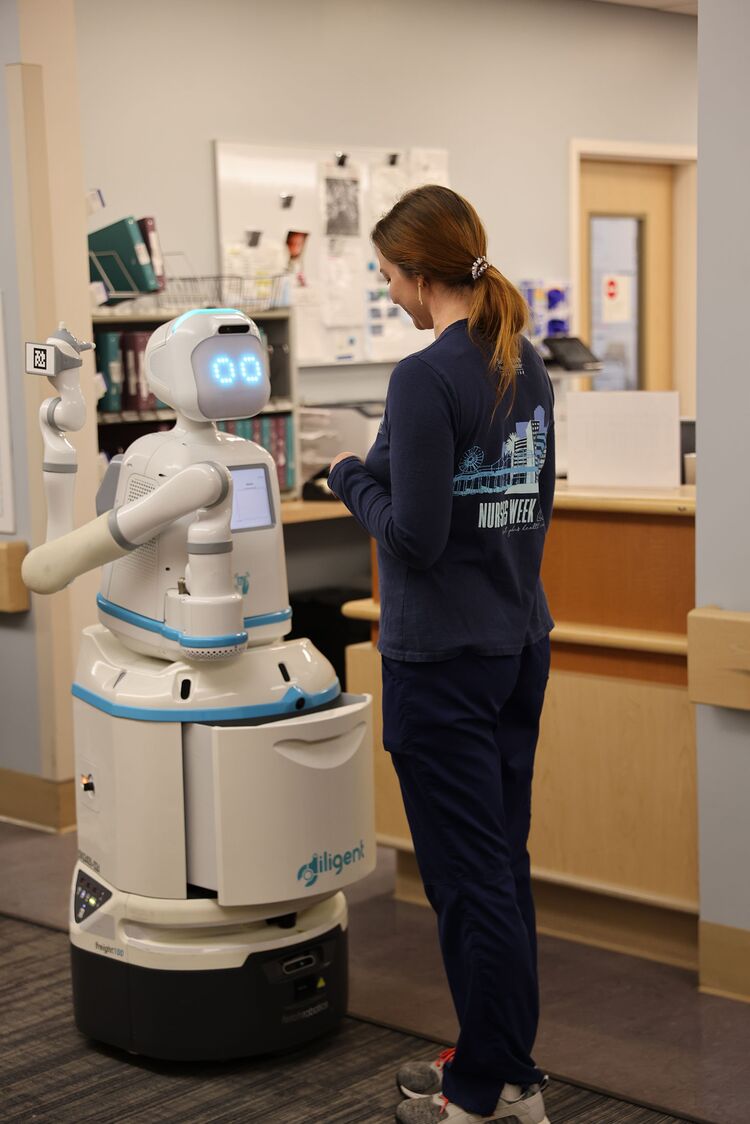
In certain circles, this is a sensitive topic. Roboticists have long focused on the “hand problem” — the challenge of fine motor control — but the industry has also been engaged in a long-running disagreement about what should happen below the waist. Robotics companies, as well as aspiring robotics companies such as Tesla Inc., have drawn billions of dollars in investment to build machines that walk like humans, arguing that doing so will make them uniquely useful not only in manufacturing and healthcare facilities but also in people’s living rooms and kitchens . But legs are tricky, and some people in the field say rolling robots are more practical and can begin doing work today that walking robots are still years away from accomplishing.
Andrea Thomaz, chief executive officer and co-founder of Diligent, says wheels are more reliable, noting that many hospitals and senior centers are already designed around wheelchair accessibility. “Wheels are safer,” she says. “If a robot is going down the hallway on wheels, it can stop without having to actively balance. And if there is a battery or power issue, a humanoid with legs could fall on somebody.”
The wheel-leg divide was on full display at CES in Las Vegas this January. Legged humanoids stood prominently across the annual tech conference show floor, attracting much of the attention and many of the headlines. But the robots that actually moved — at least reliably — were almost all on wheels.
Legged systems are far more complicated. They require additional motors, create more opportunities for mechanical failure and are often tethered during demonstrations. “Legs are a terrible idea,” says Bill Ray , a senior analyst at market-research firm Gartner Inc., arguing that they add significant engineering complexity, particularly around balance and ankle articulation. Legged robots also consume far more energy, because balancing requires constant adjustment.
Still, the bipeds offer advantages that wheeled systems struggle to match. Legs can make it easier to get up stairs. Moving one leg at a time, in theory, allows robots to recover more effectively if they begin to lose their balance. Another seeming advantage: Investors seem to like legs. 1X, the maker of Neo, a humanoid robot designed as a home assistant , has raised $123.5 million, while Agility Robotics Inc. has raised a total of $180 million across four funding rounds. Figure AI Inc., despite limited real-world deployment, has reached a valuation of $39 billion . By contrast, Diligent Robotics has raised about $50 million .
Ray attributes this disparity in part to the human tendency to anthropomorphize technology. When you as a human perceive something that looks human, he says, you attribute human values to it. “When you see a robot walking, your brain says, ‘Oh, it can climb, jump and run,’ even if it can’t do those things.”
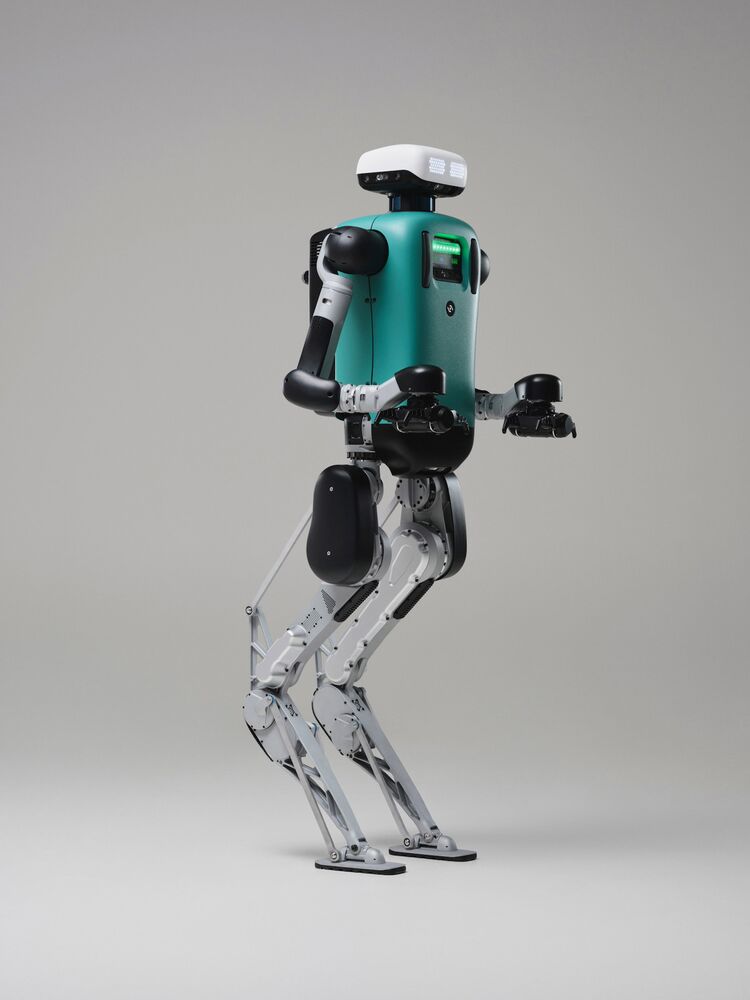
At Agility’s facility in Salem, Oregon, Digit — a 5-foot-9-inch robot with blinking LED eyes and ostrichlike legs — lifts 50-pound containers and places them onto a nearby conveyor belt. To reach lower shelves, it bends its legs at the knees and hips. Digit takes short, careful steps to enable consistent stability and predictability while still moving quickly enough to load and unload bins through the warehouse.
Digit is shaped less like a human than some rival products. Jonathan Hurst, Agility’s co-founder and chief robot officer, says he’s closely studied movement across a diverse range of animals — humans and birds, ghost crabs and horses — focusing less on anatomy or appearance than on the underlying physics of motion. “It’s made for work and provides actual value. It’s not a companion, so it doesn’t really matter what it looks like,” he says. “But it is human-centric because it needs to interact with us. Here we just need to move these boxes, and nothing else matters.”
Hurst argues that legs are critical to reliability in performing these tasks. “Would you rather be on your own two feet or on a Segway?” he asks. Human spaces, he adds, are easiest to navigate if you have two legs, a body and arms. “If you’re trying to design a robot on a path toward general-purpose utility, this is the best way.”
Bernt Børnich, the founder and CEO of 1X, says its investment in legs is beginning to pay off. “We used to have a humanoid on wheels,” he says of a previous industrial model, called Eve. But the company has improved the performance and energy efficiency of its legged systems so much that the most logical thing to do is focus on the platform with the biggest long-term potential. “There’s no reason not to have legs,” he says. “They’re generally just better for everything.”
The company plans to begin shipping its $20,000 Neo robots to homes later this year. The devices are designed to help with domestic tasks such as folding laundry while offering humanlike companionship. 1X expects to manufacture 100,000 robots annually by the end of 2027.
At its research and development lab in Glendale, California, Walt Disney Co. is developing both wheeled and legged machines for deployment at its theme parks. Based on familiar characters, the new Disney robots go beyond traditional animatronics with free-roaming characters including Star Wars BDX Droids, The Fantastic Four ’s H.E.R.B.I.E. and Olaf, the snowman from Frozen , navigating crowds in the parks and interacting one-on-one with guests in real time. “For us it always starts with the character and the story,” says Kyle Laughlin, senior vice president for technology and engineering of R&D at Walt Disney Imagineering , the cruise line and parks’ design unit. “We work in close partnership with the film, television and games teams who created these characters, and the movement system has to feel authentic to who that character is.”
Although Olaf was the one that went viral this year for a sudden malfunction , Laughlin says H.E.R.B.I.E. is among the company’s most technically challenging robots because it moves on a balancing ball and constantly performs calculations to stay upright. “We know guests may bump into them or pet them on our cruise ships,” he says as H.E.R.B.I.E. wheels across the R&D floor, not far from a BDX Droid making audible singing noises and dancing on its two small legs. “We’ve continued to work on making sure these are safe while also advancing the engineering.”
Practical considerations about specific applications drive the decisions at many companies weighing wheels versus legs, but Disney is after something different. “The goal is not to pick the ‘best’ technology,” Laughlin says. “It is to choose the form of movement that best preserves the character’s personality, emotion and believability when guests meet them in the real world.” If that’s where you’re headed, it turns out there’s more than one way to get there.