When Gustav Manning, the man once in charge of American soccer, proclaimed to the New York Times that he foresaw the sport becoming “the national pastime of the winter,” he couldn’t have known he was setting a trend. For a guy speaking in 1913, he sounded awfully modern. More than a century later, fans constantly hear that the world’s game is the sport of the American future.
Manning’s successors sold the dream with particular confidence starting in the mid-’70s, when Pelé touched down in New York from Brazil to join an experimental team called the Cosmos. That effort collapsed after a few years, but the underlying argument only gained steam. The most democratic of sports would soon bloom in the US as globalization, demographics and eventually media rights conspired. Expectations ballooned after the start of Major League Soccer and the US-hosted World Cup in 1994 . They exploded in 2023, when Lionel Messi, the sport’s best player, ditched his Paris superteam for a newish one in Miami .
For obsessives like me, it was easy to buy into the romantic promise: Men’s soccer would soon Americanize, or America would be soccerized. We could fill NFL stadiums when European teams visited, and it was getting easier to stream live matches from around the world. Soccer-centric shows like Ted Lasso and Welcome to Wrexham , even if drippingly earnest, were popular for a reason. I delighted in my Argentine family texting me about US games, and I even wrote about how Messi’s arrival could turn the domestic attention economy on its head.
The World Cup ’s return to North America in 2026 has opened my eyes.
The buildup to this tournament — an international bonanza already struggling with exorbitant ticket prices and anemic interest in the home team — laid bare a few truths. Soccer is already a serious phenomenon in the US. One 2024 study pegged it as Americans’ third-favorite sport. It’s an undeniable economic power, and it will keep growing. But American society just doesn’t work as it does in South America or Europe, where the sport is a singular cultural hegemon. It takes decades of incremental growth to make the kind of shift that keeps being predicted. It doesn’t help that no one has ever agreed on exactly how we’re supposed to identify success.
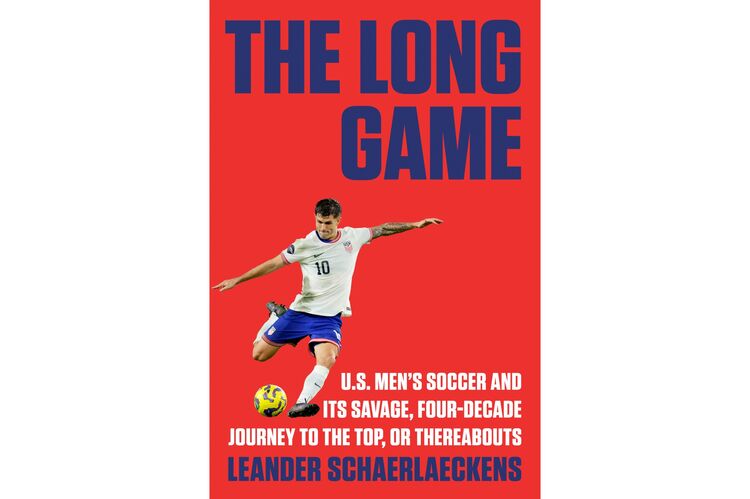
The subtitle of Leander Schaerlaeckens’ meticulous new book, The Long Game (Viking, May 12), is US Men’s Soccer and Its Savage, Four-Decade Journey to the Top, or Thereabouts . Schaerlaeckens argues that the national team’s current competence is miraculous given its history, but the “thereabouts” is apt. He reconstructs the arc of American performance on the international stage, including the all-time World Cup high of a 1-0 win over England in 1950. But the book’s heart lies with the subsequent drudgery: the comical disorganization (like when the squad went a few years in the early 1980s barely playing any games at all), financial disarray and embarrassing experiments.
Although Schaerlaeckens describes a clear improvement since then, the story is not about planned success so much as fits and starts. Those include: the 1994 World Cup that was greeted at first with national ambivalence, then huge attendance; a 2000s program to house the country’s top teenage prospects in dorms in Florida; the desolation of missing out on the 2018 World Cup; and the methodical campaign to claw back to relevance. Schaerlaeckens himself seems to have little patience for the question that has bedeviled American soccer since Manning’s prophecy 113 years ago, but the book is bursting with characters offering theories about when, exactly, soccer will arrive. ·
Read More: This Isn’t the Soccer America Imagined
It’s left to the reader to consider what “arrival” would mean in practice (and what about American culture makes us think it’s inevitable or even necessary). Mainstream commentary has a maddening tendency to float toward hypotheticals about the country’s best athletes — what if LeBron James played goalie?! — rather than remembering the shockingly recent fallow years. Schaerlaeckens recalls that the national team’s preparation for the 1990 World Cup in Italy was partially funded by a loan the federation president took out on his construction company.
One plausible gauge of American soccer’s success is its exports. When the team lined up against Portugal this March, nine of its 11 starters played club soccer in Europe, some for genuinely elite teams. And seven of the 15 biggest revenue-generating clubs in the world are owned by American billionaires or private equity firms. That includes half of the semifinalists in this year’s Champions League in Europe, including Stan Kroenke’s Arsenal FC and Apollo’s Atlético Madrid.
Yet exports tell only part of the story, as anyone who’s seen oceans of pink Inter Miami CF jerseys can attest. In The Messi Effect: How the Global Legend Changed the Future of American Soccer (St. Martin’s, June 2), the Athletic writer Paul Tenorio is quick to defend American soccer culture. Even before Messi arrived, he points out, millions of Americans were obsessed with the English and Mexican leagues. MLS teams, he writes, “retained more of a cult feel: passionate followers, but little mainstream resonance.” Messi’s arrival transformed the American landscape: Stadiums sold out, and both the league and Inter Miami benefited from huge retail and sponsorship boosts.
If soccer is still not the dominant domestic force some predicted, Tenorio sees a culprit in an MLS power structure too timid to turn a moment into something more durable and culturally significant. He’s covered MLS since 2007 — the year David Beckham arrived in Los Angeles and kick-started the league’s bid for global attention — and in beat reporter style he is granular in his indictment. Owners simply moved too slowly to change the league’s roster, salary and scheduling rules over the last two years. As a result, they failed to capture as much lasting attention as they could have by improving the product before the World Cup.
Tenorio’s well-reported account is dotted with re-creations of private meetings about matters like Messi’s contract and MLS’s finances. He paints the Miami owners as visionaries and more risk-averse team owners as bafflingly conservative, even if in some cases their caution is for obvious reasons — they remember the league’s near-bankruptcy in 2000.
One of Tenorio’s most telling revelations is that the league likely knows all this. When Messi arrived, MLS commissioned a study of his appeal. It found that his fans didn’t stick with his last two teams, in Barcelona and Paris, when he left: They followed him. So MLS has a finite window to capitalize on Messi before he retires in the next few years and to figure out how to make his surge in attention last. MLS and Apple TV recently rejiggered the terms of their broadcast deal amid skepticism that viewership was still growing much after a leap forward in 2023. My Argentine relatives no longer watch all of Messi’s games, but not for lack of interest. Boca Juniors matches are still appointment viewing for them; Inter Miami’s can be consumed in Instagram clips just fine.
The task of earning respect for American soccer has not only been on the players’, coaches’ or administrators’ shoulders. It’s the fans’ burden too. I couldn’t help but recall the baffled look I used to get from relatives in Italy — as fanatic as their South American counterparts — when I brought up any of this tortured thinking about the state of the sport in the first place. From the outside, the psychodrama looks self-inflicted. American culture may never revolve around soccer, and the national team would be thrilled with a quarterfinal appearance this summer. We’ll still watch in historic numbers, take it far too seriously, mostly move on and have this conversation again in four years. It’s the American way.