
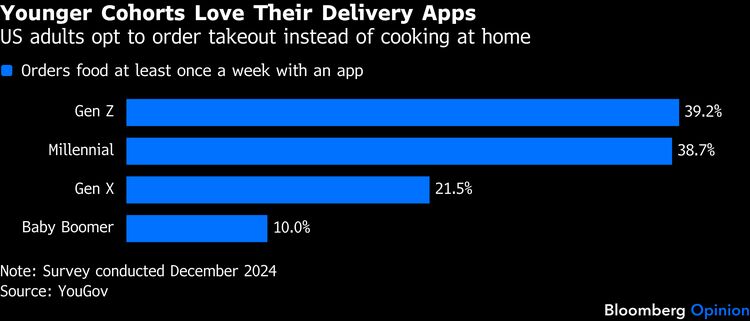
Gen Z, already accused of being an entitled, antisocial bunch of phone-addled snowflakes, can now add a new item to their collective bill of indictment. Critics are now admonishing the cohort — a generation facing significant affordability challenges — for eating out and using food delivery apps rather than making meals at home.
Could it be laziness? Sure. Many of us have opted to buy food because it was the easiest solution after a long day. But it’s worth asking whether something else is at work here — specifically, a lack of training. For the past 20 years, home economics courses have largely disappeared from the secondary school curriculum. No wonder Gen Z lacks confidence in the kitchen .
How that happened is a little-understood story. While it’s easy to imagine that the subject disappeared because it was too old-fashioned, if not downright retrograde, the reality is otherwise.
Though the field of home economics can trace its origins to before the Civil War, the idea that there could be a “science” of household management didn’t really take off until the end of the 19th century, when a growing number of female reformers began pushing the idea.
Their leader was Ellen Swallow Richards, a trailblazer who became the first woman to graduate from MIT , earning both undergraduate and graduate degrees in chemistry. She was, by her own estimation, someone who “put faith in science as a cure-all,” and sought to put the business of running all aspects of a household on a rational basis.
In 1899, she orchestrated the first of many conferences at Lake Placid, New York, to popularize the idea. These formative conferences defined home economics broadly, encompassing a wide range of subjects: cooking, cleaning, childrearing and sewing, yes, but also more modern preoccupations like nutrition and sanitation.
That such subjects needed to be taught, rather than simply learned from one’s parents on the family farm, reflected growing concern that society had reached a crisis point due to unchecked urbanization, industrialization and immigration. As Richards declared in 1908, home economics was “nothing less than an effort to save our social fabric from what seems inevitable disintegration.”
Ten years later, Congress passed the Smith-Hughes Act , which dramatically expanded federal funding for vocational education, paying the salaries of teachers who would handle shop classes and home economics.
Federal support revolutionized the field of home economics, making it a standard offering in public schools. One writer in the Journal of Home Economics predicted : “Each generation of graduates from the eighth grade and high school courses in economics should increase the number of homes in which babies and children will have better chances for survival and health.”
This critical impetus coincided with a significant expansion of the secondary-school educational system for both boys and girls. Between 1900 and 1950, the percentage of adolescents aged 14-17 years old enrolled in high school exploded from approximately 10% to 76% . It was during these crucial years that home economics went from a social movement to a standard subject.
Girls initially made up the vast majority of students , reflecting traditional gender roles. But this should not blind us to the fact that home economics was a field where women could pursue a career — becoming researchers, teachers, and professors, with most land-grant universities featuring degree programs in the subject.
Thanks to both federal support and a growing number of college-educated women able and willing to teach the subject, home economics became a standard rite of adolescence.
Who, then, killed home economics? One school of thought lays the blame on the feminists who came of age in the 1960s, who rebelled against the narrow, stereotypical gender roles associated with the field.
Still, home economics continued to attract students in the 1980s and beyond, including a growing number of boys. I should know because I was one of them, taking a class that was about evenly divided between the genders.
But during that time, a radical transformation of secondary school education was beginning. Confronted with the rise of Japan and the seeming inability of the US educational system to compete, the Reagan administration commissioned a report to diagnose the problem and offer solutions.
It was published in 1983 under an ominous title: A Nation at Risk. The report offered a dismissive view of vocational education generally, and home economics in particular. “In many schools,” it noted , “the time spent learning how to cook and drive counts as much toward a high school diploma as the time spent studying mathematics, English, chemistry, U.S. history, or biology.”
A Nation at Risk argued for an unrelenting focus on the core academic subjects needed to succeed in college, relegating practical education to an afterthought.
Still, as late as 2002, the number of students studying home economics in high school had not yet collapsed. That same year, though, marked the passage of the No Child Left Behind Act. This legislation, heavily influenced by A Nation at Risk , imposed a testing regime that tied funding to results. Schools now had every incentive to abandon electives that didn’t lead to higher test scores.
Thanks to these and other “reforms,” we now live in a world where high school students take demanding college-level courses in calculus and chemistry, but have no idea how to make an omelet, change the oil in a car, or sew a button.
Reviving home economics won’t fix these problems. A renewed focus on practical skills, though, can help the next generation navigate the practical challenges of adulthood — and, perhaps, lessen their reliance on their go-to food delivery app.
More from Bloomberg Opinion:
- Is Your Favorite Restaurant a Singular or a Plural Place?: Howard Chua-Eoan
- Kraft Mac & Cheese Doesn’t Need to Feed Our Protein Obsession : Stephen Mihm
- It’s Not Just David Chang. Celebrity Chefs Are Sellouts: Raj Tawney
Want more from Bloomberg Opinion? OPIN <GO> . Or subscribe to our daily newsletter .