By Gearoid Reidy | Updated on Jun 12, 2026 at 11:30 AM
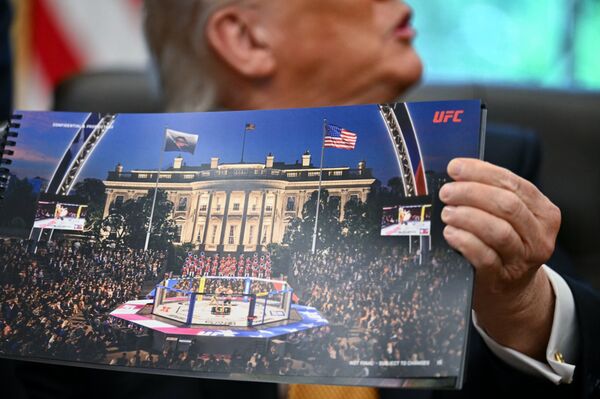
Strange things frequently happen in the sport of mixed martial arts. But when the Ultimate Fighting Championship’s cage door closes this weekend, it will be stranger than most.
The UFC Freedom 250 event , taking place on the South Lawn of the White House, ostensibly marks the anniversary of the signing of the Declaration of Independence. But falling on President Donald Trump’s 80th birthday, it’s bound to be a spectacle equal parts partisan and cringe. Trump, a longtime fight fan, has attended several UFC broadcasts. They turn into fawning celebrations carrying recruitment ads for Immigration and Customs Enforcement , with commentators and fighters seeking to curry his favor. This weekend’s card, arranged at the president’s suggestion, will take that to another level; UFC Chief Executive Officer Dana White, an ally of Trump, will be pulling out all the stops.
Some critics expect it to be “a night of authoritarian theatre” with “ shades of fascist Italy” in its focus on masculinity and spectacle. Others have said it’s reminiscent of “fights for the slave masters.”
As a mixed martial arts fan, I’ll be watching nonetheless. If this is your first taste of the UFC, I implore you not to judge it by what happens Sunday evening — and look beyond the MAGA branding to the substance of what is one of the finest competitions in the world.
Looking past what is expected to be a flag-waving, chest-thumping, openly partisan rally won’t be easy, though. “It’s going to feel like this is a broadcast not only from the White House, but almost by the White House,” says Ben Fowlkes, a longtime MMA journalist who covers the sport for Uncrowned and likens the upcoming show to “state TV.” Those not used to seeing how the UFC treats Trump are “not prepared for how weird this is going to be,” he told me.
And for those who agree with the late senator John McCain’s dismissal of MMA as “human cockfighting,” all the violence, brutality and machismo they dislike will be on display. As it gained popularity, the UFC has come under attack for its supposed association with “toxic masculinity” and the manosphere. It’s an association reinforced, critics argue, by the prominence of the organization’s longtime commentator, Joe Rogan. The author Frederick Joseph recently lamented young men’s embrace of MMA, calling their role models “not only divisive and toxic but insidious and heinous, disgusting.” The White House card will do little to dispel those views, and risks indelibly linking the brand to an unpopular president, who is already threatening to turn the arena specially constructed for the event into a permanent fixture.
It might be tacky. But to dismiss MMA because of its political branding is little more than cultural snobbery, like judging soccer by the worst excesses of FIFA.
MMA is doubtless brutal, but it’s anything but crude. Although it started as a cage-fighting freakshow, testing how styles actually fared when kung-fu fighters faced, say, sumo wrestlers, it has evolved into its own form of combat, more than the sum of its parts and still evolving.
The contest is disciplined, technical and cosmopolitan. Fighters blend the best of the world’s styles: Brazilian jiu-jitsu, Thai striking, Dagestani grappling and American collegiate wrestling. Almost every current UFC champion, male and female, hails from a different background; Ilia Topuria, who will headline the White House card against American Justin Gaethje, is just one example. Topuria comes from a family of Georgian refugees who fled conflict before settling in Spain.
I started watching more than a decade ago, when a friend said I had to catch this cocky Irishman who was fighting for a belt. That turned out to be Conor McGregor, who would become the promotion’s biggest-ever star before becoming his own worst enemy. Before the main event, I watched American Robbie Lawler face Canadian Rory MacDonald, a viscerally violent affair that went back and forth before MacDonald, his nose shattered and his face a red mask of blood, seemed to mentally break, unable to endure further pain. The victorious Lawler gave his post-fight interview with his lip split open almost to his nose. It was unlike anything I had seen before; many consider it to be the greatest fight in the promotion’s history.
If you’re squeamish about pugilism, I realize this is unlikely to convince you. But this is what makes it compelling: not the bravado, but the sight of athletes confronting not their opponents but themselves , delving into the depths of their own will to win. Once the cage door closes, boasting won’t get you very far. “It’s sports without the metaphor,” says Fowlkes. “The truth is going to find you in there in the cage.”
Few sports require athletes to put their bodies on the line so literally. You can’t have an off night. Cub Swanson, a veteran fighter of 22 years with the tattoos and scars to prove it, summed it up during an emotional retirement speech this year. “I’m terrified every time I come out here,” he said. “I just try to be brave and focus.”
White spent decades transforming the UFC from a carnival outlawed in multiple states to a mainstream sport. Trump helped, offering his casino as a venue when others refused. And it has paid off handsomely, capped with last year’s $7.7 billion deal to stream UFC on Paramount+. (That the deal was agreed shortly after Paramount secured FCC approval for its merger with Skydance has raised eyebrows.)
The question for White, and his bosses at TKO Group Holdings Inc., is whether this celebration goes too far in returning the favor and risks tarnishing that legitimacy. Like Trump, who styles himself as an outsider despite occupying the highest office in the land, there is hypocrisy in how the UFC still claims to be part of the counterculture while holding an event literally on the South Lawn.
The pageantry might be insufferable. But the saving grace is that once the door closes, the cage belongs only to the fighters.
More From Bloomberg Opinion:
Want more Bloomberg Opinion? OPIN <GO>. Or subscribe to our daily newsletter .