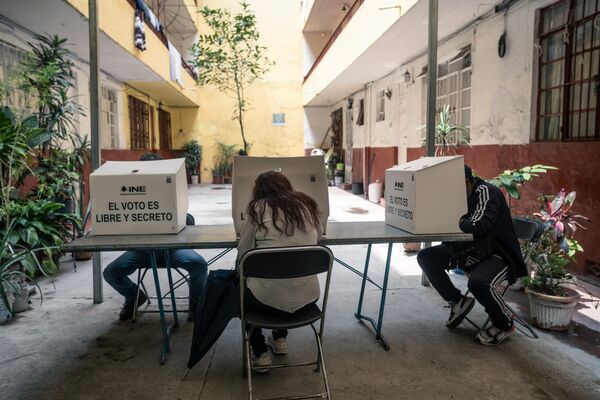
Lawmakers in Mexico have approved a constitutional change backed by President Claudia Sheinbaum’s ruling Morena party that would allow election results to be voided if the government believes that foreign influence on the vote affected the outcome.
While supporters say the amendment will protect the country from election interference, critics contend the new law will become a tool for the ruling party to subvert democratic norms and cling to power.
The adoption of the amendment could bolster Morena’s drive to dominate electoral politics in Mexico. It follows the passage in 2024 of another constitutional amendment requiring that all judges in the country — including those on the Supreme Court — be elected by popular vote. The move led to a majority of judges aligned with the ruling party occupying key positions in the judiciary.
What does the new law say?
A majority of Mexico’s state legislatures ratified a constitutional amendment that allows for the annulment of future elections in the case of “acts of foreign intervention or interference” that affect results. The amendment, which Sheinbaum signed on June 2, was previously passed by both houses of Congress.
Supporters of the amendment say it will protect the integrity of elections from foreign interference, as evidenced by “recent experiences in the Latin American region,” an apparent reference to efforts by the US government to influence elections in the region.
The new law will give judicial authorities the ability to void the results of an election “when it is objectively and substantively established that foreign interference has occurred,” the text states.
How would the law work?
Congress has yet to debate secondary legislation that is expected to clarify how the law will be implemented. However, the proposal states that any election may be annulled if it is proven that foreign intervention or interference affected the results.
According to the amendment, “foreign interference” refers to the intervention of foreign governments, international organizations or foreign private entities.
Foreign intervention could take the forms of financial support to candidates, cyberattacks, disinformation campaigns and diplomatic or media pressure. Intervention in Mexico’s territory by land, water or air with the intent to affect “the constitutional order” also qualifies as interference, according to the law.
In Mexico, elections already could be voided, but for only three reasons: excessive campaign spending, the purchase of news coverage or the use of funds from illicit sources. In practice, the law has been used rarely, and only at the state level.
Under the constitutional change, any candidate who has benefited from foreign interference in the vote won’t be able to participate in future elections.
Who can complain of foreign interference?
Anyone who believes they have evidence that there was foreign intervention in the election can submit a complaint to one of the authorities charged with supervising elections. Those entities — the National Electoral Institute, the Electoral Tribunal of the Federal Judiciary and local electoral bodies — have the ability to declare voting results invalid. The National Electoral Institute is the body responsible for organizing elections; it counts, verifies and announces the results.
Local electoral bodies perform the same functions, but at the state or municipal level. Their decisions are overseen by the National Electoral Institute. The electoral tribunal reviews legal disputes that arise following the publication of election results nationwide.
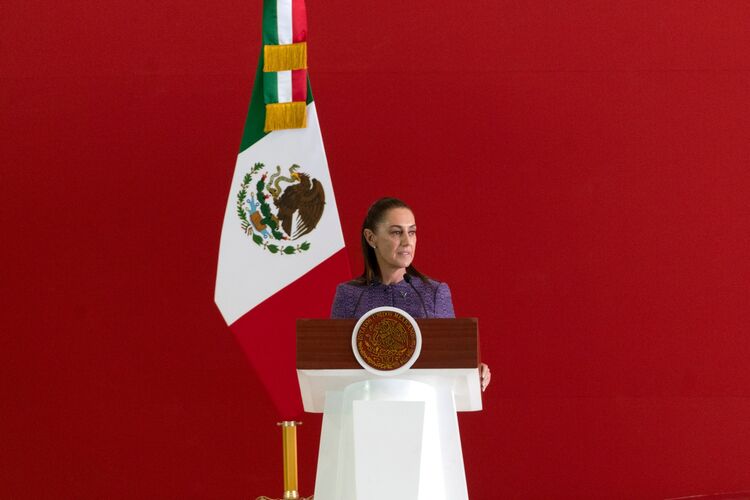
To what extent is the law aimed at the administration of US President Donald Trump?
The reform doesn’t directly mention the US or President Trump; it merely states that “Mexican democracy faces external threats that seek to subvert the will of the people through the interference of foreign governments, organizations, or agents.”
But the 2025 presidential election in Honduras was a possible catalyst. Trump endorsed conservative candidate Nasry Asfura just days ahead of a runoff vote. The US president publicly warned of negative consequences for the Central American nation if Asfura lost. While Asfura narrowly won , the eleventh-hour endorsement prompted accusations that the US had meddled in the vote.
Trump’s recent endorsement of Colombia’s right-wing presidential candidate Abelardo de la Espriella ahead of the runoff election also appears to have encouraged the adoption of the new law.
And Mexico itself has come under intense pressure from the Trump administration to combat drug trafficking. The US has indicted Rubén Rocha Moya, governor of Mexico’s Sinaloa state and Morena member, along with several Sinoloa officials for allegedly allowing drug cartels to operate. Further indictments against other governors might follow, which could affect the 2027 midterms elections in Sinaloa and other states.
What are the criticisms of the law?
The main criticism made by the opposition and election experts is that it is left to the National Electoral Institute and the judges of the electoral tribunal to define what constitutes foreign interference. That opens the door to the annulment of elections on grounds that are too broad, opponents say. Most of the members of the electoral institute were nominated by the ruling party, leading to speculation that they could face intense political pressure.
Alfredo Figueroa, former member of the National Electoral Institute, said the law was sufficiently vague that it could be harnessed by any party in power to overturn an unwanted election result.
The only purpose of the law, Figueroa said, is “to create a mechanism that allows those in power to stay in power.”