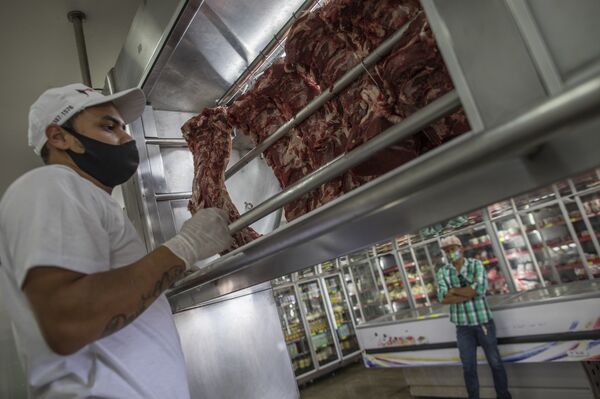
Soaring prices for the world’s largest beef producer, Brazil, mean households will be buying less red meat when they gather to watch Brazil’s first game of the FIFA World Cup this Saturday.
César Visini loaded up on chicken and sausages to throw on the grill at a family party this weekend.
“It’s more economical,” said the 29-year-old teacher, who lives in the beach town of Praia Grande. He’s irked that butcher shops have lowered the quality of their offerings to get around the high costs of premium cuts. “Sometimes the price stays the same, but the quality goes down. This has been happening a lot.”
Grilling and cheering for the national team is a time-honored tradition, but near-record high beef prices and a household debt crisis threaten to dampen appetites as the Latin American country gears up for weeks of football-watching and churrasco, or barbecue. At this year’s tournament, Brazilians will be serving up chicken and pork sausages more frequently than beef, according to forecasts from Worldpanel by Numerator .
Brazil’s falling meat consumption adds to the challenges for the Lula administration ahead of national elections in October. For a country that is among the top three globally for its per capita beef consumption, cutting back is just another sign of economic stress and threatens to upset the reelection hopes of President Luiz Inácio Lula da Silva, who previously ran on a platform of more barbecue and beer .
Tight global supplies and strong demand overseas are pushing Brazil’s exports to a record high and reducing local availability. It’s an added pressure on already cash-strapped low-income Brazilians who are finding it hard to keep up with the high costs of food and elevated debt.
Already Brazilians spent less of their overall budget on protein in the first three months of the year; a decline in the volume of beef purchases was responsible for most of the drop, according to Daniela Jakobovski, a Worldpanel account manager.
In the country’s most populous city, Sao Paulo, the price of Brazil’s favorite grilling meat, a top sirloin cut known as picanha, climbed to over 90 reais ($17.75) per kilogram in March, according to the Institute of Agricultural Economics, a public research organization. That’s up from 81 reais last year.
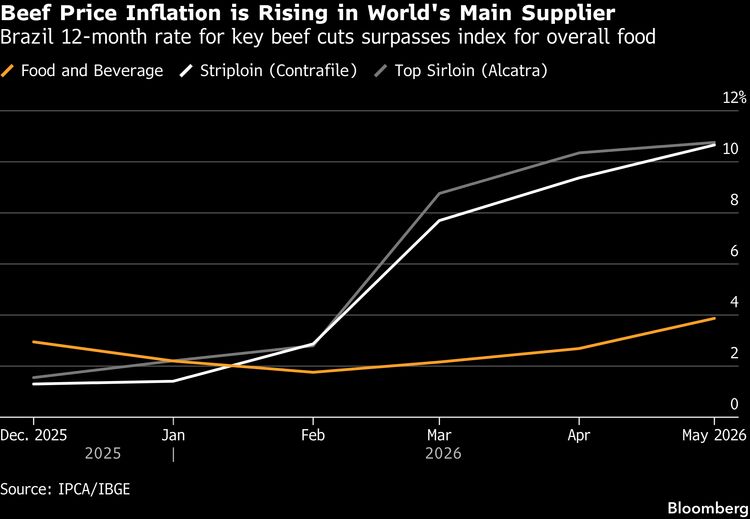
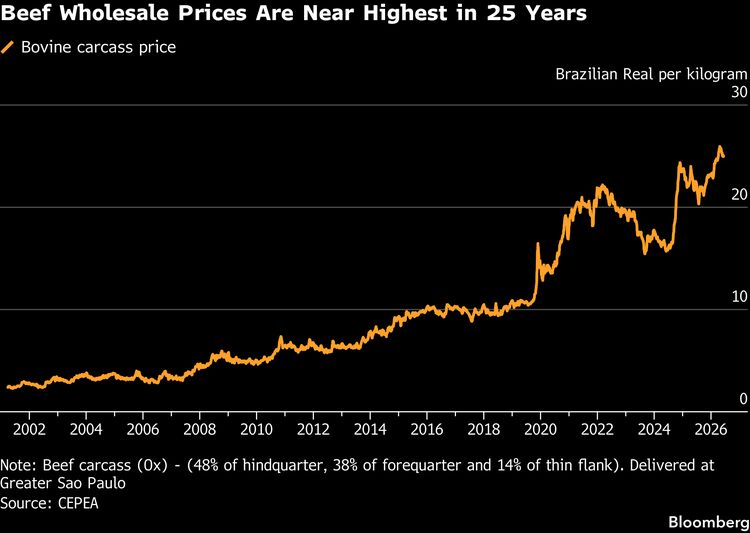
Inflation has driven up prices on some premium beef cuts by as much as 11% over the past 12 months, according to May data from the national statistics agency, IBGE. Wholesale prices for cow meat recently hit the highest on record in data going back more than 20 years from CEPEA, the University of Sao Paulo’s agricultural research center.
“People like myself who used to eat beef two or three times a week are now limiting it to once a week,” said Thiago Durões, a 37-year-old salesman who lives in Brasília. “We’re trading down to cheaper cuts and, in many cases, replacing beef with chicken, pork or whichever protein offers the best value.”
Rising beef costs are just one of many worries in Brazil, where a record 82% of families have outstanding debts, according to retail and services confederation CNC. Easing Brazilians’ debt load has become a key campaign issue for Lula, who recently released a new household debt renegotiation program in a bid to boost his popularity.
Read More: Lula Unveils Debt Relief Program Ahead of Elections
The industry has even started to blame online gambling, with beef exporters group Abiec and retailers association Abaas recently asking for government measures that would limit spending on betting platforms.
Still, Brazilians have withstood tougher times. In 2022, when Argentina won the last World Cup, food prices skyrocketed after Russia’s invasion of Ukraine drove up global commodity costs. Meatpacking companies remain upbeat on the prospect for higher sales during the tournament, with television ads featuring not only the traditional and expensive beef cuts but cheaper alternatives like hamburgers, chicken nuggets and hot dogs.
“We believe in a democratic portfolio, with both sophisticated and accessible protein offerings,” said Luiz Franco, a marketing director at meatpacker MBRF Global Foods SA, one of the sponsors of the Brazilian national football team.
But even cheaper meats face challenges given Brazil’s price-sensitive consumers. The Iran war has driven up supplier costs on everything from plastic packaging to road freight, and price hikes haven’t been able to keep pace and fully offset those costs, according to Ricardo Santin, the president of industry group ABPA.
Read the Explainer: How Iran War Is Shaking Up Food Supply Chains
The ongoing conflict in the Middle East has emerged as a new inflation risk for Brazilian policymakers. Higher oil prices are raising concerns about fertilizer costs, a critical input for Brazil’s farm sector, threatening to lift production expenses across the agricultural supply chain.
“The shock in international oil prices, in addition to affecting fuel prices, has put pressure on industrial inputs and transportation costs, with possible repercussions for items in the food chain,” Brazil’s Finance Ministry wrote in a May bulletin. “This scenario is consistent with a more prolonged and persistent inflation trajectory throughout 2026.”
Read More: Brazil Central Bank Director Sounds Alarm on Inflation Outlook
At Olinda Bar e Restaurante in the Asa Sul district of Brazil’s capital, carne de sol, a regional beef dish, has long been a favorite. But a price shock is driving more patrons these days to ordering the Caesar salad.
“Beef has become much more expensive, and that has inevitably pushed up menu prices,” said Jaqueline Rodrigues, the restaurant’s manager. “More people are opting for cheaper proteins, and some are skipping meat entirely.”