By Miles Surrey | Updated on Jun 13, 2026 at 01:00 PM
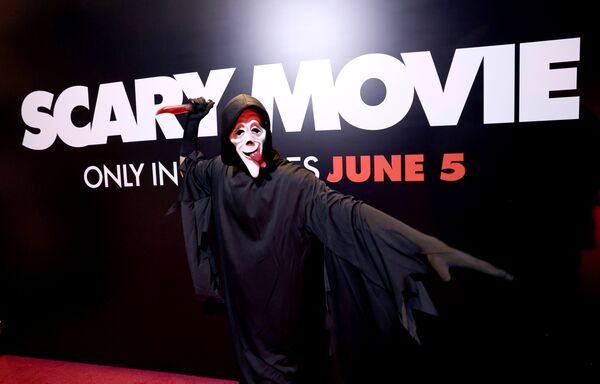
When Scream 7 arrived in theaters in February, the Ghostface turning heads wasn’t from the horror hit itself but from Scary Movie . The trailer for the long-running parody series’ sixth installment played before opening-weekend screenings of Scream 7 . After an enthusiastic fan response, star, co-writer and producer Marlon Wayans announced that the film’s release would be moved up one week to June 5.
The bet paid off. Scary Movie earned $55 million domestically over that weekend, making it the highest-grossing debut in the franchise’s history. Along with last year’s reboot of The Naked Gun , a Spaceballs sequel arriving in 2027, and rumors of a fourth Austin Powers movie finally coming to fruition, the film’s success is the latest sign of Hollywood’s spoof comedy renaissance. And its revival signals that theatrical comedies aren’t dead — they just needed the right subgenre to lead the way back.
While spoof comedies have been a cinematic fixture dating back to the silent film era , their heyday came in the ’80s with a trio of films: Spaceballs , Airplane! and The Naked Gun: From the Files of Police Squad! . The latter two hailed from David Zucker, Jim Abrahams and Jerry Zucker, who set the standard for the rapid-fire joke density, sight gags and pop-culture fluency that have come to define the subgenre.
The Wayans brothers updated the formula for a new generation with 2000’s Scary Movie , a send-up of ’90s slasher films like Scream and I Know What You Did Last Summer . When the first Scary Movie ended up grossing $278 million worldwide — more money than the films it was parodying — it launched sequels of its own. At that point, it seemed like the spoof comedy was a reliable commercial vehicle for studios: cheap to produce, easy to market, and a hit with audiences.
But as Hollywood flooded theaters with them, the films began to deliver diminishing returns. In particular, the parodies from Scary Movie co-writers Jason Friedberg and Aaron Seltzer that were released between 2006 and 2008 — Epic Movie , Date Movie , Meet the Spartans and Disaster Movie — earned abysmal reviews and stalled out at the box office. “Friedberg and Seltzer have worn out their welcome,” David Zucker said in a 2009 interview with The Guardian . “They don’t spoof scenes from other movies so much as repeat them.”
At the same time, the culture itself was evolving. The rise of streaming services created a fragmented entertainment landscape, and outside of superhero franchises and Game of Thrones , the monoculture that helped sustain spoof comedies was eroding. This shift also had an effect on studio comedies more broadly, as stars like Adam Sandler and Kevin Hart signed deals with Netflix to release projects on the platform, while recent comedies from Will Ferrell and Melissa McCarthy were streaming originals.
Over time, audiences became conditioned to treat comedies as something to watch at home, rather than make a trip to the theater for. Add to that studios viewing the genre as carrying the kind of economic risk that IP blockbusters are less susceptible to — especially when the humor doesn’t always translate internationally — and it was a perfect storm. Comedies largely disappeared from theaters, even as they remained popular on streaming platforms.
“The idea of comedy in the marketplace has been working in television and in streaming in a big way,” Erica Huggins, president of Seth MacFarlane’s Fuzzy Door Productions, said in a 2025 interview with the Los Angeles Times . “The more we change people’s habits to appreciate and get excited about wanting to go and see it in the theater, it’s going to catch on.”
A spoof comedy revival may be exactly what forces that change. These differ from most studio comedies in one crucial aspect: They rely on audiences having a common set of cultural reference points. That quality benefits from the communal nature of moviegoing — audiences get the jokes because everyone is in on them.
To that end, while Hollywood has struggled to produce these shared experiences outside of superhero blockbusters in recent years, horror is one of the few genres that consistently cuts through the noise. The sixth Scary Movie pulls from a number of recent films — including the Scream reboots, Get Out , Sinners , The Substance , and Weapons — that became box office successes in their own right. The Naked Gun reboot achieved a similar effect, capitalizing on Liam Neeson’s late-career streak of rugged revenge thrillers to deliver a playful skewering of action-movie tropes.
In that respect, spoof comedies are a useful barometer for whether Hollywood has enough cultural touchstones worth lampooning in the first place. Between the new Naked Gun , Scary Movie , and a Spaceballs sequel that has decades of Star Wars films to parody, there’s no shortage of material to mine.
Streaming services still pose a threat to theatrical comedies, but if movie parodies continue to thrive at the box office, studios might just get the last laugh.
More From Bloomberg Opinion:
Want more Bloomberg Opinion? OPIN <GO>. Or subscribe to our daily newsletter .