By Brian Lowry | Updated on Aug 15, 2026 at 01:00 PM
Green Lantern might not mean much to the uninitiated, except perhaps as the cinematic speed bump that nearly derailed Deadpool star Ryan Reynolds’ superhero career. Yet the DC Comics character ranks among the most significant in comic-book history, paving the way for superheroes to tackle real-world issues that resonate well beyond the printed page.
Those origins provide the underpinnings of the new HBO series Lanterns, which premieres on Sunday. It arrives at a pivotal moment for superheroes on screens, large and small. After a period in which the entertainment industry understandably fretted about “superhero fatigue” as projects foundered, it’s timely to remember that human-centered storytelling — dealing with material that dares to be about something — has always been a vital element of the genre. As evidence, look no further than the pangs of loneliness and personal sacrifice at the core of Spider-Man: Brand New Day .
The welcome seeds of that logic, however, were planted in the Green Lantern comics more than 50 years ago and clearly inform Lanterns . Viewers will see a show that seeks to breathe life into a hero with strange powers. Courtesy of an intergalactic police force, he has a ring that allows him to create anything his mind can conjure. But he lacks the profile of DC’s better-known triumvirate of Superman, Batman, and Wonder Woman.
While those signature titles have undergone overhauls through the years, their cinematic rise owes a great deal to a broader transformation in which creators treated comic books seriously as an art form, not just a diversion for children. Marvel in the 1960s and DC in the ‘70s unlocked their creative potential by doing so — in a way that would eventually yield commercial dividends — and few titles shone brighter in that regard than Green Lantern .
In 1970, DC was fumbling to save a character experiencing sluggish sales. While Marvel indulged in issues of social relevance in the 1960s, introducing characters like Black Panther and exploring bigotry in the thinly veiled allegory of the mutant X-Men, DC lagged behind, seemingly still rooted in the campy “Bam! Pow! Oof!” Batman TV series that starred Adam West.
With little to lose, DC handed the reins on Green Lantern to a pair of rising stars, writer Dennis “Denny” O’Neil and artist Neal Adams , who would go on to become comic-book legends. Their collaboration yielded a memorable 13-issue run, beginning with No. 76, which paired the hero with Green Arrow. The stories exposed Green Lantern to an America he had overlooked during his space-faring adventures, riven by racial injustice, drug abuse, environmental damage and corporate greed.
Those comics cast the square-jawed hero, a.k.a. Hal Jordan, as benignly oblivious to earthbound problems as he dealt with galactic threats, while the anti-establishment Green Arrow served as an ill-tempered guide prying open his eyes. They also introduced a new Green Lantern in John Stewart, one of DC’s first Black heroes, who went on to supplant the elder version in spinoffs like the animated Justice League .
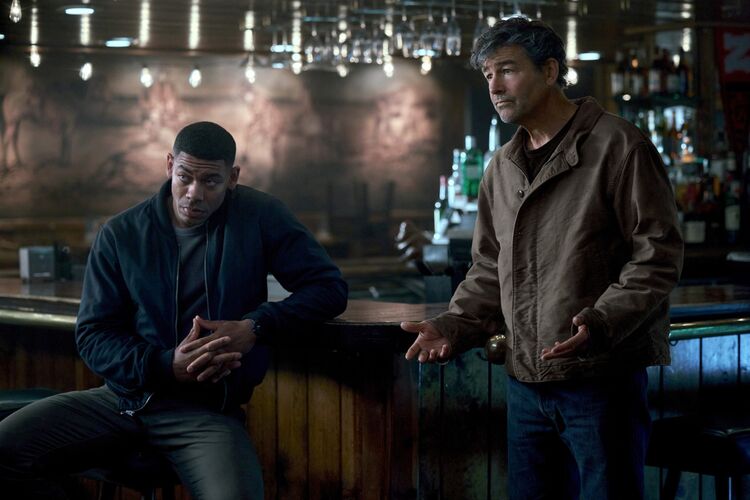
The new series doesn’t directly adapt those stories, but it does feel imbued with their spirit. The plot pairs an aging Hal Jordan (Kyle Chandler) with trainee John Stewart (Aaron Pierre), as the two investigate a murder in a rural Nebraska town that might have vast, interstellar implications. The series format allows that narrative to unfold more slowly than a movie would, blending a murder mystery and mismatched buddy-cop vibes with the grittiness of Jordan’s jaded, seen-it-all hero.
Notably, the show’s creative team includes Lost co-creator Damon Lindelof, who infused a 2019 HBO adaptation of the adult-oriented graphic novel Watchmen with prescient imagery of masked police marauding through American cities.
O’Neil and Adams died, respectively, in 2020 and 2022, at the ages of 81 and 80. As a team, they put their stamp on numerous characters, including a defining, darker shift in Batman that lingers to this day.
Yet as is so often true, that success didn’t come soon enough to “save” Green Lantern , despite a wave of media attention that greeted their efforts. Then again, even during the Vietnam era, the comics might have been a bit ahead of their time, especially for DC readers accustomed to more fanciful storytelling.
Those landmark issues nevertheless inspired and influenced a generation of comic-book creators, who yearned to tell tales with similar impact, ushering in a period of more ambitious storytelling. Innovations rippled through not just that medium but its breakthroughs in movies and television, which arguably began with Batman in 1989 and peaked (commercially, anyway) with Marvel’s string of hits during the 2010s.
Although the ‘70s Green Lantern-Green Arrow team-up was relatively brief, Adams, an enormously colorful figure, reveled in what his work on Green Lantern represented and the eventual comic-book renaissance. He told Vulture in a 2018 article titled “The Moment Superhero Comics Got Woke” — which credited those comics with having “altered the course of the superhero genre” — that Green Lantern “woke up generations to the idea that comic books aren’t just for kids.”
DC didn’t reap rewards at the time. But by offering a glimpse of the creative leap superheroes could undertake if presented with the kind of respect that historically eluded them, Adams and O’Neil lit the way for
Lanterns
and the abundant “green” that would flow from comics in the decades that followed.
More From Bloomberg Opinion:
Want more Bloomberg Opinion? OPIN <GO> . Or subscribe to our daily newsletter .