
America remains the best country in the world to get rich. Some see this as cause for celebration , while others view it as evidence of a broken capitalist system. As an economist, I am less interested in debating whether billionaires (or trillionaires ) should exist than in asking what the alternative is. One of those alternatives is Europe, where the system ensures that the richest are not too rich — and that their wealth is inherited rather than earned.
In Florence, the richest families have occupied that position for six centuries , with hardly any turnover. This is an extreme case, but it is not unusual in Europe for the wealthiest families to be the same for generations. In the US, by contrast, the richest tend to be self-made. The difference is about policy as much as culture.
In 2007, two economists looked at the richest families in the US and noted that in the 1960s, women made up half of the top 0.01%, but by the turn of the century, they made up less than a third. The explanation, the authors speculate, is that there are more self-made men in the top 0.01%. When wealth is based on inheritance, men and women are equally represented. But because women are (sadly) less likely to accumulate wealth, their smaller share suggests that self-made entrepreneurs dominate America’s wealthiest ranks — which a glance at this list can verify.
American philanthropist and former hedge-fund manager John Arnold recently noted that some European countries require between 50% and 75% of estates go to heirs. There are far fewer wealthy Europeans than Americans among the signers of the Giving Pledge , the promise to give away most of your fortune.
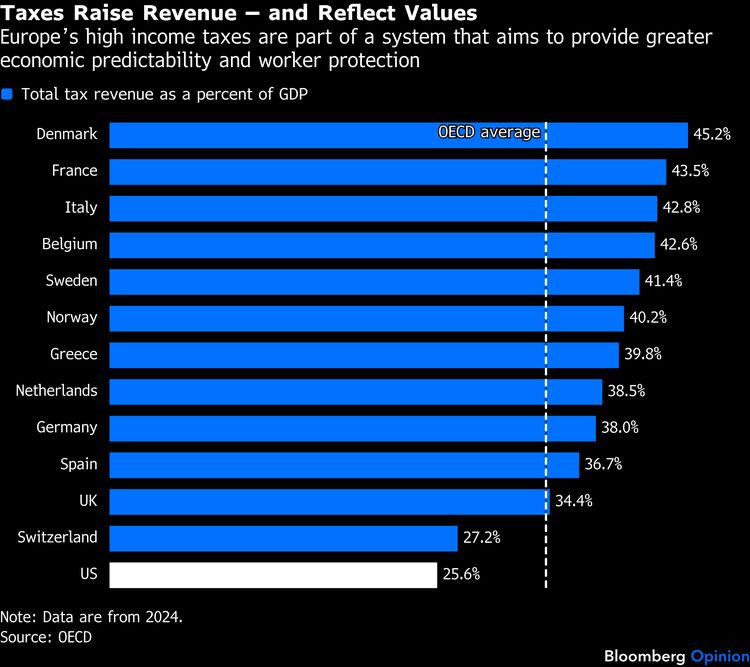
That’s in part because in Europe, charity largely comes from the state, which is funded by taxes, and the structure of that tax system makes it more difficult to accumulate a fortune. Europe taxes income and consumption at higher rates. Regulations on businesses and financial markets also make it harder to launch a successful business.
Defenders of the extremely wealthy ( including me ) argue that it’s more important for an economy to enable upward mobility than it is for it to limit extreme wealth. And some European countries are more egalitarian.
In Denmark, for instance, less than 20% of income advantages are passed on from parent to child — compared to 50% in the US. And overall, there is more wealth mobility in Denmark than in the US. But the linkages between parent and child wealth are still strong for the top tier of wealth: Being wealthy as a child or young adult, usually because of inheritance, is extremely predictive of being wealthy as a 45-year-old.
Of course, in many ways the tax policy of a country reflects the values of that country. Which is more desirable: More security and better odds of reaching the middle class if you aren’t born into it, or the ability to become fabulously wealthy? There is no right answer. It comes down to values around risk .
It’s not as if self-made billionaires don’t exist in Europe. But its system puts a premium on security and safety, high income taxes, and regulations that ensure more predictability, worker protection and government benefits. This ensures that more people don’t fall into deeper poverty and have the chance to join the middle class. But it also makes it harder for anyone to become a billionaire (or even a millionaire) if they aren’t born that way. The US system is far more tolerant of risk — including the upside of becoming a millionaire (or even a billionaire).
On first impression, it may seem like the European way is preferable. Isn’t an economy that offers easier access to the middle class better than one that rewards a handful of billionaires?
But it is important to remember that middle-class Americans (and in some cases lower-middle-class Americans) often live better than middle-class Europeans . And that’s partly because what made the billionaires wealthy — technological or business innovations that lead to better services — also improved the quality of life of middle-income Americans. Yes, a lot of people get rich, but so does society overall.
Elsewhere in Bloomberg Opinion:
- ‘Tax the Rich’ Won’t Save Cities Like New York : Nicolas Rohatyn
- A $20 Trillion Wealth Transfer Is Happening Under Our Noses : Mark Gongloff
- Think the Economy Is Unfair? Blame the Upper Middle Class : Allison Schrager
For more, Or subscribe to our newsletter .