
Emerging-market assets extended their gains as a combination of lower US bond yields, a weaker dollar and relatively steady oil prices provide relief to global markets.
MSCI’s EM currency index advanced, with the Hungarian forint leading the charge after central bank officials said the nation could adopt the euro as early as 2031. On the opposite end, the Colombian peso dragged peers lower along with energy prices since the nation is an oil exporter. A gauge of developing-world stocks rose for a second straight day.
Brent crude was little changed by early afternoon Tuesday, holding around $100 a barrel after a three-day drop that eased inflation anxiety and helped to push Treasury yields lower. The dollar also fell. Meanwhile, Eastern European currencies benefited from an easing in French risk premia.
“Today is a good day for market risk sentiment,” said Ning Sun, senior EM strategist at State Street in Boston. “The combination of those factors benefit EM, in particular oil importers and countries with higher correlation with the US bond markets.”
Emerging-market investors’ are still focusing firmly on Brazil, where Monday’s post-election rally is expected to extend until the Oct. 25 second-round vote. The real which rallied to a five-month high on Monday, will gain further, Societe Generale analysts said, advising short dollar and euro positions against the Brazilian currency.
Elias Haddad at Brown Brothers Harriman said the first-round result has handed “momentum” to challenger, Flavio Bolsonaro, heading into the runoff.
Brazil watchers expect the nation will have a better chance of tackling its ballooning deficit under the eldest son of former President Jair Bolsonaro, even though he has yet to put forth a detailed plan on how to do so.
Read: Brazil Market Euphoria Hinges on Fixes Bolsonaro Hasn’t Laid Out
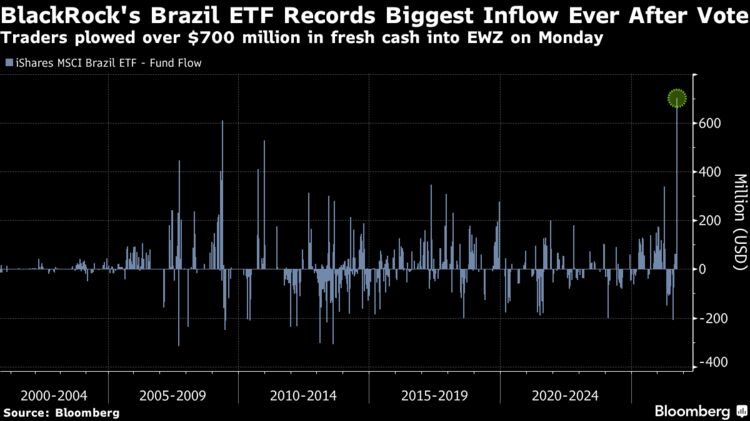
Still, traders added over $700 million in fresh cash into BlackRock’s iShares MSCI Brazil ETF — the world’s largest exchange-traded fund tracking Brazilian stocks with about $9 billion in assets — Monday following Sunday’s vote.
The mood more broadly remains cautious, however, with Treasury yields near multi-decade highs, fears of a French crisis boosting the dollar.
Policymakers are being forced into action. India, for instance, is expected to raise rates this week for the first time in nearly four years. In Chile, the government pledged to sell dollars after the peso’s 4% slide in the past month. Zambia’s kwacha , a strong year-to-date performer, fell for the sixth day as energy importers clamored for dollars.
Emerging-market investors have “gotten burned” by a range of factors in recent weeks, according to Phoenix Kalen, head of EM strategy at Societe Generale.
“Investors may be thinking about de-risking their portfolios and staying quite selective, which suggests an environment where the majority of EM foreign-exchange spot returns will be negative,” said Kalen, who expects currencies from Brazil, Colombia, India and Indonesia to be among the outperformers over the coming months.