Vietnam’s ambitions to rapidly expand liquefied natural gas imports to feed growing electricity demand are unraveling, as red tape and financial hurdles delay nearly all of the country’s planned power projects.
Of 18 proposed developments — which would have a combined capacity of more than 20 gigawatts — only LNG Hiep Phuoc is on schedule, Industry and Trade Minister Le Manh Hung said at a government meeting last week. Just two of the projects have started construction, Deputy Industry and Trade Minister Truong Thanh Hoai said at the same session.
The delays threaten Vietnam’s plan for the super-chilled fuel to make up as much as 12% of its power mix by 2030. The country, which started importing LNG in 2023, is viewed by the global industry as a major potential growth market.
But soaring LNG prices due to disruptions in the Strait of Hormuz, combined with local regulatory hurdles and bottlenecks in the power-plant supply chain, risk forcing Vietnam and other emerging Asian economies to rethink the fuel’s role in their energy mixes.
The problems are part of a wider issue, with many Vietnamese generation and transmission projects falling behind schedule. The trade ministry warned last month that the country faced the risk of power shortages from next year due to the delays. Vietnam’s goal of at least 10% annual economic growth through 2030 is adding pressure to the grid, with new factories, technology and infrastructure projects boosting power demand.
The LNG Hiep Phuoc project in Ho Chi Minh City is aiming to begin commercial operations by the fourth quarter of 2028, according to reports in local media. Of the other 17 planned gas-fired power stations, about five are supposed to be finished before the end of the decade.
Read More: Vietnam Warns of Blackouts From 2027 as Power Projects Stutter
Most of the projects are struggling to complete land and site clearance, financing arrangements and power-purchase agreements, according to a government account of last week’s meeting. Acting Deputy Prime Minister Pham Gia Tuc has ordered authorities to establish detailed timelines for each project to identify delays earlier.
“These delays are now widely recognized,” said Duong Dinh, associate director at Vietcap Securities, a financial services company. The trade ministry “has proposed several mitigation measures, including the addition of 5,300 megawatts of coal-fired capacity equipped with carbon-capture technology to compensate for delays in LNG-fired power projects,” she said, adding that Vietcap expects a potential shortage in power generation from 2028 to 2030.
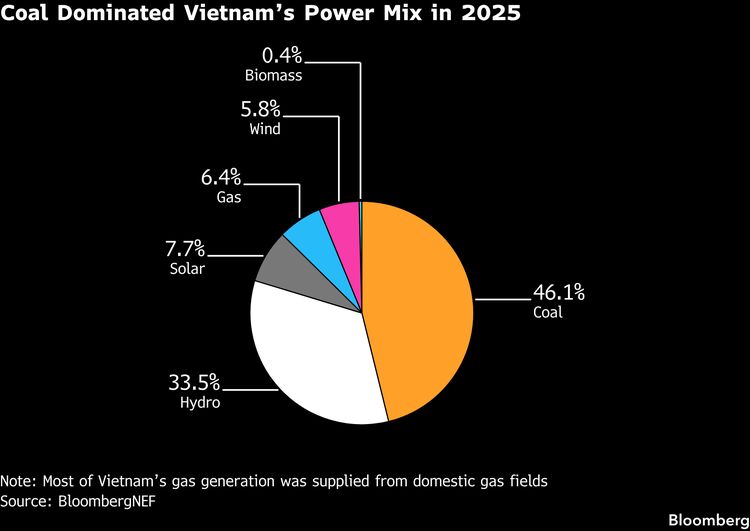
The Southeast Asian nation remains dependent on coal for its electricity. The fossil fuel accounted for 46% of power generation last year, followed by hydro on 34% and solar with 8%, according to BloombergNEF . Vietnam’s LNG imports will reach 3 million tons by 2030, BNEF forecast, down from an estimate of 4.9 million tons made in 2025.