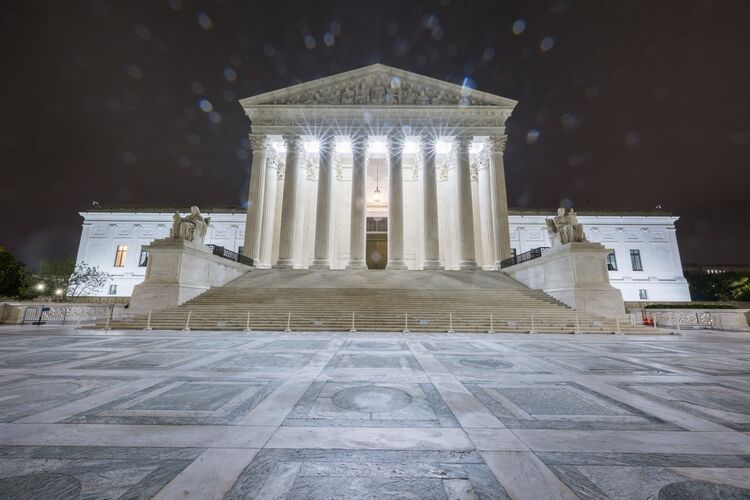
The US Supreme Court wrestled with whether to allow state and local lawsuits blaming oil companies for climate change, as the justices opened their new term with a clash carrying big stakes for the environment and the energy industry.
Hearing arguments on Monday in a case involving Exxon Mobil Corp. and Suncor Energy Inc., several justices suggested openness to letting at least a narrow class of claims go forward. But a key justice also voiced concern about the consequences of permitting a deluge of new suits against the energy industry, in addition to the dozens that are already pending.
“Presumably, if you prevail, the next day a municipality in every single state will file a lawsuit,” Chief Justice John Roberts told the lawyer representing the city and county of Boulder, Colorado.
The companies are operating at a disadvantage after conservative Justice Samuel Alito decided to recuse himself from the case last week because of his wife’s stock holdings. That means the clash could end in a 4-4 split, which would leave intact a Colorado Supreme Court ruling letting the Boulder suit go forward, without setting a nationwide precedent affecting other cases.
The showdown comes at a fraught time for US efforts to stem the changing climate, with the Environmental Protection Agency under President Donald Trump systematically dismantling federal constraints on greenhouse gases. Trump, whose administration is backing Exxon Mobil and Suncor, has called climate change “a hoax” and “con job.”
Meanwhile, climate impacts are rapidly intensifying . The atmospheric level of carbon dioxide, a major greenhouse gas, is now more than 50% higher than it was before industrialization began. The extra heat trapped in the atmosphere is raising average and extreme temperatures, making rainfall more extreme, storms more intense and harming health, from heat-related illnesses to insect-carried diseases.
Multifaceted Fight
The Boulder suit is the latest test of efforts to use litigation to hold energy companies accountable for climate change. The Supreme Court closed off one avenue in 2011 by ruling unanimously that states can’t invoke federal law to force emissions cuts.
Boulder is now trying a different approach by suing under Colorado state law, claiming the oil companies misled the public about the risks of climate change while simultaneously contributing to the problem by producing and promoting fossil fuels.
Suncor and Exxon say climate change is a global phenomenon that doesn’t lend itself to state-by-state litigation the way fights over localized pollution do. The companies contend the US Constitution’s structure precludes suits under state law over such an inherently trans-boundary issue.
“This case involves an unprecedented effort to use state law to regulate global conduct,” the companies’ lawyer, Kannon Shanmugam, argued.
Boulder calls that a novel argument that has no basis in the text of the Constitution and would invade the traditional authority of states to protect their citizens. The city and county say they can sue over in-state harm even though most of the companies’ carbon emissions happen elsewhere.
“Applying state law to such cases has never been viewed as one state impermissibly projecting its law nationwide,” Boulder’s lawyer, Kevin Russell, told the court.
Roberts suggested early on that he was amenable to at least some claims, saying the court has long allowed similar suits over out-of-state activities that have an in-state effect.
“I guess I’m not quite sure what makes this situation different from all those other ones where we’ve allowed them to proceed in state court,” Roberts told Shanmugam.
‘Crystal Clear’
Another conservative, Justice Brett Kavanaugh, was more overtly skeptical of the Boulder lawsuit. He said Supreme Court precedents “make crystal clear that interstate air and water pollution are matters for federal law unless Congress specifically preserves state law.”
But Kavanaugh also pointed to what he called a “wrinkle” in those precedents, a 1977 ruling that said the Clean Water Act lets interstate suits go forward as long they apply the law of the state where the pollution occurred rather than the place where the effects are felt.
One of the court’s liberals, Justice Elena Kagan, resisted the companies’ sweeping constitutional arguments but was more receptive to their backup contention that the US Clean Air Act precludes the Boulder suit.
“Why not just say this really does just get in the way of how Congress decided to regulate greenhouse gases?” she asked.
Another liberal, Justice Ketanji Brown Jackson, suggested the whole fight was premature, noting that the Colorado Supreme Court ruling didn’t reach other arguments the companies are making for dismissing the lawsuit.
“I understand that you have several other federal issues that you have raised that are still pending in the state court,” she told Shanmugam. “So why shouldn’t we wait and hear all of these claims once the state courts are done with their federal considerations?”
The court is scheduled to rule by late June in the case. Suncor v. County Commissioners of Boulder County, 25-170 .