By Alastair Marsh | Updated on Oct 06, 2026 at 08:42 AM
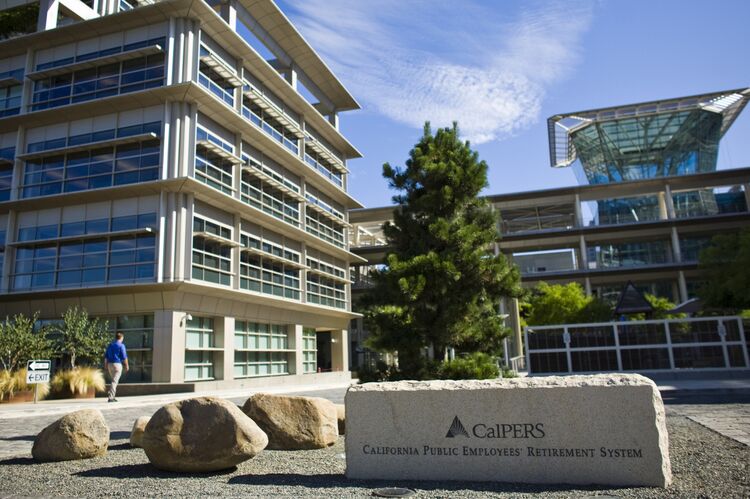
California Public Employees’ Retirement System is planning to build out its private-credit bets targeting the energy transition, an area its analysis indicates is undervalued by the market.
Calpers, whose existing investments in the strategy include an $800 million allocation to a fund run by Goldman Sachs Asset Management, is now looking into placing more client money into similar funds, according to Peter Cashion, who oversees the pension plan’s sustainable investment strategy.
It’s an “underappreciated” investment opportunity, he said in an interview. “Most private credit funds, they’re doing asset-backed securities or senior lending to the standard corporates, but very few are specialized in green or brownfield energy projects.”
According to Cashion, adopting the strategy has meant that Calpers has in some cases made “near equity returns for debt risk.”
Calpers, which oversees roughly $640 billion in assets, made clear back in February it was unfazed by the broad selloff in the market for private credit triggered by anxiety that AI would upend software bets. The pension fund has set an 8% target for investment in the asset class, Chief Executive Officer Marcie Frost said at the time.
Private credit has been making headlines amid questions around valuations. The Securities and Exchange Commission recently signaled it will be focused on how firms determine what their stakes are worth and how those values and risks are disclosed to investors. That’s as the financial industry has been seeking to expand its private offerings to a wider audience, including individuals and retirement accounts.
When it comes to bets tied to the global energy transition, Cashion said the rationale for moving deeper into private credit rests in the idea that companies are freer to grow using leverage than they are relying on public equity markets.
“You’ve had all this equity that’s been raised over the last four or five years for energy transition,” he said. “But for companies to have proper profitability they need the leverage, they need the debt.”
While debt financing for transition sectors has grown considerably in the past few years, equity financing still dominates. Of the $41.3 billion that flowed into such assets in the first half of 2026, only $11 billion was in the form of debt, according to Net Zero Insights.
Calpers has set a target of investing $100 billion in so-called climate solutions by 2030. That covers assets related to mitigating carbon dioxide emissions, transitioning away from fossil fuels and adapting to rising temperatures. As of last year, it had invested $60 billion in those strategies.
“The whole reason we have this $100 billion target is that we think we can generate outperformance,” Cashion said. “With a big thematic mega-trend like this, there’s going to be opportunity in multiple areas.”
Calpers is also looking for ways to increase its exposure to insurance-linked securities , which he says is an asset class that has the “size and scale” to make a meaningful dent in its $100 billion target.
And Cashion cautioned against being distracted by the frenzy around investing in AI infrastructure. According to BloombergNEF, investments in data centers may reach $750 billion this year, compared with more than $2 trillion for the energy transition.
“As big as data center development and buildout is, climate transition is much bigger,” Cashion said.