America’s automakers enjoy the refuge of an anti-Chinese wall. But so do foreign, non-Chinese automakers who also sell vehicles in America, especially if they manufacture here. This means Chinese competition is exerting pressure on US dealer lots already; indirectly, yes, but it’s likely to intensify. Detroit’s defensive moat is less impenetrable than it might seem.
This point was made recently, if also indirectly, by none other than Paul Jacobson, General Motors Co.’s chief financial officer, at a recent conference:
I think the United States is the most lucrative auto market in the world. And that’s evidenced by what you see many competitors doing in terms of aiming more capacity. I think that’s been a defense and a pivot away from some of what we’ve seen of Chinese competition throughout the world. And the US becomes a little bit of a safe haven.
Chinese automakers suffer from chronic overcapacity and cutthroat competition in their domestic market. One escape hatch is exports. China is expected to ship about 10 million vehicles overseas in 2026, roughly one in every six vehicles sold outside of the country and up tenfold in just six years. While the US is effectively off-limits, Chinese brands have made big inroads in Asia, Europe, the Middle East and South America.
Even if GM and Ford Motor Co. have largely retreated to their home base already, many of their peers remain truly global — and therefore exposed to this new, fast-growing competition in both domestic and export arenas, with stricken Volkswagen AG the unfortunate exemplar .
This makes the US an appealing bolt-hole. It isn’t a growth market but remains the second largest in the world by units and number one in revenue terms (due to high average pricing). Plus, it is still weighted heavily to the internal combustion engines that legacy automakers know and love.
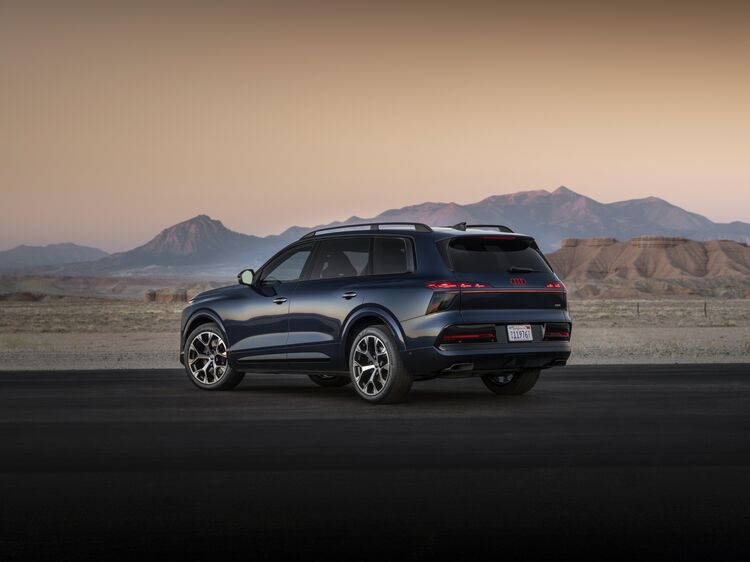
Bayerische Motoren Werke AG noted this summer that strong US sales growth helped to partly offset a steep decline in China in the first half. Audi, VW’s premium brand, is struggling in both China and the US but still regards the latter as having “the greatest potential in the medium term” of any major market. Audi recently unveiled the Q9, a three-row luxury SUV complete with monumental front grille that is very much geared to the American driver not looking for much change out of a hundred grand .
It is mass-market Japanese and South Korean automakers that are really capitalizing on the US market of late, however. Honda Motor Co. Ltd. and Hyundai Motor Co. both enjoyed big jumps in sales in September, adjusted for selling days, even as GM and Ford recorded declines. Toyota Motor Corp.’s growth was more subdued, but that was owed mostly to the swap-over of its best-selling RAV4 SUV to an all-hybrid lineup, depressing sales of the outgoing gasoline-only variant. In contrast, sales of electrified, mostly hybrid, models jumped by a third for the company that mainstreamed the category with the Prius.
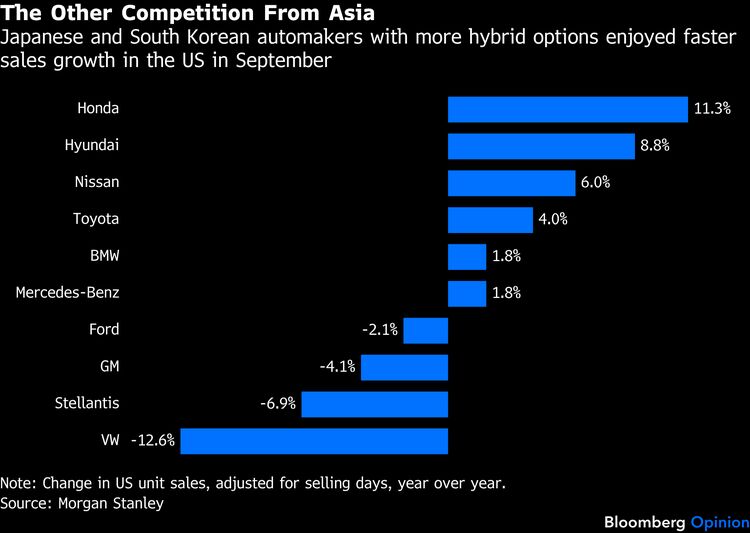
With their portfolios of cheaper, more fuel-efficient and hybrid models, Japanese and South Korean automakers are primed to do well in a US market weighed down by $50,000 sticker prices, low consumer confidence and war-fueled pump prices .
GM and Ford both suffered steep declines in battery-electric vehicle sales — unsurprising given the disappearance of federal EV subsidies — while pickup trucks fared better in September. Stellantis NV, owner of Chrysler, broadly fit the same pattern. These results are emblematic of the US incumbents leaning into premium-priced gas-guzzlers, reflecting their reliance on buyers in the upper arm of a K-shaped domestic auto market .
Detroit may feel sanguine about drivers of less means going for a Honda CR-V or Toyota Camry. It shouldn’t. For one thing, with their EV sales having collapsed, the US automakers are pivoting harder to hybrids themselves, but that is an area where they are clearly playing catch-up.
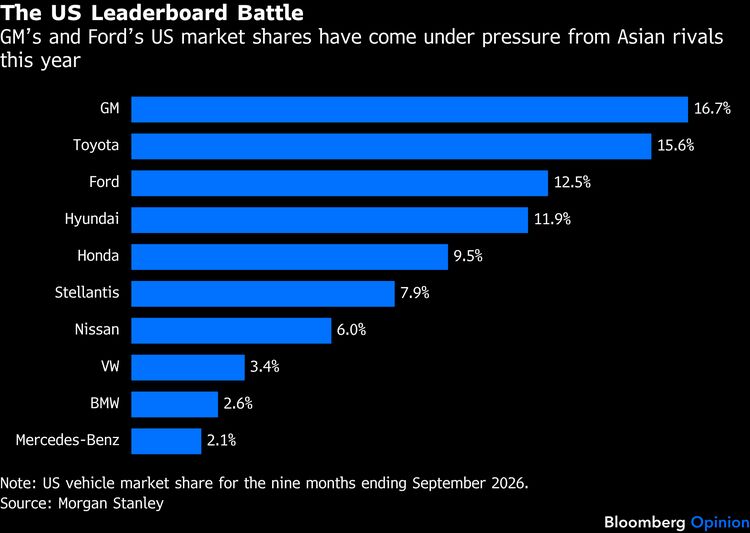
More broadly, while greater focus on value over volume has shored up pricing and margins for the US automakers, market share can’t be traded away ad infinitum . Back in 2000, the Detroit three still commanded about 67% of their home market. Their market share in the nine months through September this year stands at 37%, down about 1.3 percentage points, year over year, according to figures compiled by Morgan Stanley.
Ford is at risk of being overtaken by Hyundai in terms of US unit sales, while Toyota is snapping at GM’s heels for the number one position — something it managed to grab once before, in 2021, albeit partly due to semiconductor shortages back then. All this is before any Chinese companies set up shop stateside, remember.
While not at Chinese levels, the US already suffers an excess of auto plants that shows up in relatively low capacity utilization . The side-effect of Washington’s reshoring drive is that it will encourage yet more capacity to open up , especially as foreign automakers seek a bigger slice of the US market to offset Chinese pressure elsewhere. The architect of that reshoring, President Donald Trump, has boasted, “They’re all coming here.” True enough and good for investment, if not necessarily for the homegrown incumbents who must fight to keep their turf.
More From Bloomberg Opinion:
- How Ford and GM Can Avoid VW’s China Pains : Liam Denning
- America's Job Machine Is Putting Workers Behind: Jonathan Levin
- What My New EV Says About the Future of Oil Demand: Javier Blas
Want more Bloomberg Opinion? OPIN <GO>. Or you can subscribe to our daily newsletter .