By Thomas Black | Updated on Oct 05, 2026 at 11:30 AM
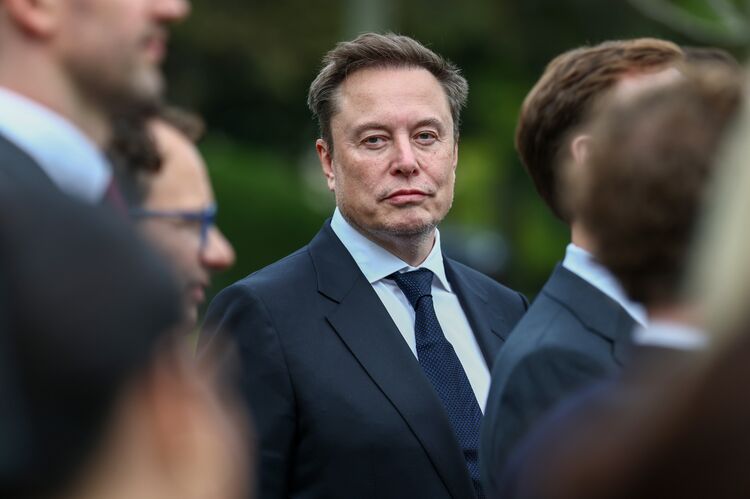
Elon Musk added to his annals of antics on Thursday, warning Delta Air Lines Inc. Chief Executive Officer Ed Bastian that he will lose his job for choosing Amazon Leo to provide aircraft internet over SpaceX’s Starlink.
Musk’s criticism of Bastian, who has bragging rights for leading the most profitable US airline, isn’t notable for being outrageous. The chief executive officer of SpaceX and Tesla Inc. has challenged Meta Platforms Inc.’s Mark Zuckerberg to a cage fight and pilloried OpenAI’s Sam Altman with nicknames such as Swindly Sam and Scam Altman.
Nor is harsh language unusual for the airline industry. Michael O’Leary, the boisterous CEO of Ryanair Holdings Plc, was forced to apologize last month for labeling his European competitors “rapists” for high airfares, and United Airlines Holdings Inc. CEO Scott Kirby often takes sly jabs at American Airlines Group Inc., where he was passed over for the top job.
Musk’s remarks popped off the screen because his company supplies a service, and yet, he’s attempting to publicly shame a potential customer that he’s supposedly courting. This is a bully sales tactic, which belongs in the dustbin of history for legitimate businesses.
Still, Musk has a point: Starlink already offers high-speed internet on aircraft and has signed up several of Delta’s competitors, including United and Southwest Airlines Co. Starlink, a unit of Space Exploration Technologies Corp. or SpaceX, now boasts the highest speed internet available for aircraft. Amazon Leo, in contrast, has an unproven satellite internet product that won’t be available to Delta until 2028 and is at a structural cost disadvantage to Starlink. That puts the airline on the backfoot when it comes to offering customers the best onboard internet service now.
SpaceX has built an unprecedented network of more than 11,000 satellites in low orbit. It provides Starlink with the lowest launch costs, and those costs are about to drop even further after the first orbital flight of the massive Starship rocket, which deployed 26 new generation satellites.
Amazon Leo, which Amazon.com Inc. created in 2019, has about 400 satellites in Low Earth orbit. The company will struggle to expand this network rapidly because it depends on third-party launches to put satellites into orbit and at a much higher cost than Starlink. This will be the case until Blue Origin, Jeff Bezos’s space company, begins to launch frequently and routinely retrieves the first-stage booster for reuse. Even then, Blue Origin’s New Glenn rocket will be behind Starship, which is designed to reuse both rocket stages and has the capacity to carry much more volume into space.
Delta and Amazon reached an agreement in March for internet service, beginning in 2028, on 500 aircraft. That followed Amazon’s announcement that it had signed JetBlue Airways Corp. as one of its first customers. It offered previews of its system to select potential customers to tout a “new gigabit-speed Ultra antenna” to provide super-fast internet .
The risk for Delta and Bastian is that for two years the company will have to explain to its best SkyMiles customers why the current internet service on its planes, provided by Viasat Inc. and EchoStar Corp.’s Hughes unit, is slower than competitors. And that’s if everything goes as planned with Amazon Leo.
Delta currently claims to be the leading premium-service airline followed closely by United, which already offers Starlink internet. American Airlines has lagged on sprucing up its network to capture more business class customers. It signed a deal to start Starlink service in early 2027. Southwest is introducing premium seating and products to its cabin, including Starlink internet that began rolling out on its planes in June.
This danger for Delta is heightened by all the advertising Starlink is doing to create brand awareness for internet on the move, along the lines of what “Intel inside” did for computers. This makes sense because its customers can use Starlink as a selling point for their services. United is doing just that with a marketing campaign boasting faster internet with Starlink.
Bastian had to be well aware of the risks. He has defended his decision, saying the price for Amazon’s onboard internet service is lower than Starlink’s, and Delta expects to offer other Amazon services such as streaming, video games and shopping. Amazon must have aced its test run for Bastian to have committed to the costly and time-consuming task of putting new internet equipment on Delta planes.
The payoff could be large if Amazon Leo meets expectations on connectivity and speed, allowing Delta to offer better internet at a lower cost than competitors. Bastian will certainly need to continue defending his decision, because Musk is unlikely to let up on the criticism.
Will Amazon Leo be able to compete with Starlink? It’s in the best interest of all market players that it is. Starlink and Musk will otherwise have a near monopoly on fast, satellite internet service. Without competition, Starlink will more easily harvest all that it’s built through higher prices.
This all gets back to the reason Musk’s relatively innocuous statement (by his standards) attracted so much attention. It boils down to a company using its market power to bully customers into helping snuff out a competitor before it gets started. Competition is at the heart of capitalism, the economic system that has created enormous wealth and lifted hundreds of millions of people out of poverty. Our society and system of government also tend to urge us to cheer for the underdog, the Horatio Alger.
The clear underdog here is Amazon Leo, which has the daunting task of taking on the most disruptive space company in history. Bastian is rooting for the underdog. Let’s hope it doesn’t cost him his job.
More From Bloomberg Opinion:
Want more Bloomberg Opinion? OPIN <GO>. Or you can subscribe to our daily newsletter .