Elliott Hill didn’t clear the decks enough when he became chief executive officer of Nike Inc. two years ago. So on Thursday, Hill, accompanied by new Chief Financial Officer David Denton, slashed sales and profit forecasts.
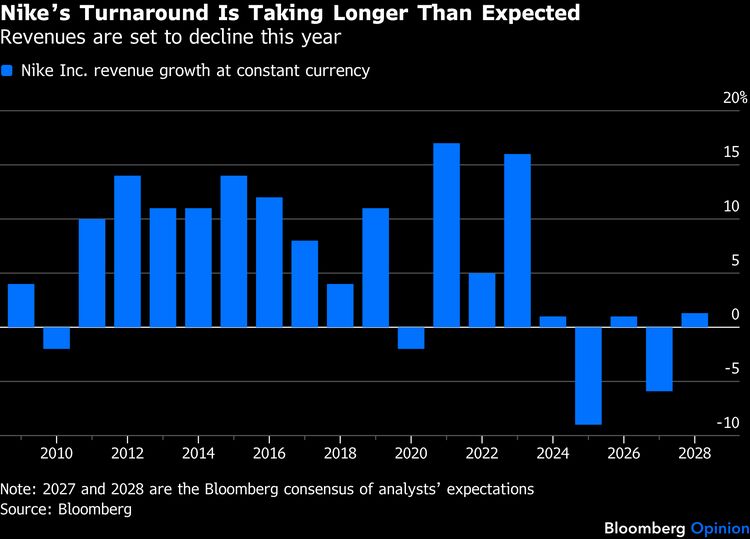
Getting all of the bad news out of the way was necessary. But with Nike shrinking its Jordan and China businesses, it may still be too little, too late. The long-promised turnaround has been pushed further out yet again. Hill needs to start showing some real progress to get investors back on board.
In October 2024, the freshly arrived Hill withdrew guidance for the year to May 2025 and has been setting expectations quarterly ever since. Last week, he broke with that habit and forecast that sales in the year to May 2027 would decline by a percentage in the high single digits. Earnings per share are forecast at $1.15 to $1.35, excluding 15 cents of restructuring costs. Before the revision, analysts had been expecting revenue to drop by 2.4% and earnings of $1.65 a share.
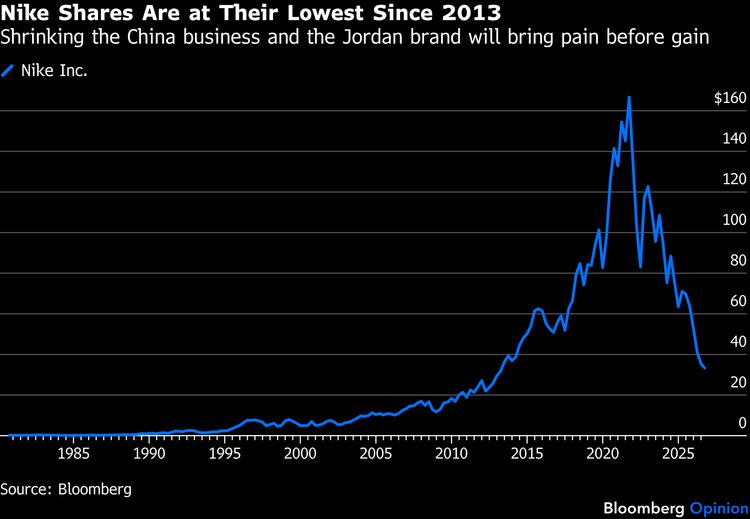
On Monday, S&P downgraded Nike’s long-term credit rating to A from A+ and warned it could make further reductions in the next 12 to 24 months if the turnaround fails to take hold. Nike shares fell 2.3% in early trading, bringing the stock’s slump over the last year to about 53%.
The financial expectations maneuvering is yet another area where Hill has been outclassed by Bjoern Gulden, CEO of Adidas AG, who lowered his forecast of operating profit by about €1 billion within weeks of taking the top job at Nike’s main rival in January 2023. That gave him plenty of room to rebuild, which he has subsequently done. At Nike, it has been death by a thousand cuts.
Some of Hill’s reluctance to reduce forecasts more aggressively earlier in his tenure is understandable. Denim was having a serious fashion moment when he arrived at Nike, but athleisure — wearing workout clothes outside of the gym — was still going strong.
Now the jeans revival has morphed into a broader wardrobe refresh , in which fashion-forward shoppers are swapping their sneakers for dressier shoes and Nike fleeces for blazers.
Nike also announced results for the first fiscal quarter, and Hill said the company was making progress in the gear people actually wear for sports, which he has made his top priority. Sales grew by a double-digit percentage in running, football, North American basketball, tennis and golf. This helped North American sales expand by 2% in the three months to Aug. 31, a rare bright spot.
But headway in track and field wasn’t enough to offset the slump in athleisure and the Jordan brand. Together they account for about 60% of revenue. Jordan footwear is particularly important in the US.
While Hill could be forgiven for not foreseeing just how quickly style would shift — fashion is fickle after all — he must shoulder some of the blame. Leading a company that generates annual revenue of $45 billion, he had to start somewhere: He chose sports, and this appears to be working, thanks to a steady drumbeat of new shoes and gear. But he should have tackled the fashion side of the business in tandem.
Gulden was able to steer Adidas back to €2 billion of operating profit by 2025 because he found some hot shoes to replace the stocks of Yeezy sneakers it was left with after it ended its partnership with Kanye West in October 2022. The successors were the low-rise terrace styles led by the Samba.
At Nike, the P-6000 and a wallet-friendly version of the Vomero 5 — sneakers with a high-tech running look — rose by a double-digit percentage in the quarter. Then there’s Nike Mind, a range that helps the wearer prepare for sport, and the Moon Shoe, described by Vogue as the “Samba of 2026.”
But none of these are enough to move the needle. Hill is still waiting on his own soar-away shoe. He acknowledged there was a “lack of energy” in athleisure and a “sea of sameness.”
He plans to tackle this shortfall by more carefully targeting different parts of the fashion market. This is the strategy he has applied to sports, organizing teams around “fields of play” like basketball and football. He should have been doing this already.
Nike is also launching Pace, a program to deliver $2.5 billion of cost savings through 2031.
With a new CFO, action on cost was inevitable. If Pace helps Nike become nimbler and get novel products to market quicker, it is welcome. But no one ever cut their way to growth. What Nike needs is must-have sneakers. And job cuts risk further destabilizing the business.
As well as turbocharging Nike’s innovation, Hill needs to continue to rightsize its classic chunky shoes, which have taken a back seat to Adidas’ low-fitting models. One such style, the Air Force 1, is now back to health, with new iterations selling without the need for discounts. Sales of another model, the Dunk, fell almost 50% in the quarter.
But just as Hill is getting a handle on this business, Nike faces an even bigger cleanup involving more of its Jordan sneakers, where it has been oversupplying the market. It will reduce the volume and frequency of retro product launches beyond the Air Jordan 1, which is already being managed down. The action will hurt sales, given that the Jordan brand accounted for 13% of its global business in the quarter.
With the slate wiped clean to some extent, Hill has a platform to outperform, as Gulden did. There have been some flashes of the old Nike prowess, like its Rip the Script World Cup campaign , but it may be too much of a stretch for Nike to regain its powerhouse status.
The sporting goods landscape has changed permanently, with upstart rivals nipping away at Nike’s market share in running, and now football, since On Holding AG signed Nike star athlete Kylian Mbappé . Adidas has proved to be a powerful legacy competitor, too, and will only become more of a menace as Gulden seeks to roughly double Adidas’ North American sales to $10 billion.
Without a breakthrough soon, investors will have to face the fact that Nike just isn’t doing it anymore.
More From Bloomberg Opinion:
- Nike’s China Reset Needs More Than the Kardashians: Juliana Liu
- Your $30 Jeans Are Running Out of Cheap Power: David Fickling
- Mbappe Is Kicking Nike When It’s Already Down: Andrea Felsted
Want more Bloomberg Opinion? Terminal readers, head to OPIN <GO>. Or subscribe to our daily newsletter .