Higher global bond yields will put pressure on the Australian budget as the widespread selloff pushes debt refinancing costs higher, Australian Treasurer Jim Chalmers warned on Tuesday.
“Right around the world, including in Australia, these higher borrowing costs will play out in our budgets,” Chalmers told Bloomberg Television’s Haidi Stroud-Watts and Shery Ahn.
“One of the big upward pressures on the budget, unfortunately, will be as some of this cheaper debt rolls off and is replaced by more expensive debt,” he said, adding that he’ll update the national budget with the impact of higher borrowing costs by the end of the year.
Global bonds are under pressure as resilient US growth and high oil prices lead to bets on more rate hikes to curb inflation. More broadly, concerns over debt, deficits and government spending, as well as corporate bond issuance, have also weighed, pushing a global yield benchmark to the highest in two decades.
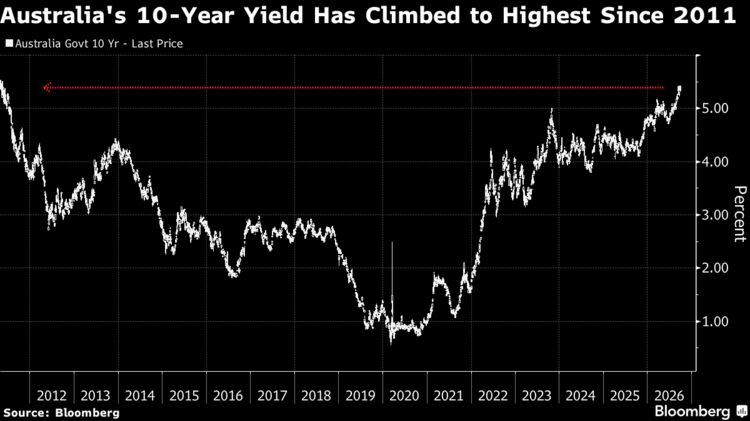
Australia’s 10-year yields hit the highest since 2011 last month, although the country’s sovereign bonds has fared better than most given its AAA credit rating, relatively low government debt and an improved budget position last fiscal year.
Read More: Australia-US Bond Yield Gap Nears Zero as Policy Paths Diverge
In May’s budget , Chalmers estimated a shortfall of about A$28 billion ($20 billion), or 1% of gross domestic product, widening to more than A$31 billion in fiscal 2027 and holding in the low 30-billions for the following two years.
If the Treasury lifts its yield assumptions about 50 to 60 basis points higher, to be in line with market pricing, that may cost the budget about A$6 billion over the next four years, said Robert Thompson, head of Australian economics and rates strategy at Royal Bank of Canada in Sydney.
Chalmers was speaking from Tokyo, a day after he and his Japanese counterpart Satsuki Katayama announced a new dialogue framework to enhance economic security cooperation, including on investment trends and supply chains.
Read More: Japan, Australia Finance Chiefs Set Up Dialogue to Deepen Ties
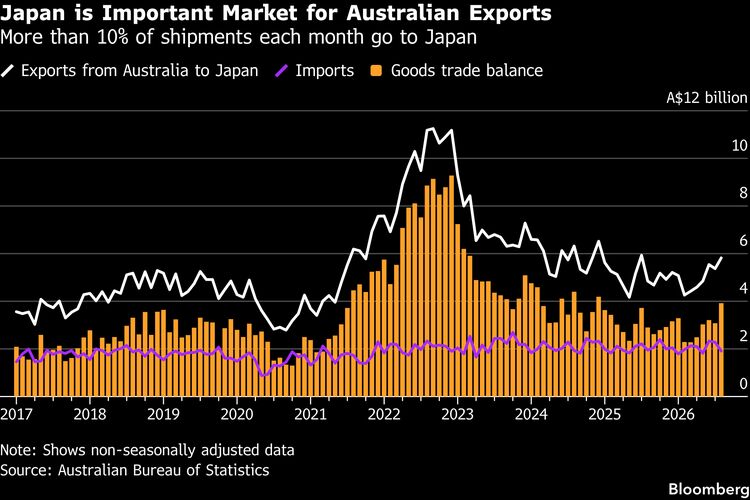
Australia is an important destination for Japanese investment, with Japanese firms the second largest investors into Australia behind the US, according to a recent report on bilateral financial flows.
Liquefied natural gas, coal, iron ore and other commodities has been the main targets in Australia for decades, although it has expanded in recent years to real estate, services and other sectors. Both countries are looking to develop Australia’s critical mineral resources as well.
The two nations face similar challenges stemming from China, whose tight export controls on rare earths have raised concerns about supply chains and whose military activities have heightened security concerns among its neighbors.
“Japan and Australia are islands of opportunity in a sea of uncertainty, and it’s hard to think of two economies which are more complementary to each other than the Australian economy and the Japanese economy,” Chalmers said.