Voters in Quebec elected the separatist Parti Québécois for the first time in more than a decade, setting the stage for more strained relations with Prime Minister Mark Carney’s government and an eventual referendum on the province’s independence from Canada.
The party won the election Monday but fell short of a majority government in the 127-seat legislature. PQ Leader Paul St-Pierre Plamondon, a 49-year-old former lawyer, is set to become the French-speaking province’s new premier.
St-Pierre Plamondon has promised to hold a referendum on secession during a first four-year term — but not while US President Donald Trump remains in office.
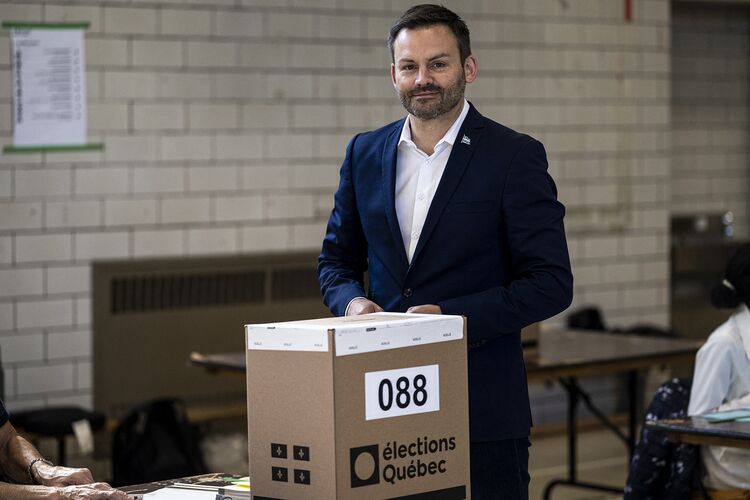
Carney congratulated the new premier, who’s known simply as PSPP, in a post on X. “Building a stronger Quebec is core to our mission of building a stronger Canada,” the prime minister said. “I look forward to working with you to support Quebec’s businesses and workers impacted by tariffs, create more good jobs, work to end homelessness, and get more homes built across Quebec.”
Quebec, a province that represents about 20% of Canada’s economy and is a major exporter of aluminum, aerospace and hydroelectricity, has seen its manufacturing base affected by the US-Canada trade war and other disputes. As long as Trump is in power, St-Pierre Plamondon has said, a government led by him would hold off on asking Quebecers whether they want to break away from Canada to avoid having the US president’s unpredictable tactics interfere in the debate.
“A referendum is an opportunity to decide for oneself,” St-Pierre Plamondon said during his victory speech in Montreal. “It’s normal to ask ourselves this question again in light of our accelerated linguistic and cultural decline in recent years, and also with the legitimate goal of becoming fully in control of our own destiny.”
His speech, mostly in French with a few words in English, was interrupted by the crowd shouting, “Quebec, a country! Quebec, a country!”

The Canadian dollar, which on Monday dropped to the lowest level versus the US greenback since April 2025, rallied modestly on Tuesday morning to trade at 1.425 per US dollar.
A secession referendum would be the third in the province’s history. In the last attempt in 1995, the pro-sovereignty “yes” vote lost by a margin of just over one percentage point.
Such a vote, even if several years away, is a significant risk to Canadian unity. Patrick Taillon, a constitutional expert at Université Laval, pointed to the “volatility and unpredictability” of voters. People who are “dissatisfied at a given moment” can suddenly tip the scales in a campaign, he said.
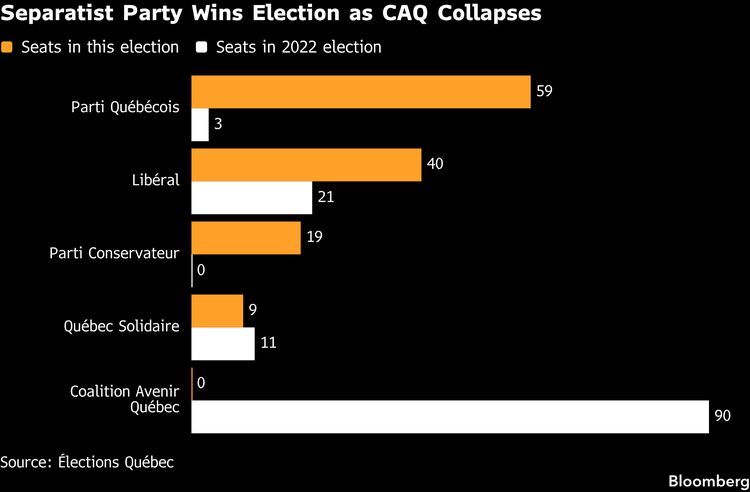
The Parti Québécois was elected to 59 seats, five short of a majority, meaning it will have to work with at least one other party to pass laws and budgets. But it did so with a very low share of the popular vote for a winning party — just 28%.
The Quebec Liberal Party ran second with 40 seats at 24% of the vote.
The governing Coalition Avenir Québec, which won 90 seats four years ago for a second term, was wiped out, winning zero seats. “Tonight’s result is a tough one,” said CAQ Leader Christine Fréchette, who was only the second woman to be premier of Canada’s second-largest province. “Quebecers wanted change, and I respect their choice.”
The voter turnout was slightly less than 67%, according to updated information from Élections Québec .
Risk premiums for Quebec bonds have widened lately as polls showed a PQ government was likely. An index of 30-year Quebec bonds yields more than 9 basis points above its Ontario equivalent, up from about 7 basis points two weeks ago. Quebec’s 10-year bond spreads over Canadian government bonds are also currently the widest among the four major provinces.
Read More: Canada Stares Down ‘Quebexit’ Risk as Trump Looms Large Nearby
“Clearly spreads would widen and perhaps rather sharply in a true referendum campaign, especially if it surprised pollsters by not rejecting separation,” Derek Holt, Bank of Nova Scotia’s head of capital markets economics, said in a report Monday.
But for now, many Quebecers don’t view a referendum as a priority.
Tax Cuts
The PQ’s victory is not necessarily an endorsement of separation. Several polling firms have shown about 70% of Quebecers are opposed to independence, especially with the ongoing trade war with the US.
However, public views on separation could very well shift if US-Canada tensions ease, or Carney’s strong popularity wanes.
“As far as I’m concerned, the referendum, if it happens, it’ll happen. It’ll create uncertainty, whatever,” Alain Bouchard, the co-founder and executive chairman of the Canadian convenience store giant Alimentation Couche-Tard Inc., said. “I’ve voted ‘yes’ before, and I’ve voted ‘no.’ As far as I’m concerned, if it comes up again, we’ll see. But it’s not my main concern.”
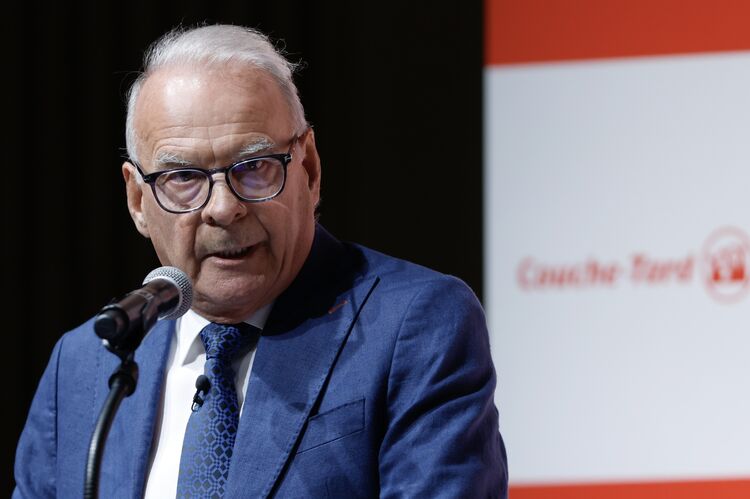
Bouchard spoke Friday at a Montreal event organized by Andrew Lutfy, the head of apparel company Groupe Dynamite Inc. Lutfy gathered hundreds of Quebec business leaders to ask the next government to reduce regulation and implement policies to help boost Quebec’s gross domestic product to C$1 trillion ($701 billion) over the next seven years, up by more than 50% from last year’s levels.
The province has become “uninvestable, much less attractive than other markets around the world,” said Lutfy, whose company is based in the Montreal region.
The PQ’s economic plan includes large cuts in the number of civil servants and a gradual reduction in the corporate income tax rate to 9.5%, from 11.5%, offset by a reduction in grants for businesses.
His agenda sits well with many businesses. Quebec’s designated new premier has promised in his first 100 days in office to unlock funds to address homelessness, eliminate taxes on used goods, lower the gas tax, create a secretary to overhaul the bureaucracy, conduct an audit of technology projects and lower immigration thresholds.
St-Pierre Plamondon emphasized during his campaign that it’s important for Quebec to have greater control over its language, culture, immigration and finances. That may exacerbate tensions with the federal government.
Carney is also facing a secession movement in Alberta, the western province that produces most of Canada’s oil and gas. Voters will cast ballots on Oct. 19 in a referendum asking whether they want the provincial government to take steps toward setting up a future vote on leaving Canada. But recent polls suggest the remain-in-Canada campaign has a large lead.