Supply Lines is a daily newsletter that tracks global trade. Sign up here .
Germany and France are urging the European Union to adopt new powers that could sever China or other countries from its single market, as the bloc’s two biggest economies adopt a more confrontational stance ahead of talks in Beijing.
The suggestion came in a letter, seen by Bloomberg News, sent Monday to European Commission President Ursula von der Leyen, the top EU executive.
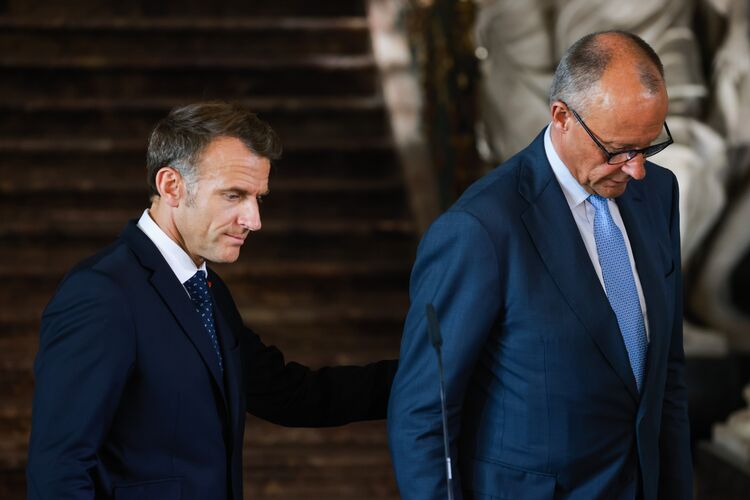
“We need a credible instrument in the hands of the Commission to allow for decisive and systemic reaction,” the letter reads, suggesting “powerful measures up to an immediate cut-off from the internal market if needed.”
It also calls for an instrument that would force Europe to reduce various supply chain dependencies on foreign countries.
While the letter doesn’t specifically mention China, the EU is currently exploring ways to rebalance its trade relationship with the world’s second largest economy. Having Germany and France aligned behind these proposals will give them significant heft going into an EU summit next week, where leaders will discuss the issue.
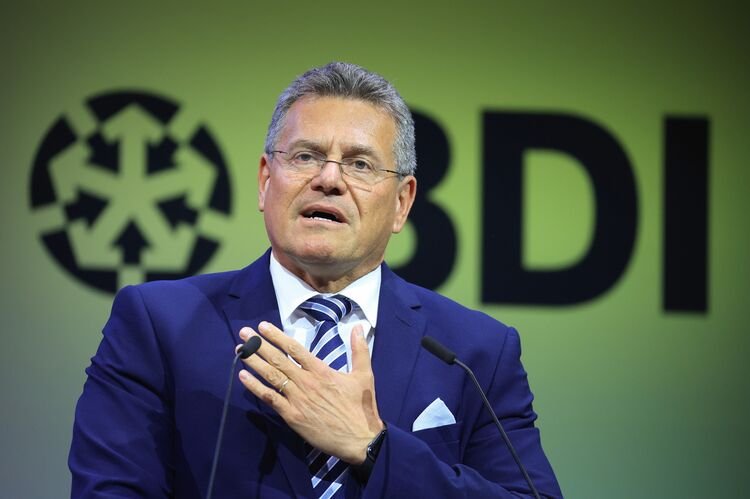
The proposals came to light just before EU Trade Commissioner Maros Sefcovic arrives in Beijing this week for two days of talks with Chinese officials to get a sense of where things stand ahead of the upcoming European Council meeting.
China is on a week-long holiday and its Ministry of Foreign Affairs didn’t immediately respond to a request for comment outside business hours.
What Bloomberg Economics Says...
“Cheap Chinese imports are becoming a bigger headache for the EU. They may be helping contain consumer price increases, but Brussels fears they could also damage key European industries.”
— Antonio Barroso. For full analysis, click here
Beijing has repeatedly threatened to retaliate if the EU introduces new trade tools or discriminatory restrictions targeting Chinese companies or products. The Chinese Ministry of Commerce warned last week that fresh tariffs on the country’s goods could undermine trade negotiations with the bloc, vowing to “respond resolutely” to protect the interests of Chinese industries.
Tensions have flared ahead of the talks, with risks on the rise that the standoff could escalate into a full-blown trade war. Beijing on Saturday began an anti-dumping investigation into European exports of a chemical used for pesticides, pharmaceuticals and dyes, citing the EU’s recent probes into Chinese chemical products.
German Chancellor Friedrich Merz said the proposal was devised in Berlin and Paris as the bloc is being “massively affected” by unfair trade practices — and the commission needs better tools.
“We want to enable the European Commission to act quickly when necessary,” Merz told reporters in Berlin. “The drawback of European trade policy in recent years has always been that decision-making took too long.”
German officials, speaking anonymously in line with government protocol, said the market-access tool should be seen as a second strike weapon in an all-out trade war with a country like China. It could be deployed, for instance, if China blocked all exports of rare earth materials, which the EU relies on to build modern technologies.
“The European Union is faced with unprecedented challenges,” the Franco-German letter says, arguing that countries are weaponizing trade and distorting markets. “We need urgent action to address these threats, to diversify and to derisk.”
In addition to the new tools, Germany and France are urging the EU to act more aggressively by investigating whether entire sectors, such as chemicals, plastics and hybrid cars, are facing unfair competition from heavily subsidized imports. Such probes could result in new tariffs.
Currently, similar EU investigations tend to focus on specific products, not entire sectors.
“The EU has been slow to react in trade issues — and China is clearly a major consideration — but I think Europe is more vulnerable than China at the moment,” said Nick Twidale, chief market analyst at AT Global Markets in Sydney. “If China were to retaliate with a rare earth export ban, this may hurt Europe more.”
Read More: Can Anything Slow China’s Export Juggernaut?
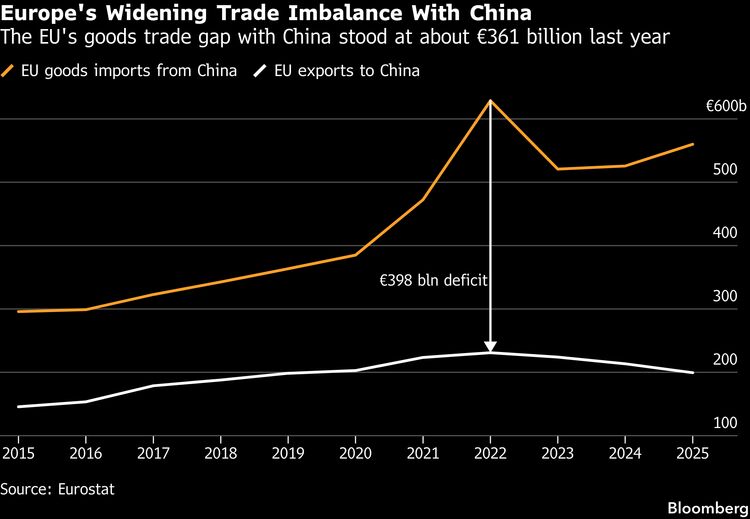
EU leaders directed the commission in June to reengage with Beijing over the bloc’s trade deficit with China, which reached €360.6 billion ($404 billion) last year and continued to widen in the first half of 2026.
In response, Sefcovic launched a new series of talks with Beijing, starting with Chinese Commerce Minister Wang Wentao’s visit to Brussels in June. At that meeting, the two sides set an October deadline to make progress on trade disagreements, from growing imbalances and Chinese export controls to intellectual property rights.
In parallel, EU policymakers in Brussels are also exploring possible new trade measures to let the EU react more swiftly and with greater force to countries undermining trade relationships. They are also looking at measures to encourage supply chain diversification.
“Some elements of the rhetoric and posture from the EU side are probably attempts to strengthening bargaining positions,” said Homin Lee, a strategist at Lombard Odier in Singapore. “The actual trajectory of the bilateral trade relations need to be closely monitored for better calibration of what’s actually going to happen.”