Latin American currencies posted some of the biggest gains on Monday, with the Brazilian real spearheading the advance after right-wing candidate Flávio Bolsonaro surged to a surprise lead in the first round of the presidential election.
The real soared as much as 5%, trading at its strongest levels since May, as investors jumped to price in a change of government in the Oct. 25 runoff against Luiz Inácio Lula da Silva. Swap rate contracts tumbled more than 130 basis points and the nation’s benchmark Ibovespa stock gauge jumped the most since 2020, closing 7.7% higher.
Read more: Brazil Assets Surge as Investor Favorite Bolsonaro Leads in Race ·
Among Brazil’s regional peers, the Chilean peso leaped by the most since April, rising 1.8% on the back of renewed dollar sales by the government. The Colombian peso jumped almost 2%, the second best performance in emerging markets, while the Mexican peso also advanced. Latin America currencies drove an index of emerging-market currencies up 0.4% in the day, its biggest jump in almost two weeks.
“We have been bullish BRL going into the election not because we expected this result, but because we found the balance of risks asymmetric towards a strong BRL given very attractive valuations,” said Alvaro Vivanco, a strategist at Wells Fargo Securities LLC. “High carry, commodity exposure and now a clearer policy path are likely to bring significant inflows.”
Strategists at UBS Group AG, including Alejo Czerwonko and Luciano Telo, said a “deeper and durable fiscal adjustment” is the base case following the first-round results.
“An increased likelihood of a change in government, together with the composition of the new congress, raises the probability of a credible fiscal anchor,” UBS strategists wrote in a note.
Read more: Euro Hits 17-Month Low on Region’s Fiscal, Political Risks
Meanwhile, currencies in Central and Eastern Europe were leading losses amid rising concerns over the region’s public finances that sent the euro to its weakest level since May 2025.
Equity Gains
MSCI Inc.’s gauge for developing-market equities climbed 1.8% on Monday, the most on a closing basis since August. Technology was by far the biggest contributor to gains on the equities index on Monday, with heavyweight Taiwan Semiconductor Manufacturing Co. jumping 3% on optimism that a discussion between the chip giant and Elon Musk’s Terafab will lead to a potential collaboration.
“We remain tactically bullish on emerging markets’ equities and hard currency bonds as the region is well-positioned to benefit from the ongoing global capex boom,” said Homin Lee, a strategist at Lombard Odier in Singapore.
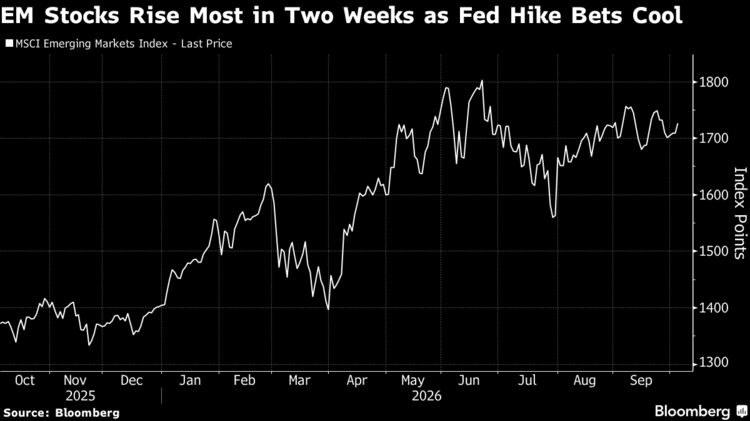
However, the rise in developed-market bond yields is a headwind for emerging-market assets broadly, according to Rajeev De Mello, a global macro portfolio manager at Gama Asset Management SA. He sees more volatility ahead for equities this quarter, although he maintains a constructive view and tips technology and semiconductors in particular. Such stocks linked to the AI investment cycle, are “an important counterweight to higher yields.”
“I would favor the more technology-heavy North Asian markets, particularly Taiwan and Korea, where companies have direct exposure to the continued expansion in AI-related investment,” said De Mello. “Higher global yields are likely to create turbulence for EM equities, but as long as the AI capital-expenditure cycle remains strong, I would expect the technology-led markets to remain relatively resilient.”