
On Sept. 18, Tether gathered more than a hundred people for a black-tie soiree in Charlotte, North Carolina. The guests had come to celebrate the imminent opening of the stablecoin giant’s US headquarters in the Queen City. Among those attending was White House crypto adviser Patrick Witt, according to two people in attendance, who asked not to be identified discussing the closed-door event. Cantor Fitzgerald Chairman Brandon Lutnick was also there, one of the people said.
As attendees dined on brisket, Tether Chief Executive Officer Paolo Ardoino gave a speech about the company’s wide-ranging investments and its mission to expand financial inclusion, one of the people said.

Some ten days later, Democratic staff of the US Senate’s Permanent Subcommittee on Investigations presented a sharply different picture of the company’s activities. Iran had leaned heavily on Tether’s stablecoin USDT to evade sanctions and finance regional proxies including Hezbollah, the subcommittee said in a report . Of 846 cryptocurrency wallets sanctioned or targeted for seizure over ties to Iran and its proxies, 84% had transacted exclusively, or nearly exclusively, in USDT, according to the report. It also drew attention to the “undue leniency” shown to crypto firms by President Donald Trump’s White House.
Tether is “taking advantage of the permissive environment that the Trump Administration has created,” Senator Richard Blumenthal said in an interview. “Tether is one entity that deserves very serious and penetrating scrutiny and investigation.”
The report felt “like a political attack” on the crypto industry, Ardoino said in an interview. He said the numbers cited in the report are incorrect and don’t account for all the funds frozen by Tether. The company works with law enforcement agencies in 70 countries, including the National Bureau for Counter Terror Financing of Israel, he added. “What matters is that now we have stronger relationships,” he said.
A Cantor Fitzgerald spokesperson declined to comment. Witt did not respond to requests for comment. The White House has repeatedly framed its crypto policies as aimed at promoting US financial innovation and securing the country’s advantage over China.
The whiplash between the Senate report and the celebratory gathering underscores how Tether’s standing in Washington remains closely tied to the party in power. Just a few days before the soiree, the Senate had failed to advance the Clarity Act, legislation that would have put broader digital-asset market rules into statute. No Democrats voted to advance the bill, with tougher ethics provisions on elected officials’ crypto holdings emerging as a key sticking point after Trump earlier reported $1.4 billion in crypto earnings for 2025.
Congress has already enacted a federal framework for stablecoins under the Genius Act. But broader crypto market rules remain unsettled. US regulators have pushed ahead with policies of their own, leaving parts of the industry’s new operating environment more vulnerable to a change in administration.

El Salvador-based Tether, the world’s largest stablecoin issuer, is especially exposed to that dynamic. Before Trump’s return to the White House, the company had paid $41 million to settle US allegations that it made untrue or misleading statements about the reserves backing its stablecoin and later largely eschewed the country. That all changed after the US elections in 2024.
Emboldened by a crypto-friendly administration and support from Commerce Secretary Howard Lutnick, whose former firm Cantor Fitzgerald is an investor in Tether, Ardoino made his first visit to the US early last year. The company began ramping up its lobbying efforts. In January, it launched USA₮, a US stablecoin issued by Anchorage Digital Bank under the new federal framework, from a base in Charlotte under the leadership of former White House crypto official Bo Hines.
Read More: Tether’s $193 Billion Stockpile Fuels Doomsday Investing Spree
More broadly, dollar-linked stablecoins have been embraced by the Trump administration as a means to promote the greenback globally and create demand for US debt. Stablecoins, a type of cryptocurrency typically pegged to a traditional asset like the US dollar, are backed by reserves of cash-like assets such as US Treasury bills.
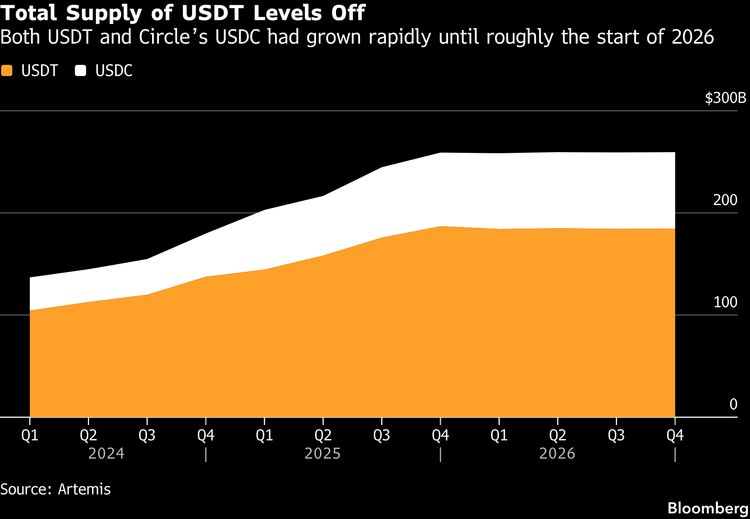
As of September, Tether owned about $134 billion of Treasuries and reverse repurchase agreements collateralized by US government debt. Treasury Secretary Scott Bessent has said the stablecoin market could swell tenfold by the end of the decade to $3 trillion, though it has more or less plateaued over the past year. The administration is considering an initiative to boost the use of stablecoins overseas , in a bid to reinforce the dollar’s status and boost demand for Treasuries.
The crypto industry “continues to have significant pockets of support in this administration and Congress, with this support seemingly unswayed by any unsavory aspects related to illicit transactions or regulatory noncompliance,” said Eswar Prasad, senior professor of international trade policy at Cornell University.
The bigger impact may come down the line, according to Max Meizlish, a research fellow at the Foundation for Defense of Democracies. The report “reads like a warning shot that, under a different administration, Treasury could someday determine Tether is a financial institution of primary money laundering concern,” he said. “Tether needs to be doing more.”
With midterm elections looming in November, that longer-term impact may soon come into view. Polls show Republicans losing ground amid voter discontent over the economy and the war in Iran, with Democrats increasingly hopeful of retaking the House and possibly the Senate.
The Iran report “might be a warning, I don’t know,” said Ardoino. “But I think it was very poorly constructed,” he said, noting that Tether hadn’t seen the findings until they were made public.
Unlike decentralized cryptocurrencies such as Bitcoin, Tether can blacklist specific addresses and prevent USDT held there from moving, making the speed and scope of its freezes central to the dispute.
For its part, Tether has been at pains to showcase its efforts. On Sept. 28, within hours of the Senate report’s publication, the company published a blog post highlighting its role in freezing roughly $550 million of Iran-linked USDT so far in 2026. Much of the money was tied by the Office of Foreign Assets Control to the Central Bank of Iran.
Tether says its cooperation with law enforcement has contributed to the freezing of about $5 billion in assets linked to illicit activity globally. The company has become considerably more interventionist in the past few years, with freezing activity picking up roughly 500% since 2024, according to BlockSec data .
Ardoino said this is partly the result of authorities around the world improving their crypto tracing capabilities.
“We have become better, as law enforcement has become better,” he said.
Blumenthal meanwhile outlined the Senate report’s findings in letters sent to Bessent and Attorney General Todd Blanche, calling for Tether’s anti-money laundering and sanctions compliance programs to be probed.
It is doing “nowhere near enough” currently, Blumenthal said.