Maharashtra, India’s wealthiest state, will cut water supplies to homes by at least 10% after a powerful El Niño left the country with its weakest monsoon in more than a decade.
The state government has ordered local authorities, including in India’s financial capital of Mumbai, to curb water consumption from Oct. 16 and impose deeper cuts if needed to ensure supplies last through August next year, the Water Resources Department said in a statement on Monday.
After drinking water and industrial demand, the western Indian state will prioritize supplies for fodder and seed-production programs. For the upcoming winter planting season, authorities have been instructed to favor food crops that require less water and produce higher fodder yields. Factories have been ordered to recycle at least 30% of their water use.
Maharashtra’s water stress carries wider implications for India’s economy. The state accounts for about 14% of national output and is home to some of the country’s biggest companies, including Reliance Industries Ltd., Tata Group and Mahindra & Mahindra, as well as some of the nation’s biggest banks. It is also among top producers of sugar cane, wheat and cotton.
Dryness from a potentially record-breaking El Niño is straining economies across Asia. Wildfires have intensified in Indonesia, disrupting palm oil production and blanketing parts of the region in thick haze. The dry spell also threatens rice harvests throughout Southeast Asia, putting pressure on the region’s most important food staple.
In India, the water scarcity underscores the vulnerability of the continent’s third-largest economy to weather disruptions. Poor rainfall has depleted reservoirs, threatening crops from rice to sugar cane and soybeans, as well as hydropower generation. That’s raising the risks of further increases in food prices , which accelerated for a seventh straight month in August to the highest this year.
Read More: India’s Weak Monsoon Threatens Harvests, Spending and Growth
Emerging supply concerns have prompted the government to slash import taxes on edible oils and allow duty-free raw sugar purchases from overseas to curb domestic prices ahead of the festival season. Rising inflation could also push the central bank to raise policy rates for the first time in four years .
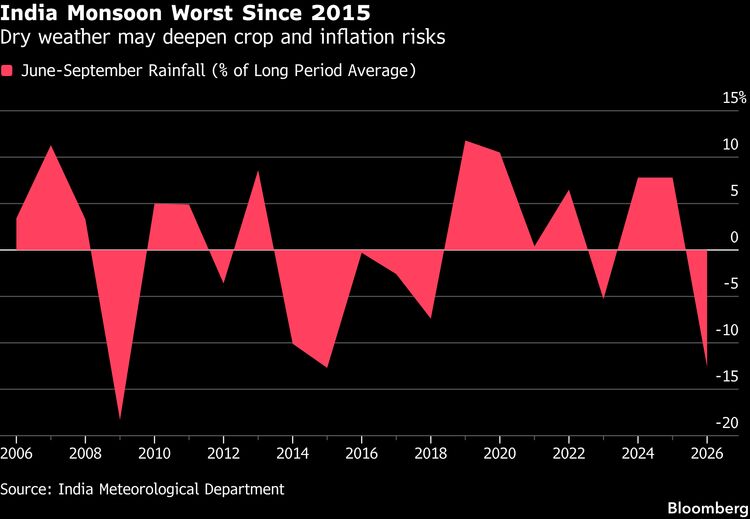
Rainfall during India’s June-September monsoon was 12.6% below the long-term average, the biggest shortfall since 2015. Precipitation is also forecast to be less than normal across most of the country during the three months through December, according to the India Meteorological Department.
Maharashtra has declared drought conditions in about three-quarters of its 358 sub-districts, and announced more than 67 billion rupees ($695 million) of relief measures, including restructuring farm loans and emergency funding for rural employment.
Neighboring Karnataka , home to the technology hub of Bengaluru, and Andhra Pradesh have also said many of their sub-districts are drought-affected .
Karnataka endured its second-worst monsoon in five decades, according to M.S. Divakara, director of the state’s natural disaster monitoring center. The state is India’s biggest producer of coffee and finger millet and one of the top maize growing regions. The drought will impact coffee plantations, Divakara said.