
UK Prime Minister Andy Burnham has demonstrated that he doesn’t lack ambition when it comes to the most intractable problems facing modern Britain. The question is whether he can turn that bold talk into real reforms.
Homelessness offers a good test. Here Burnham has given himself a more immediate deliverable: a promise to “ get everyone in for Christmas ,” backed by £442 million and a national summit on the topic. That’s a worthy aim — a winter on the street can mark a young person for life. At a Labour Party conference last week, Burnham repeated the pledge and promised the biggest council-house building program since the postwar boom.
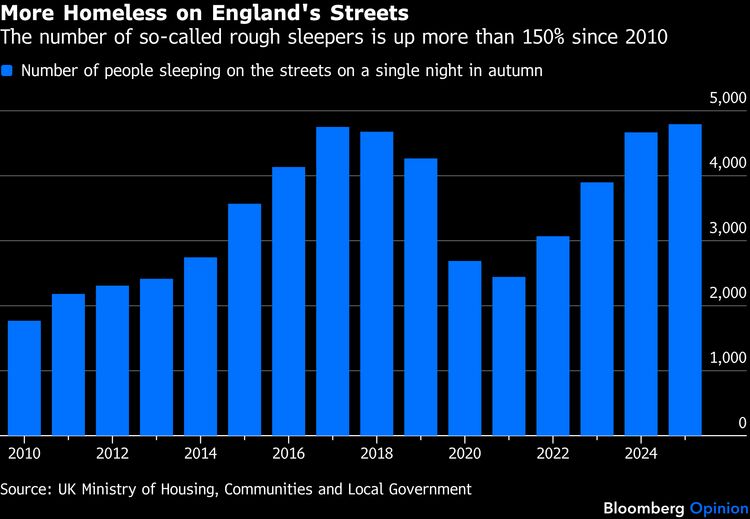
It’s also a promise Britain has heard before. Theresa May promised to end rough sleeping by 2027. Boris Johnson brought the deadline forward to 2024. Keir Starmer’s government launched a £3.5 billion national plan last December to end homelessness “for good.” Yet England hit a record high in its latest annual estimate, notching its fourth consecutive rise in rough sleeping.
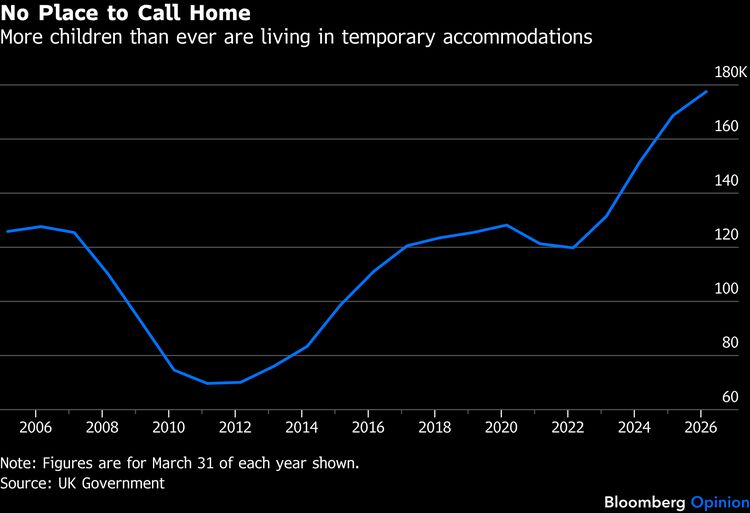
And that’s only the visible edge: 135,580 households and 177,530 children were in temporary accommodations at the end of March. Councils spent £2.8 billion in 2024-25 on temporary accommodations .
Burnham’s experience as mayor of Greater Manchester may prove to be an advantage. His “A Bed Every Night” policy was no winter gimmick. It lifted conditions for access while providing a consistent room each night and a caseworker to connect with services. Alongside other initiatives, it helped reduce homelessness by 53% between 2017 and 2020.
Since then, however, pressures have returned and the count has resumed rising. Getting people off the streets isn’t enough if more keep arriving or there’s a shortage of permanent homes.
Homelessness is, of course, a global problem. But while housing markets and institutions differ, some lessons bear emulating. One program in Scotland bypassed shelters for people with complex needs, and its Housing First Pathfinder moved them directly into permanent tenancies ; 80% were still there two years later. Houston not only focused on housing and support but also got more than 100 agencies that worked in silos to operate as one system, sharing data and reducing fragmentation.
Finland offers both a model and a warning: After a decade of decline, homelessness rose by 20% in 2025 as rising rents, unemployment and benefit cuts pulled support away.
So what should Burnham’s summit produce? The Labour Party deserves credit for long-overdue planning reform, but the country won’t be able to build its way out of today’s problem fast enough. Local authorities should be empowered to buy and convert existing buildings, release public land, and use modular homes where cost-effective. For the hardest cases, housing must come with treatment and support over time.
Second, the plan should aim to stop homelessness before it becomes entrenched. The most common routes into homelessness in England are a landlord’s notice, a relative’s spare bed being withdrawn or domestic abuse. For those on the edge, emergency cash, debt help and legal intervention can often prevent a slide into rough sleeping with all the mental illness and addiction risks it poses. Job support and skills training matter, too. And nobody leaving prison, hospital or care (or Home Office accommodation) should do so without having somewhere safe to stay.
Finally, coordination matters. Councils, the National Health Service, prisons and charities should work together and share the information needed to identify those at risk and get them housed and supported. London’s so-called CHAIN system shows that person-level data can guide services; the next step is connecting that knowledge to housing availability across local authorities.
National leadership requires more than setting targets and a budget. Simply spending billions on temporary winter fixes — without addressing the underlying causes of homelessness — is unlikely to ever fix the problem. Although Burnham’s Christmas drive matters for those it brings indoors, it should be judged as a start. The harder test comes later: In the next homelessness survey, are there fewer people in the doorways or merely different ones?
More From Bloomberg Opinion:
- Labour Angst Over Migrants and Welfare Will Test Burnham’s Backbone: Martin Ivens
- Trump Is Copying Putin’s Losing Playbook With Canada: Marc Champion
- Germany’s Far-Right ‘Firewall’ Is Confronting a Historic Threat: Katja Hoyer
Want more Bloomberg Opinion? OPIN <GO>. Web readers, click here . Or you can subscribe to our daily newsletter.