Boeing Co.’s Chief Executive Officer Kelly Ortberg must be pinching himself.
In the span of just a few days, the company’s beleaguered Starliner spacecraft was given new life by NASA, a software glitch casting a cloud over its 737 Max airliner was lifted , it reached a labor agreement with unionized engineers to avoid a painful strike, and its defense business got a shot in the arm with a more than $20 billion contract to build a stealth fighter jet for the US Navy.
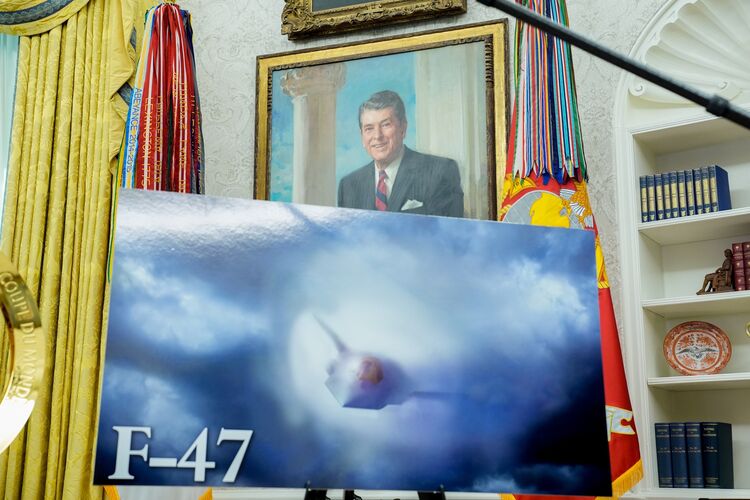
That’s an incredible run. The biggest feat, by far, was beating out rival Northrop Grumman Corp. for the Navy’s stealth fighter, which comes on the heels of it scooping up the contract for the Air Force’s F-47 stealth jet last year over Lockheed Martin Corp. The company, which had been locked out of the stealth platforms, now has two, turning the tables on its rivals. These have the potential to reverse the fortunes of Boeing’s troubled defense, space and security unit, driving earnings growth for decades to come.
There should be all kinds of design, engineering, supply-chain and production synergies between the two stealth programs. The downside is the tremendous pressure Boeing now faces to ramp up those capabilities while keeping costs down and meeting production deadlines, something the unit has struggled with in the past. The buzzword around Boeing must now be execution: These wins will be meaningless if it can’t drive the projects across the finish line on schedule and at or under budget.
The Department of Defense has given Boeing the opportunity to prove that its troubles, including the contract to build a new Air Force One presidential aircraft that turned into a money pit, are behind it. A lot can go wrong with these new contracts as investors have learned painfully from past programs, including the T-7A Red Hawk training aircraft, the MQ-25 pilotless, air-refueling plane and the KC-46 air-refueling tanker aircraft. Those programs had fixed-price contracts that resulted in Boeing losing money after the company ran over schedule and costs ended up much higher than expected.
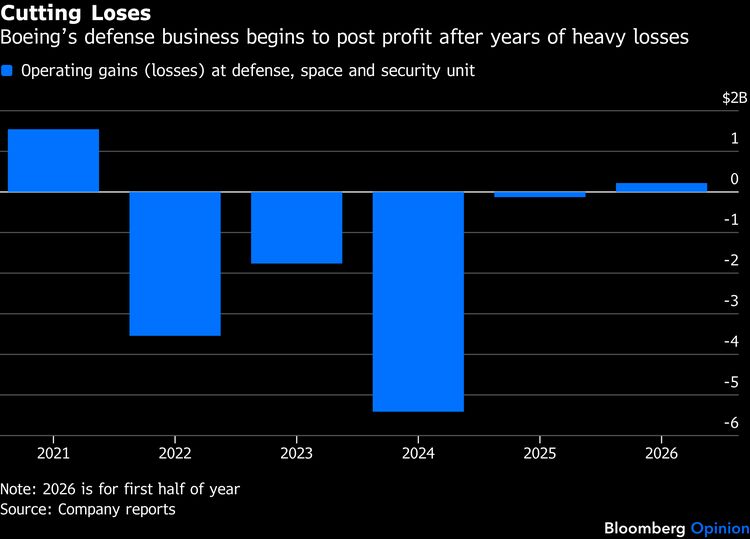
Boeing’s defense, space and security unit piled up operating losses of almost $11 billion from 2022 through 2025 after periodic write downs on its different programs. The unit stopped the bleeding in the first half of this year and eked out an operating gain of $218 million. A lot of the credit for this goes to Ortberg, who took over as CEO in August 2024 and went to work changing the company’s manufacturing culture, improving its supply chain and negotiating smarter contracts.
Ortberg has vowed to steer away from fixed-price agreements. The details of the contract for the Navy’s fighter aren’t available yet, but it’s likely to be similar to the F-47, which is a cost-plus deal , with incentives and fees to keep the work from ballooning out of control both on cost and time. The company will have to marshal its resources to ensure work on these two key defense programs goes smoothly. This is why finding agreement last week with Boeing’s unionized engineers and technical workers was so important, after an earlier offer was voted down.
Starliner also contributed to the losses at the defense unit. The spacecraft was already behind schedule and over budget when it encountered engine problems while carrying two astronauts Butch Wilmore and Suni Williams to the International Space Station. NASA decided not to risk returning the two astronauts home on Starliner, and their planned eight-day trip in space devolved into a nine-month odyssey. Insult was added to injury when NASA decided to bring the two astronauts home on Dragon, the spacecraft built by rival Space Exploration Technologies Corp.
NASA last week threw the embattled Starliner a lifeline by agreeing to use the spacecraft to fly an uncrewed mission to the ISS as early as December, and then operate as many as five crewed missions beginning in 2028. The spacecraft will need to be certified to fly on the new Vulcan Centaur rocket built by United Launch Alliance , which is a Boeing-Lockheed joint venture.
This is good news for Boeing’s space program, although it’s likely to continue to struggle. Ortberg should either spin out or sell this business. Times have changed radically since legacy space companies such as Boeing sent astronauts to the moon and dominated a market based mostly on NASA and defense department contracts. Legacy space companies are now falling hopelessly behind competitors, led by SpaceX, as the market turns to more commercial launches and satellite networks.
Boeing investors and its airline customers will also be celebrating the Federal Aviation Administration’s determination on Oct. 2 that a software glitch on the 737 Max aircraft isn’t a safety issue. This means that certification of the 737 Max-10, the largest version of this plane, won’t be delayed much if at all, and that the Max-7, which just gained certification, can continue to be delivered.
The past week brought a bounty of good news for Boeing; Ortberg must now execute in a fashion that translates to long-term success.
More From Bloomberg Opinion:
- Musk Is Trying To Bully Delta . He Has a Point: Thomas Black
- SpaceX Is a Huge Threat to Earth-Bound Rivals, Too: Chris Hughes
- To Understand US Economy, Board an Airplane : Allison Schrager
Want more Bloomberg Opinion? OPIN <GO>. Or you can subscribe to our daily newsletter .