US stocks touched session lows as investors weigh renewed energy-supply risks, hawkish comments from a Federal Reserve official and lingering worries about the artificial-intelligence trade.
The S&P 500 Index fell 0.4% as of 11:39 a.m. in New York, while the Nasdaq 100 declined 0.6% . The 10-year Treasury yield rose to 5.3%, pressuring rate-sensitive sectors. The Cboe Volatility Index hovered near 15.55 .
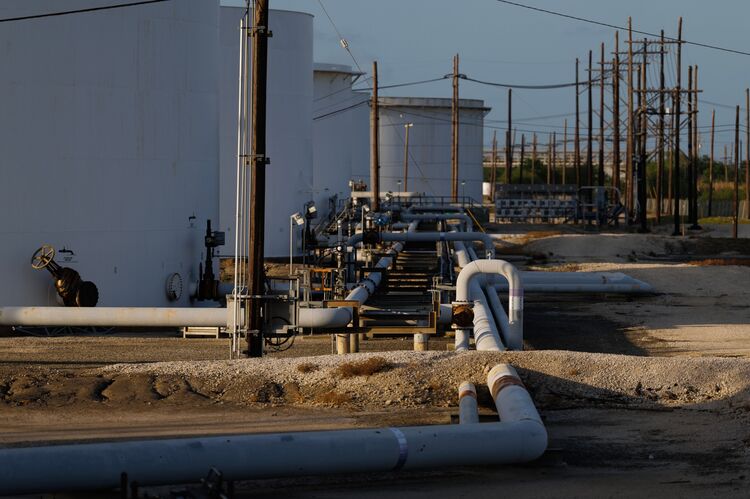
Oil advanced after a report that the White House asked the Pentagon to prepare potential strike options against Iran that could be carried out before the midterm elections. Hurricane Isaias is also developing in the Gulf, adding to concerns around energy supply.
Fed Governor Christopher Waller said additional rate increases will probably be necessary to bring inflation under control, while noting policymakers have flexibility over when to act and don’t necessarily need to raise rates at consecutive meetings.
Artificial-intelligence regulation, along with government spending on healthcare and defense, is emerging as equity investors’ chief points of focus as the final month of the US midterm campaign kicks into high gear.
Unease about the upcoming elections is swaying the market, according to Manulife John Hancock Investments strategist Matt Miskin. He notes that banks and industrials, which are sectors that “typically do better under Republican policies,” have recently weakened. That may signal the market is “pricing in a bit more of a blue wave.”
Banks are also under pressure from credit-card, auto loan and mortgage rates that are all near 20-year highs, he said. Lenders can benefit as “higher yields can lead to better revenues, but they can also lead to a tipping point where consumers just can’t pay these kinds of loans,” he said.
AI remains central to the outlook for the US earnings season. Deutsche Bank strategists expect third-quarter earnings growth to remain at a historically elevated 34% year-on-year pace, with AI-driven demand helping sustain earnings growth of about 54% for megacap technology companies.
A larger share of US companies is also expected to surpass third-quarter earnings estimates than in the prior quarter, according to Citigroup strategists Richard Schlatter and David Chew. Their model projects 66% of Russell 1000 companies will beat estimates, compared with just over 60% in the second quarter. Technology is expected to notch the most earnings beats.
Globally, the reaction to AI-related results is mixed. Samsung’s record preliminary quarterly results failed to satisfy the most bullish expectations, while TSMC delivered 51% sales growth. The contrast comes as investors prepare for a US earnings season in which AI spending and demand are expected to remain dominant themes.
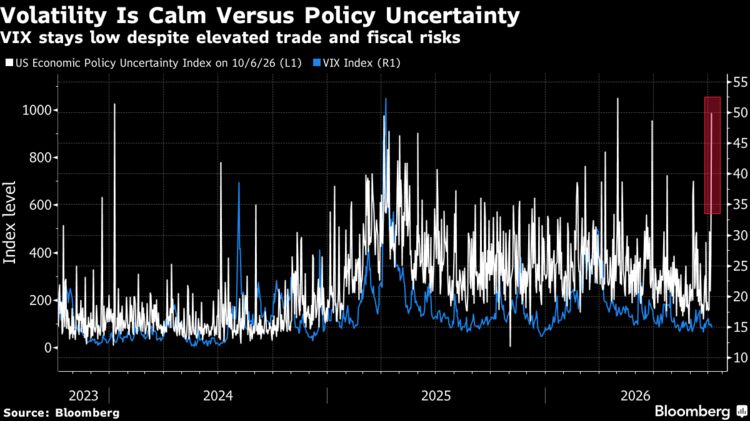
The backdrop for policy has become increasingly uncertain. An index tracking US economic policy uncertainty has posted one of its sharpest increases in three years, even as market volatility remains relatively muted.
In corporate news, Broadcom Inc. is already considering another large-scale transaction after launching $60 billion of debt financing to support Anthropic PBC’s AI build-out. And SK Hynix Inc.’s Solidigm has selected lead banks for a planned US initial public offering next year, according to people familiar with the matter.
Retail stocks are in focus Thursday after PepsiCo Inc. cut · its profit forecast, saying its recovery in North America is taking longer than anticipated. And denim company Levi Strauss & Co. posted · the slowest growth in its direct-to-consumer channels since late 2022 — in part due to a marketing misstep — while raising its full-year earnings outlook.
Chipotle Mexican Grill Inc. shares jumped 6% after the Financial Times reported that Starbucks Corp. has worked with advisers in recent months on a takeover proposal for the burrito chain. Palantir Technologies Inc. gained 2.5% after Goldman Sachs upgraded the stock to buy from neutral, citing its underperformance this year.
Sectors in Focus
- Watch US insurers, utilities and home-improvement retailers as Hurricane Isaias develops and the storm moves toward the Gulf Coast. Oil and gas producers are shutting wells and evacuating personnel along the storm’s projected path.
- Data-center companies · are also in focus after a sharp drop in demand for an Nvidia-backed data-center operator’s IPO exposed new vulnerabilities in the AI financing boom. A planned $5.5 billion listing for Australia’s Firmus Grid Ltd. is under pressure after the offering failed to attract sufficient investor support at the marketed A$11 share price, according to people familiar with the matter.
- Watch bank stocks as Goldman Sachs and Wells Fargo were rated buys by a TD Cowen analyst, while Morgan Stanley was rated a hold on valuation.