European Commission finance chief Valdis Dombrovskis urged euro-area member states to observe budgetary restraint, pushing back against a proposal from Italy and Greece to introduce additional leeway.
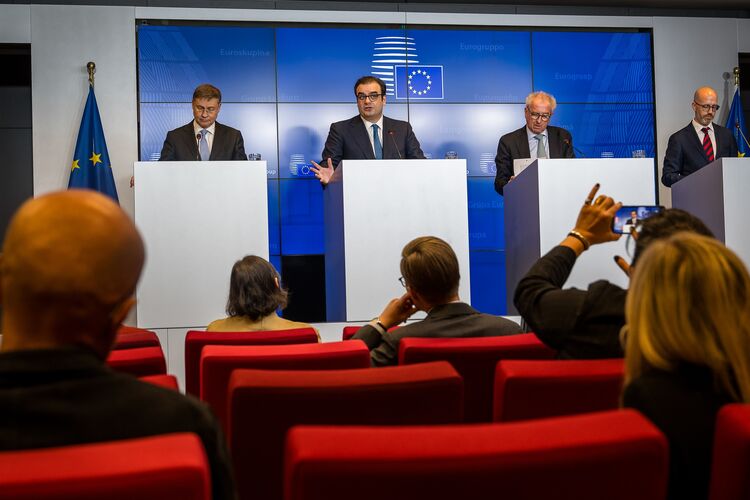
“What I am emphasizing is the need for fiscal prudence, especially in the light of current bond market developments,” he said after a meeting of the region’s finance ministers in Luxembourg. “We cannot come with new fiscal flexibilities all the time.”
Still, Dombrovskis said that he “will have a deeper look at the suggestions of Italy and Greece.”
The discussion comes as euro-area governments face a sharp rise in borrowing costs, with the selloff initially centered on France · increasingly spilling into other sovereign markets.
The extra yield demanded by investors to hold French 10-year bonds compared with those of Germany recently hit its highest since 2011. The bonds of other indebted European nations including Italy, Greece and Belgium have also come under pressure.
“We have confidence in France’s commitment vis-a-vis sound public finances, and I have personally a lot of confidence in my good colleague Roland Lescure,” Eurogroup President Kyriakos Pierrakakis said.
The turmoil has sharpened concerns about governments’ ability to respond to the energy shock with additional spending. The surge in energy costs is already feeding through to consumer prices, with euro-area inflation accelerating to 3.8% in September, the highest in three years.
That combination is creating increasingly difficult policy trade-offs for European governments. Measures to cushion households and companies from higher energy costs are increasing deficit levels while inflation is keeping interest rates elevated and investors are demanding a larger premium to finance heavily indebted countries.
“We have elevated energy prices, high energy prices, rising inflation on the one hand, but we have also pressures and challenges in the bond market on the other,” said Pierrakakis. “The two key words here are protect and preserve: we need to protect households, we need to protect businesses, we need to protect every European experiencing the costs of the energy shock.”
The official, who also is Greece’s finance minister, added that “at the same time, we need to preserve the fiscal credibility of our fiscal freedom.”
The European Commission, the EU’s executive arm, is pressing governments to restrain spending. EU officials have repeatedly told national capitals to only introduce targeted and temporary support measures for companies and households, and in recent days they warned against some governments’ calls for more national spending that could breach EU deficit and debt limits.
EU rules already provide governments with some room to absorb the energy shock. The Commission gave additional leeway this year originally designed to accommodate higher defense expenditure to cover qualifying energy-security measures through 2028.
Italy and Greece have sought additional budget flexibility from Brussels, while France has instead emphasized the need to restore its public finances as investors scrutinize its ability to stabilize a debt burden approaching 120% of economic output. But some member states are wary of further attempts to weaken the EU’s budgetary constraints.
“I don’t think it is a good idea that we create national escape clauses for cases and crises like these,” said Belgian Deputy Prime Minister Vincent Van Peteghem, arguing instead for temporary measures to face the high energy prices driven by the supply shock.