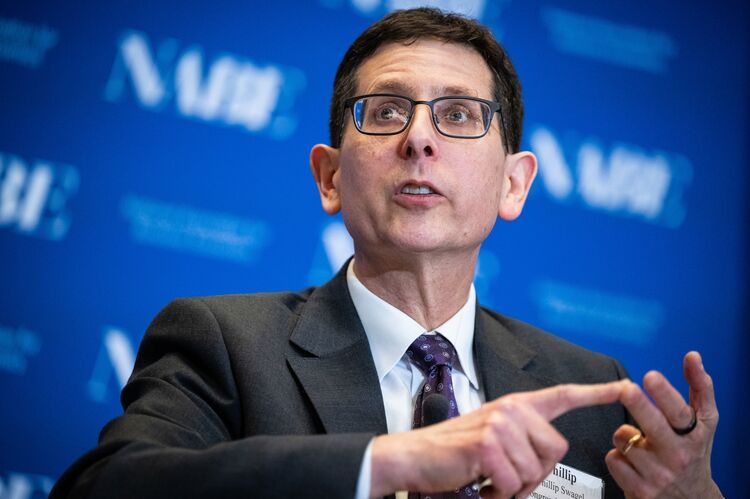
Congressional Budget Office Director Phillip Swagel warned the idea of embracing faster economic growth as the solution for reining in the US federal debt — one being championed by Treasury Secretary Scott Bessent — is unlikely to work.
“Growth will help, but it’s probably not plausible that growth alone will stabilize our fiscal trajectory,” Swagel said at a Minneapolis event Thursday.
Swagel, a US Treasury official during the George W. Bush administration, said the CBO is set to upgrade its growth forecast in its next set of projections, in January or February, incorporating effects from the artificial intelligence boom. But “the deficit is so wide that that alone won’t take care of it,” he said of stronger gross domestic product gains.
The US would need to grow at least 5% annually to stabilize the levels of federal debt, he said, assuming an interest-rate level of 4%. A 5% level of rates would need 6% GDP gains, after adjusting for inflation, he said. Currently, five-year US Treasury yields are just over 5%.
Nominal GDP, which is unadjusted for inflation, would need to have sustained increases of 7% to 8% “to keep the debt ratio stable,” Swagel said. “It’s pretty challenging.”
Economists surveyed by Bloomberg estimate the US to be on track for a 2.1% growth rate, adjusted for inflation, for 2026.
Earlier in the week, Bessent said that if the US sustained over 3% growth, the US would be able to bend the debt-to-GDP curve. That ratio is currently roughly 100%, with debt held by the public at $32.4 trillion.
The CBO in February this year projected the debt ratio will exceed its 1946 record of 106% in 2030.
Swagel, at Thursday’s event at the Federal Reserve Bank of Minneapolis, said the US is now running “a structural deficit of 6% of GDP.” This year’s ratio is forecast at roughly that rate — a historically high figure for a period of low unemployment and solid economic growth.
An increase in interest rates has propelled the government’s debt-servicing costs, but Bessent has argued that borrowing costs will drop once the Iran conflict subsides and energy prices tumble.
Swagel said the scale of borrowing is putting some pressure on interest rates, though the impact is “small.”
“Somehow we’re managing, even with interest rates going up,” he said of the elevated borrowing levels. But he did warn that if there was a “negative shock” leading to even higher rates, there could be a broader challenge.
“It’s almost like a like a turbocharger,” he said of that scenario. The shock of higher rates “feeds into the deficit, feeds into the debt, feeds back into interest rates to the economy.”