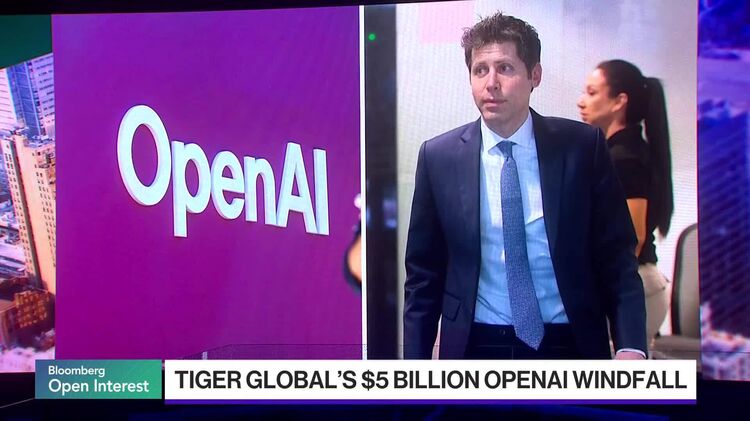
A year before OpenAI released ChatGPT to the public, Sam Altman called Tiger Global Management founder Chase Coleman with a pitch: become one of the few institutional investors in his startup at a $15.7 billion valuation.
Altman, OpenAI’s co-founder and chief executive officer, was building something big.
Five years later, OpenAI is in talks to raise $30 billion at a $1.4 trillion valuation, and Tiger is poised for a paper profit of $5 billion, making it one of the firm’s biggest wins since its founding a quarter-century ago, according to people familiar with the matter.
Most other major investors caught wind of OpenAI’s potential later, after the viral release of ChatGPT in 2022, which helped kick off the current AI arms race.
Tiger Global agreed to invest $150 million in 2021 and has added to its stake multiple times since then, the people said. The investment firm won’t be able to fully exit and realize gains until OpenAI’s initial public offering, which Altman has delayed at least until next year.
So far, the early bet has boosted Tiger Global’s hedge fund and public-private crossover fund, which gained 9.4% and 19.3%, respectively, through the first nine months of this year, the people said.
The latest vintage of the firm’s venture capital fund counts OpenAI as one of its biggest holdings. The fund has a gross internal rate of return of 65% as of June 30, and a net IRR of 44% after fees, they said, asking not to be identified discussing confidential details.
Representatives for Tiger Global and OpenAI declined to comment.
The winning wager represents a redemption of sorts for Tiger Global, which was stung in 2022 by a tech-stock rout and venture markdowns as rising interest rates crushed startups. The firm’s assets plunged to $50 billion from $100 billion.
Losses across Tiger Global’s multiple funds resulted in an executive shakeup and prompted the firm to return to its roots: making smaller, more concentrated wagers, with Coleman taking greater charge of illiquid bets.
As part of that push, he has been more hands-on with the firm’s latest venture fund, Private Investment Partners 16. At $2.2 billion, the fund is the firm’s smallest in about a decade. In addition to OpenAI, it also has stakes in Anthropic PBC, Waymo and AI startup Temporal Technologies Inc., people said.
Tiger Global, which now manages about $60 billion, was also the first hedge fund to back OpenAI. Some VCs like Khosla Ventures invested in 2019, while others like Y Combinator, and billionaires Reid Hoffman and Peter Thiel got in even earlier, around 2015, according to data provider PitchBook.
The OpenAI investment ranks among Tiger Global’s most successful bets over the years. Its early investment in JD.com in 2010 resulted in a profit of more than $6.5 billion, while a 2009 wager on Flipkart led to a $3.5 billion gain.
Coleman founded New York-based Tiger Global in 2001. He’s one of several so-called tiger cubs, which refers to alumni of Julian Robertson’s Tiger Management who went on to start their own hedge funds.