By Leonardo Lara | Updated on Oct 07, 2026 at 08:44 PM
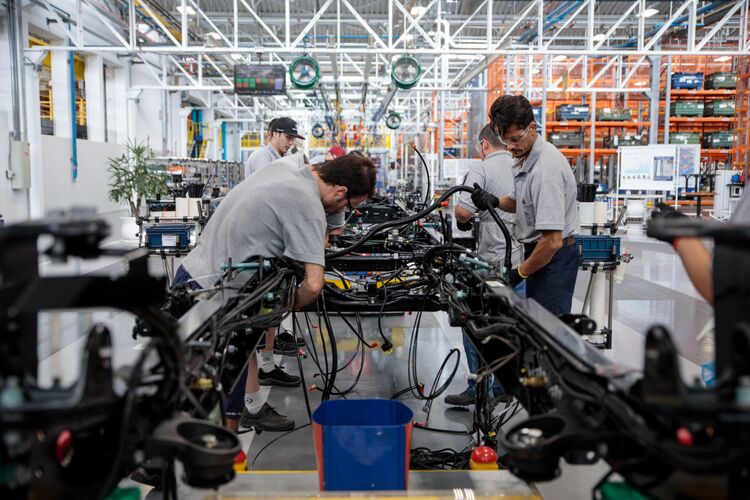
Brazil’s rising imports of vehicles partially assembled in China could eventually put thousands of auto-industry jobs at risk in the South American country, the head of Stellantis NV’s business in the region said.
Chinese automakers such as BYD Co. and Great Wall Motor Co. have gained traction in the Brazilian market with imports of knock-down kits, industry parlance for autos partially built in one country that are shipped to another nation for final assembly and sale. Those vehicles require a fraction of the labor to be completed in destination countries compared to traditional assembly lines that build cars from scratch.
Stellantis would need only 10% of its roughly 35,000 workers in South America if the automaker were to adopt a knock-down kit strategy, Herlander Zola, Stellantis’ president for South America, told reporters Tuesday in São Paulo.
“If this model really starts shifting” to favor imports of partially built vehicles, “that is the part of the business chain that is at risk,” Zola said.
Chinese auto brands accounted for about 17% of new-car sales in Brazil through the first nine months of 2026, including a 25% share in September alone, according to Zola. That’s a rapid gain from roughly 9% for all of last year.
“No one could have predicted this kind of acceleration,” Zola said.
China’s BYD, Geely Automobile Holdings Ltd. and others do business in the country, with some promising local production. BYD, for example, plans to begin making some of its models by the end of this year at the plant it is building on the site of the former Ford Motor Co. facility in Bahia state.
Zola said Stellantis could import knock-down vehicles itself if needed to be competitive, potentially by tapping its partnerships with Chinese automakers Leapmotor and Dongfeng.
“We have a completely open range of options to adapt to whatever is most suitable and competitive, given the developments expected in Brazil, Argentina, and other markets,” he said.
The global expansion of Chinese automakers has sparked debate in auto-producing nations about whether steps should be taken to protect domestic manufacturers.
Opposition candidate to Brazil’s presidency Flávio Bolsonaro has not laid out a detailed auto-industry policy during his campaign. He held a narrow lead over incumbent President Luiz Inácio Lula da Silva during the first round of the country’s elections, with a runoff scheduled for Oct. 25.
In 2024, Lula implemented a green mobility and innovation program which included sustainability requirements and tax incentives for companies that invest in decarbonization and the production of new technologies.
The Brazilian government’s 35% tariff on imported electric vehicles is not enough to ensure that carmakers invest in domestic auto production, Zola said. He also said a lack of rules mandating purchases from domestic suppliers risks putting Brazil’s automotive supply chain at a disadvantage against importers.
“Which Chinese brand utilizes Brazil’s industrial base, supplier network and automotive supply chain?” he said. “As of today, none of the Chinese companies established here do, including those that have already started production.”
Zola said that the Brazilian government should define a clear industrial model to support domestic industry, potentially involving new import barriers and incentives for local manufacturing.
“The automotive supply chain as a whole will need to adapt to the predictability that will soon emerge once there is greater clarity regarding the incoming government, regardless of whether it is right-wing or left-wing,” he said.