The European Union is striking a more assertive approach to China as it heads into two days of negotiations in Beijing aimed at avoiding an economically damaging trade war.
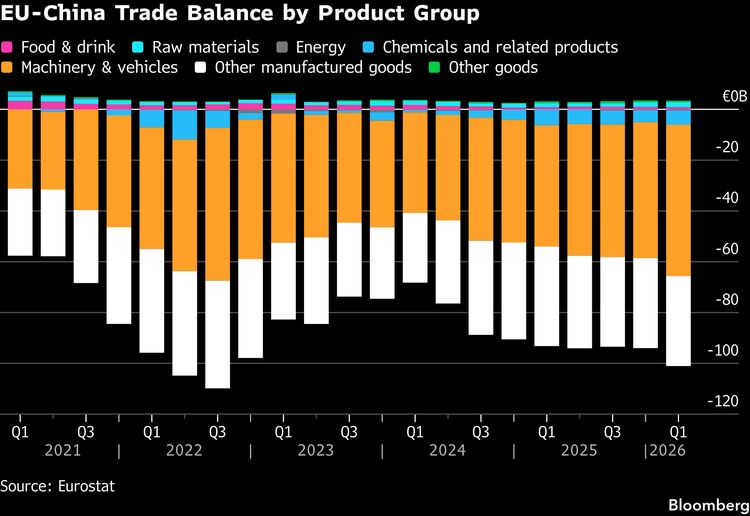
The EU’s trade chief, Maros Sefcovic, will meet with Chinese Commerce Minister Wang Wentao this week to address a trade deficit that exceeds $1 billion a day. The meeting comes as the EU prepares so-called safeguard measures · that would limit imports of Chinese hybrid vehicles – a move that may be seen as an escalation.
Germany and France this week called on the EU to adopt stronger tools — including an instrument that could cut off China from the bloc’s massive single market — in order to defend European sectors that have fallen prey to surging Chinese imports. But the EU wants to moderate its action to try to avoid retaliation from Beijing.
“It represents a significant change of approach from the European Commission side in the EU-China trade talks,” said Alicia García Herrero, a senior fellow at Bruegel , a think tank in Brussels, referring to the possible safeguard measures. “Beijing would respond if Europe takes this step.”

Weak consumption at home has left China increasingly reliant on manufacturing and overseas demand to support its sluggish economy. But its dominance of critical rare earth supplies — leverage it’s already wielded in trade negotiations with the US — gives Beijing a powerful card of its own as Europe simultaneously tries to curb Chinese imports and secure the materials its factories need.
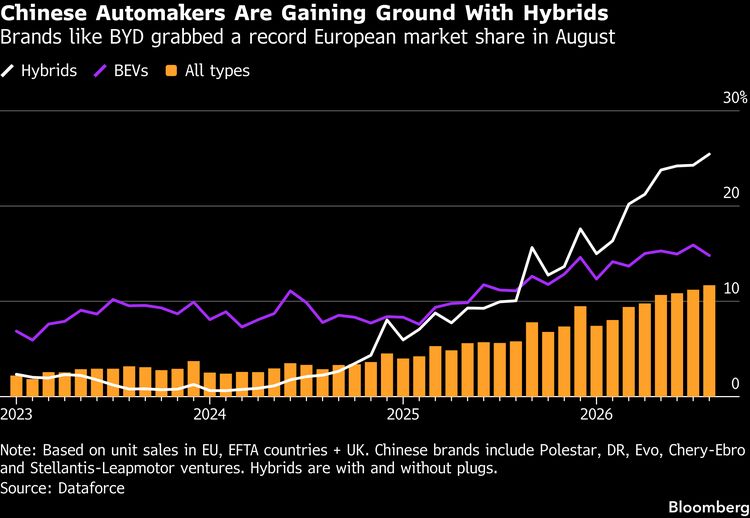
For now, Brussels is pressing ahead. The commission is preparing safeguards · to limit imports of Chinese hybrid cars after their sales surged in Europe, Bloomberg reported earlier. The restrictions could include a time-limited tariff-rate quota, which would levy imports above a certain volume. Chinese-made cars accounted for about a quarter of hybrid sales in Europe in August, even as growth in Chinese electric-vehicle imports has slowed after the EU imposed steep tariffs.
Read More: Europe’s Making Fewer Cars and Lots of Them Are Actually Chinese
The European and Chinese auto industries have been closely intertwined for decades. The likes of Volkswagen AG and Mercedes-Benz Group AG long dominated the market in China with their efficient combustion-engine models. Then fast-moving local upstarts led by BYD Co. and Geely Automobile Holdings Ltd. took over by aggressively expanding into electric vehicles.
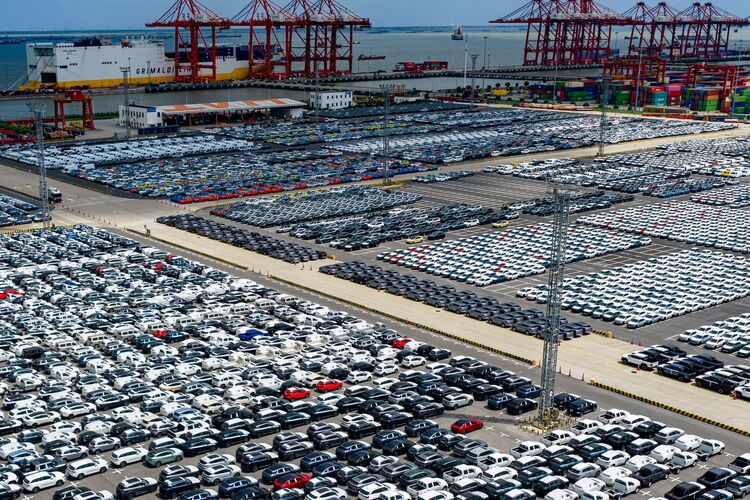
The push has led to significant overcapacity and prompted a near-ruinous price competition in China. In a bid to sidestep that, the country’s automakers are now shipping a growing number of vehicles overseas — shut out of the lucrative US market, much of their expansion has targeted Europe.
The outcome of this week’s talks is expected to feed into a key summit in Brussels next week, when EU leaders will weigh whether to adopt a more forceful response to the surge in Chinese exports — and the threat they pose to European manufacturing industries and millions of jobs across the bloc.
Already, the EU’s two biggest economies have presented a rare united front in calling for tougher measures to rebalance trade with Beijing. In a joint paper sent Monday to European Commission President Ursula von der Leyen, France and Germany proposed new powers that could sever China or other countries from the EU market in the event of a trade war.
The move prompted a thinly veiled warning from Beijing in the middle of a week-long national holiday. The Chinese Commerce Ministry on Tuesday urged France and Germany to “refrain from pushing the EU to resort to protectionist tools” and to “avoid taking the wrong path through the wrong means and ultimately backfiring on themselves.”
And in a comment on Wednesday, Yuyuantantian — a social-media account linked to China’s state broadcaster and frequently used to signal official policy thinking — said the proposal adds further complication at the outset of the talks. “If continuously pushed forward, it will not only further narrow the space for resolving issues through dialogue, but also damage the negotiation outcomes already achieved by both sides,” it said in an article .
Foreign Minister Wang Yi will also host a new round of talks with the French president’s diplomatic adviser, Emmanuel Bonne, during his trip to China on Oct. 9-13. China expects the meetings with Bonne, who last visited Beijing a year ago, to help strengthen coordination with France, Foreign Ministry spokeswoman Mao Ning said at a regular briefing on Thursday.
Guo couldn’t confirm or deny a report in the South China Morning Post that German President Frank-Walter Steinmeier is planning to visit China in the coming weeks.
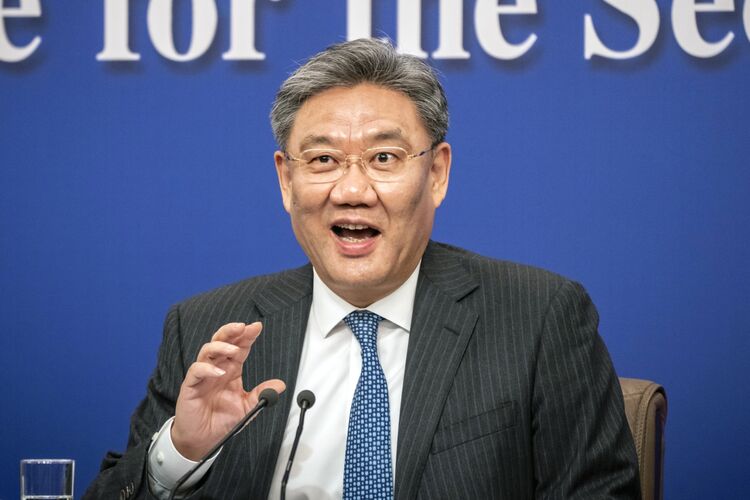
When Sefcovic and Wang last met in June in Brussels, the EU set an October deadline to make progress on trade disagreements and deliver what the bloc’s trade chief called “tangible results.”
But some European officials are pessimistic that the latest meeting can resolve core disputes over overcapacity, market access and export control, though it’s possible both sides could make more minor concessions to keep the dialog going, according to officials familiar with the matter.
“Beijing’s incentive is to buy time, not to change its growth model,” said Sari Arho Havren, an associate fellow at the Royal United Services Institute who specializes in China’s foreign policy. “Deterrence depends on Beijing believing that Europe would pull the trigger, and Europe’s record on that is very poor.”
The EU’s anti-coercion instrument — which would allow the bloc to deploy an array of measures in response to coercive trade tactics — took about two years to enter into force since its initial proposal. The instrument has never been deployed since its creation.
Easing tensions between China and the US may also make it harder for the EU to act because Beijing is no longer grappling with a potential trade war on two fronts, said the officials who spoke on the condition of anonymity.
Chinese President Xi Jinping returned from a pageantry-filled state visit to Washington last month with an agreement to extend the US-China trade truce until January.
“Europe would need to be ready to absorb Chinese countermeasures, above all on rare earths,” said Arho Havren. “Without stockpiles and alternative supply, a kill switch is a threat Europe cannot afford.”
Beijing has repeatedly threatened to retaliate if the EU introduces new trade tools or discriminatory restrictions targeting Chinese companies or products. The latest warning came last week , after reports that some EU member states are pushing for a European version of the US’s Section 301 tool.
What Bloomberg Economics Says...
“An EU-China trade war would probably start small. The risk is that it wouldn’t stay that way.”
— Antonio Barroso and Adam Farrar. For full analysis, click here
Wang Yiwei, a professor of international relations at Renmin University and a former Chinese diplomat in Europe, viewed the European moves as a tactic to apply pressure outside the negotiation table and raise its asking price.
But China takes a clear, tough stance and has ample means to respond, he said, ranging from anti-discrimination investigations, industrial and supply chain security investigations, to probes into the impact of foreign subsidies.
The tit-for-tat has already started. Over the weekend, Beijing began an anti-dumping investigation into European exports of a chemical used for pesticides, pharmaceuticals and dyes, citing the EU’s recent probes into Chinese chemical products.
“Is the EU just like the US — does it have to fight a proper trade war with China before it recognizes China’s real strength and starts negotiating with China in good faith?” Wang said.