By Tony Capaccio | Updated on Oct 09, 2026 at 12:00 PM
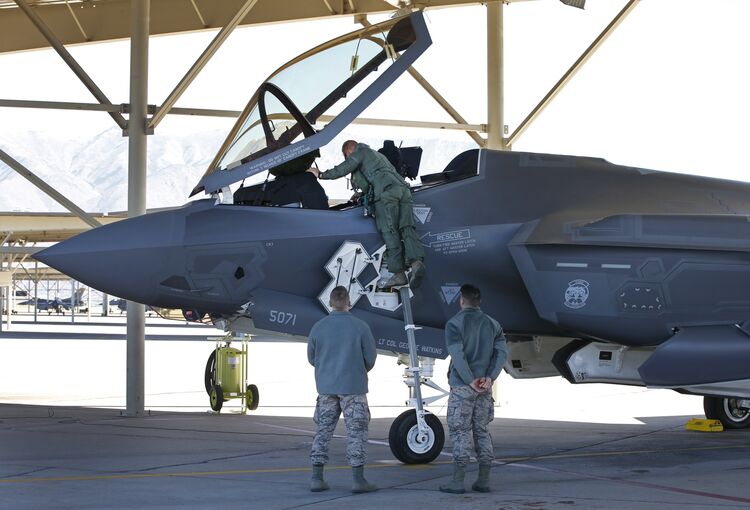
The US defense industry’s use of commercial freight companies is facing scrutiny after a shipment diverted to Hong Kong by United Parcel Service Inc. resulted in potentially sensitive F-35 stealth jet parts falling into the hands of the Chinese government.
The wayward shipment — which should not have transited through the jurisdiction of a US adversary — took place in May. US officials are now investigating the incident, which has proven to be an embarrassment for the Department of Defense and F-35 developer Lockheed Martin Corp. Lawmakers are also probing how China got a hold of the parts and are pushing for a review of the Pentagon’s oversight of the complicated global supply chain for US armaments.
The Pentagon is used to moving big things around the world. The Defense Logistics Agency — which buys, stores and ships parts for the military — and US Transportation Command have tens of thousands of personnel dedicated to that task.
But the various contractors that supply the US military and its allies can’t exactly load up a C-17 cargo plane every time spare parts or repairs are needed. Private shippers offer an efficient and cost-effective way to get equipment around the world.
While not all spare parts are cutting-edge military technology, there are regulations in place that are meant to ensure sensitive shipments do not pass through unfriendly countries. About 85% of small parcel packages of US military parts are shipped via commercial air, according to US Transcom.
UPS was tasked with shipping an F-35 cockpit canopy and weapons-bay door from Australia to the US for inspection, possible repair or disposal, according to people briefed on the incident.
The components were being transported for Lockheed Martin. They were coated with radar-absorbing material that enhances their stealth capabilities, two of the people said. The parts were originally meant to travel to San Francisco via South Korea and Taiwan, both of which are US defense partners. After leaving Australia later than intended, they were first flown on a UPS flight to Seoul. But an employee of the shipping firm then put the cargo on a plane transiting through Hong Kong, hoping to speed up delivery, according to a person briefed on the incident.
The person said a UPS worker missed an email from logistics firm DSV A/S, working on behalf of Lockheed Martin, specifying the shipment must not transit through Hong Kong in order to comply with the US International Traffic in Arms Regulations. The ITAR rules are meant to keep sensitive US weapons technology from falling into the hands of adversaries.
While the F-35 parts were in Hong Kong, the Chinese government took possession of them, two people briefed on the matter said. It’s yet to return them to the US, despite the Pentagon’s requests, and China has publicly denied knowledge of the incident. The seizure happened to be disclosed on the eve of Chinese President Xi Jinping’s formal state visit to Washington in late September, though both sides downplayed the incident.
Read More: F-35 Parts Seized on UPS Path to US That Often Stops in China
The F-35 stealth fighter is the world’s most advanced warplane and the most expensive weapons development program in US history. China has for years targeted the aircraft in espionage efforts.
The F-35 has been operational since 2015 and the US has restricted sales to its closest partners and allies. It’s a widely used technology among those friendly nations: 19 countries have purchased the jet to date, including South Korea, Japan, Singapore and Australia. So far, about 1,375 F-35s have been delivered to the US and its allies. Australia has more than 70 of these jets, and is also a hub for F-35 parts and maintenance in Asia.
The fear that China could learn valuable intelligence about the F-35 was one reason a US bid to sell the plane to the United Arab Emirates, announced in President Donald Trump’s first term, later collapsed. Members of Congress have also raised concerns that the current Trump administration’s plans to sell the F-35 to Saudi Arabia risks exposing cutting-edge US military technology to Beijing.
The Pentagon and Lockheed Martin have downplayed the sensitivity of the canopy and weapons-bay door seized by China. Both said the parts were “unserviceable,” while Lockheed said the components were “deemed low risk for exploitation.”
But others disagree, arguing that China’s physical access to the components could help it understand how the US’s closely guarded stealth tech works.
“There’s a lot of technology built into the canopy,” said Diana Maurer, a director at the US Government Accountability Office who follows F-35 supply chain issues. “It’s not good the Chinese now have one,” she added. “I’m sure the Chinese celebrated and then they got busy trying to reverse engineer it and figure out how to counter it with their own technical capabilities.”
The F-35’s global sustainment program and spare parts pool is mostly overseen by Lockheed Martin, the jet’s developer and one of the largest US defense firms. It uses private shipping providers to transport parts.
In a statement about the shipment that went to Hong Kong, the company said “our logistics decisions are not made unilaterally” because “the US government designates the approved transportation options and we select the carrier that best aligns with those government-mandated parameters.”
Commercial shippers must also adhere to strict federal export control laws. That includes the ITAR rules outlined in the email missed by the UPS employee. There are also Commerce Department Export Administration Regulations and the Pentagon’s Defense Federal Acquisition Regulations.
The Defense Department has publicly distanced itself from any responsibility for the errant shipment. Transcom said in a statement that “it was not involved in the transportation or coordination of the shipment in question,” while the Defense Logistics Agency said it “has no statutory or regulatory oversight authority over prime contractor internal shipping protocols.”
The Pentagon said it’s working with US authorities and industry partners to “retrieve these components, investigate the incident, and place safeguards to avoid a future occurrence.”
In the meantime, the armed services committees of both the House of Representatives and the Senate are investigating, as is the State Department’s arms export compliance agency. Republican Senator Tom Cotton of Arkansas, chairman of the Senate Intelligence Committee, has called for a review of the global supply chain, while other lawmakers have also demanded more information.