If America sold tap water the way it sells, say, eggs or gasoline, with the price right there in your face every time you consume it, then our national argument about inflation might have looked much different over the past decade.
That’s because tap water isn’t free, though it might seem that way whenever you drink it at a restaurant, flush a toilet or run a lawn sprinkler. In fact, the price of tap water soared more than that of eggs between 2015 and 2025, with the wet stuff up 62% and the, uh, eggy stuff up just 28%, according to a report from the nonprofit advocacy group Food and Water Watch.
We ran a whole US election about the searing outrage of egg prices just a couple of years ago, when they were $3.60 a dozen, costing an average three-person US household maybe $240 a year. In no state was tap water that cheap last year, according to the report, which sifted through the bills of the 500 biggest community systems, serving 155 million total customers. The average US water bill last year was $531 for 60,000 gallons, enough money to make a lot of omelets.
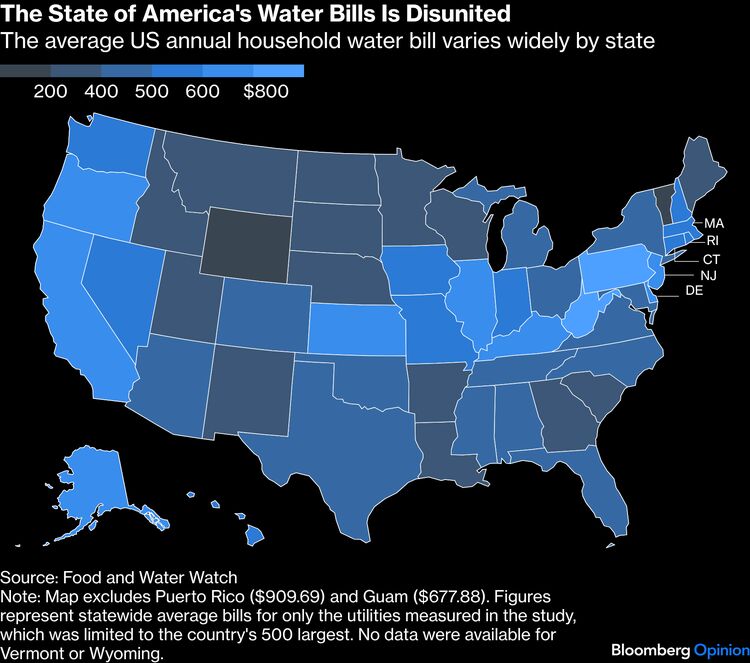
The country’s cheapest annual water bills were in Idaho, at an average of $285.61 a year. The most expensive were in West Virginia, at $1,382.27 a year. Do those price gaps make any sense? No, they don’t, which gets at large and growing problems with pricing an increasingly precious commodity in this country.
Read More: Rising Water Bills Have Added to the Squeeze on US Households
With reservoirs and groundwater disappearing because of a heating planet and demand surging from farms, industries, data centers and more, water has understandably been called the new gold . But the difference between water and gold is that you don’t need gold to survive. Reliable access to safe drinking water is a human right, and it’s inhumane to charge so much for it that people can’t afford it, as already happens in the US. At the same time, if we don’t price water to reflect its increasing scarcity and importance, then we will run out of it even more quickly.
Some of the country’s high water bills do make sense from a certain perspective. Of the 25 most expensive providers, more than half were in California, where the average water bill was $693 last year. California bills increased 83% over the past decade, outpacing the rest of the country. This is unfair to low-income Californians, most of whom are unable to afford their tap water, by the report’s measure. But you could argue California’s water should be more expensive, given how much of it comes from the Colorado River, which has lost 20% of its flow this century.
Then again, six of the 10 most expensive average water bills in the US were in West Virginia and Pennsylvania, places not exactly famous for decades-long water shortages. All six of those bills came from private companies rather than local governments. In fact, the average bill from a for-profit private water system in the US was $823 last year, compared with $494.05 for public utilities, a 67% increase based on nothing but who’s selling. In some states, that premium is even higher. Private water companies in Illinois and Indiana, for example, charge nearly double the rates of public providers.
Even in these places, there may be some justification for higher water bills, given the massive and expensive need for infrastructure maintenance and repair alone. Nearly 20% of all the water pumped by utilities leaks from pipes before it ever reaches anybody’s home, costing those providers more than $6 billion a year, according to the water-research firm Bluefield Research. When the water does get delivered, household leaks shed another 900 billion gallons every year, according to the Environmental Protection Agency, enough to serve at least 11 million homes.
Meanwhile, dollars for water-infrastructure repair are drying up as quickly as the Colorado, Bluefield notes. Trump’s latest federal government budget calls for slashing funding from an already paltry $23 billion in the 2026 fiscal year to $8.6 billion in 2027. Such numbers do little to fill a funding gap that will yawn to $2.1 trillion across the next quarter-century, according to the American Water Works Association.
You can see the vicious cycle developing: Leaks cost utilities revenue, but without revenue, they can’t fix leaks. So the leaks get bigger and the revenue gets lower. Something’s got to give. And because water utilities don’t get money from taxes or fees like other public services, they can only raise revenue by raising customers’ bills.
And that burden is falling on the Americans who can least afford it. In Puerto Rico, where the average water bill is $909.69 a year, the lowest-earning households pay an unthinkable 20% of their incomes on water alone. In West Virginia, that number is 11%. An estimated 2.2 million Americans don’t have safe running water, according to the CDC Foundation, a nonprofit group. That’s 2.2 million too many.
One possible solution would be a federal water marketplace that sets prices based on need and ability to pay. Ideally, that means big tech companies building thirsty data centers and farmers growing alfalfa in the desert to export to Saudi Arabia (which outlawed growing alfalfa in 2018, to save water) paying their fair share. Given our current government, that’s not happening anytime soon.
Local governments have more leeway to manage their water systems, however. In 2023, the nonprofit US Water Alliance modeled adjusting water pricing to fit various household characteristics of customers of the Greater Cincinnati Water Works. It found that basing rates on property values cut water bills for most residents while raising them for the wealthiest, generating the fairest pricing of all methods.
This suggests most of us are subsidizing the water guzzling of the wealthiest Americans. One complication of tying water bills to property values is that it could be seen as a property tax, and those wealthy homeowners have the money to sway local politics against such a levy. It could become a hot-button political issue.
But that’s not necessarily a bad thing. Given how precious water is becoming, it’s certainly more useful to fight about that than the price of eggs.
More From Bloomberg Opinion:
- El Niño Is a Rehearsal for Rest of Our Lives: Mark Gongloff
- How an Island Drought Can Lift Sneaker Prices: David Fickling
- Heat Is Melting Our Grip on Climate Reality: Lara Williams
Want more Bloomberg Opinion? Terminal readers, head to OPIN <GO>. Or subscribe to our daily newsletter .