At a local real estate agency on London’s southeastern edge, manager Steve Brown has added a new, and rather unlikely, topic to the usual chatter with clients about house prices and commute times: swap rates.
That’s because there’s a growing disconnect between the interest rate set by the Bank of England and the level determined by swaps traders in markets. The BOE, which in theory sets borrowing costs for the broader UK economy, has held steady at 3.75% all year and yet swaps have surged, pushing average mortgage rates to around 6% in the process.

“It’s become a daily conversation for every estate agent in London,” said Brown, who runs Winkworth in Blackheath. “People aren’t necessarily worried about house prices, they just can’t afford the monthly payments.”
The shift shows how volatility in a relatively arcane financial market is spilling over into Britain’s economy. Homeownership remains a key national aspiration and a pillar of Prime Minister Andy Burnham’s growth agenda, but the affordability squeeze risks undermining efforts to help younger people onto the property ladder.
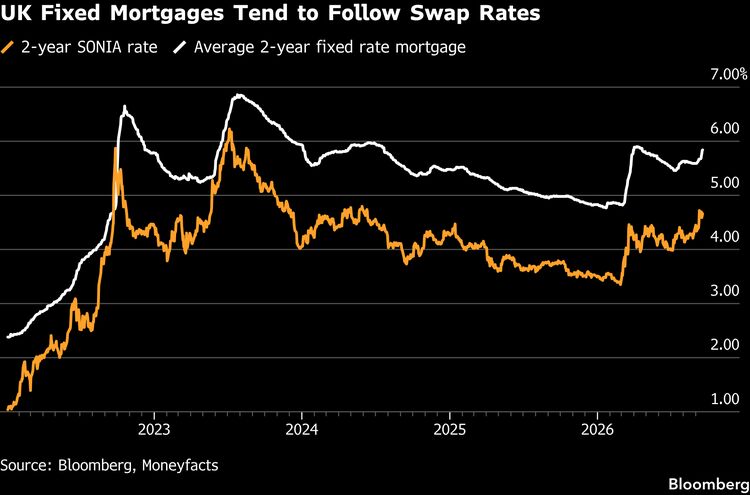
Swap rates are used by banks to hedge the risk that stems from lending fixed-rate mortgages while holding variable-rate deposits. They are also used by traders to speculate on the outlook for the BOE’s key rate.
The problem is expectations for the latter have been swinging wildly ever since the outbreak of war in the Middle East, as an increase in energy prices fueled inflation concerns. That has caused traders to go from betting on rate cuts to wagering on multiple hikes — all using swap rates.
Read more: Traders Are at Odds With ECB and BOE on Scale of Rate Hikes
There’s nearly $1 trillion turnover of over-the-counter sterling interest-rate derivatives each day, and the UK is the largest trading center globally, according to data from the Bank for International Settlements. But they have previously garnered little mainstream attention.
Housing Pain
The extra strain that the surging swaps rate is putting on a struggling housing scene is already evident. Buyer inquiries were 9% lower in September compared to last year, according to property portal Rightmove.
And supply is higher than usual as properties languish on the market. The number of homes on sale per UK estate agent is now 65, the highest for the time of year in over a decade, Rightmove said .
Mortgage demand has weakened too. The latest BOE data show that lender approvals for home buying fell to 54,900 in August, the fewest since June 2023.
“Higher rates mean lower affordability and fewer house purchases,” said Graham McClelland, chief executive officer at Gen H, a mortgage lender.
Read more: How to Navigate a Treacherous UK Housing Market: Money Distilled
It’s a growing problem for Burnham, ahead of his government’s first budget this month, as he seeks to bring down the rising cost of living and persuade voters that his Labour party can be fiscally responsible. Many are still scarred by a spike in mortgage rates after former prime minister Liz Truss’ budgetary plans in 2022.
Most UK borrowers get mortgages at a fixed rate for just two or five years. By comparison, 30-year fixed mortgages dominate in the US, while the French and Germans typically fix loans for more than 10 years.
So UK homeowners are vulnerable to swings in interest rates because they have to remortgage more regularly, and the unique importance of swaps in pricing loans means a spike feeds through quickly.
“We’re fairly unique globally in that exposure to swap-rate volatility,” said McClelland.
That sensitivity has been especially painful this year, as swaps became more volatile. BOE Governor Andrew Bailey noted a more than one percentage-point rise in mortgage rates since the end of February as “a substantial tightening of monetary conditions.”
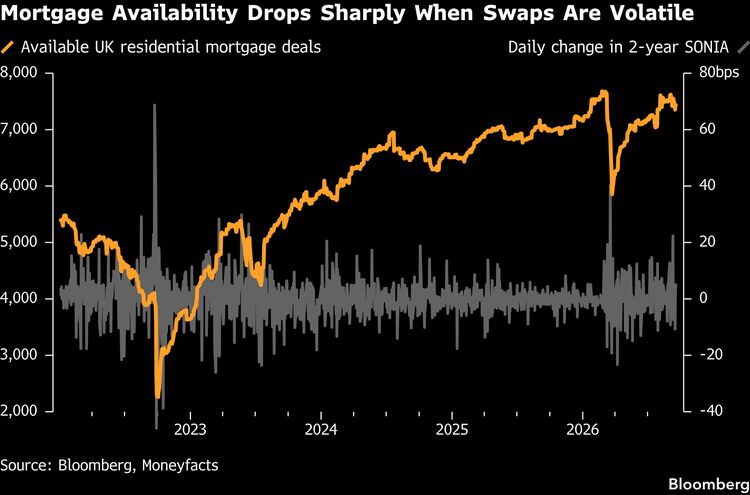
Since the start of the US-Iran war, lenders have been repricing faster to avoid being caught offering the cheapest mortgage on the market when swap rates rise.
“It’s often the first thing you check in the morning and the last thing you check at night,” said Chris Sykes, a director at the broker MSP Financial Solutions. “You can almost tell what Donald Trump has tweeted because of how swaps have moved.”
Doom Loop
This year’s volatility has been persistent. Since the US-Iran conflict started, the median rise on up days has been around 5 basis points, compared with about 3.5 basis points since the start of 2022. On roughly a quarter of those days, the increase has been at least 10 basis points.
Such moves are leading lenders to preventatively hike their rates to avoid having to go back into the market to hedge more when swaps have risen. When volatility is incredibly high, some pull offers altogether.
“We used to say that the bigger lenders would take longer to respond — we described them as oil tankers,” said Ben Merritt, head of mortgage trading for the UK subsidiary of Banco Santander SA. “I feel like I’m now operating in a market of speedboats.”
It all creates further uncertainty for home buyers, making for something of a doom loop. For Winkworth’s Brown, it’s meant “some really difficult conversations” with both vendors and would-be owners — and constant scrutiny of the swaps market.
“I don’t remember a time ever like this that it was jumping around so much,” he said.