Turbulence across Europe’s bonds is sparking debate over the tools policymakers use to keep markets functioning in the event of a broader financial crisis.
Some analysts are honing in on the European Central Bank’s repo program, where banks receive cash in exchange for collateral. While not conceived as a crisis mechanism, it’s treated as an important source of liquidity should conditions tighten further.
But use of the so-called Main Refinancing Operations has been limited: it’s cheaper for banks to get funds in the market. While there’s still ample liquidity, analysts say there would be a stigma around tapping the facility because it can be seen as a sign of distress.
“I have never met a bank treasury that said stigma is not an issue,” said Rohan Khanna, head of European rates strategy at Barclays Plc.
Read more: France Turmoil Threatens to Drag ECB Into Bond Market Showdown
The ECB has been encouraging financial institutions to regularly tap such short-term funding as part of their liquidity management . Market analysts suggest the ECB should follow the Bank of England by making funding costs more attractive, which would help to reduce the stigma.
Just this week, banks tapped the BOE’s Short-Term Repo for a near-record £132 billion ($175 billion), more than eight times the €18 billion ($20 billion) borrowed from the equivalent one-week euro-area program.
“That’s where the euro zone can also learn from the UK,” said Eddie Gerba, a visiting senior fellow at the London School of Economics, who has previously done research for the BOE and advised the ECB. “There’s lessons to be learned about how can it deepen the repo market and how it increases its importance in the banking sector’s short term funding.”
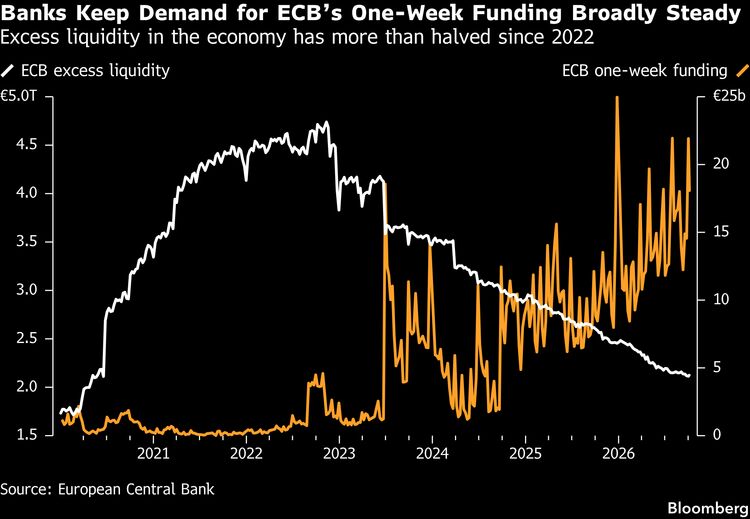
The issue is coming to the fore as the euro area’s excess reserves have declined toward €2 trillion from a peak above €4.5 trillion four years ago. That’s helped drive an increase in euro-area repo rates to their highest since March 2025.
RBC Capital Markets said repo rates could rise further due to heavy bond issuance from governments, singling out France’s record funding plan for 2027. The nation’s political and fiscal issues are leading to the risk of contagion in the region, and RBC pointed to an “unusually sharp move” in European repo markets at the end of last month as an “ominous signal” of tighter liquidity.
Andrea Appeddu, director of research at Citigroup Inc, said so far demand for cash at the MRO is insufficient to make up for falling excess liquidity.
Read more: France’s Bond Crisis Deepens as Investors Head for the Exit
Repo programs are not the only mechanism that can help the functioning of markets should conditions deteriorate. The ECB can also buy bonds via its so-called Transmission Protection Instrument, or TPI, a completely separate tool. But that has yet to be activated after being created in 2022. France’s finance minister said the country is far from needing the ECB to step in .
The ECB and the BOE declined to comment.
Who Is It?
The concern among treasurers is not that the ECB identifies individual borrowers — it doesn’t. But it publishes Eurosystem borrowing data at the national level. If borrowing suddenly rises in one country, traders and bankers could quickly start trying to work out which institution is responsible — leading to the potential for the market to bet against it.
“If that one country’s number goes up, then the rumor mill starts: Who is it? Who is it? Who is it?” said Barclays’ Khanna. “And then it goes downhill from there.”
If lenders continue to avoid this funding, more demand will remain in private repo markets, potentially pushing up secured borrowing costs and making liquidity conditions less predictable.
“It may be signaling that the transition point at which reserves cease to be ‘in excess’ is approaching sooner than the market currently prices,” RBC strategists including Peter Schaffrik said. “Spread products and rate structures sensitive to liquidity dynamics merit close attention in the months ahead.”
Job for Successor
That creates an awkward dynamic for the ECB. The central bank will want banks to become more comfortable using its regular refinancing operations, yet bankers say little has been done to reduce the perceived reputational cost of doing so.
With ECB President Christine Lagarde’s term up next year, UBS Group AG’s Reinout De Bock expects her successor to be “on top of this” with more communication.
“The ECB would love to see more participation in its short term operations,” said Christoph Rieger, head of rates and credit research at Commerzbank AG. He said the ECB would need to lower the cost of accessing its funds to more closely align rates with those currently available in money markets.
For Pooja Kumra at TD Securities, the ECB should make the facility more attractive given the recent volatility in the market.
“Broader financial tightening may require a more forceful response from the ECB to help stabilize markets,” she said. “If there are risks linked to bank liquidity, the ECB could make these operations more accessible at a cheaper rate.”
Another potential option is to create a game-theory scenario in which every bank is required to use the facility at the same time, making it harder for markets to infer which institution is under stress and avoiding any witch hunts.
“The ECB has put many of the right elements in place, but normalization requires not only a change in communication and pricing but also repeated use by a sufficiently broad range of banks,” said Ivan Sangiorgi, associate professor of finance at the ICMA Centre in the University of Reading’s Henley Business School.