Asset-backed commercial paper, blamed for amplifying the 2008 financial crisis, is making a comeback as banks turn to the short-term funding market to do more business with less strain on their balance sheet.
Once a way for Wall Street to finance everything from mortgage lending to complex structured credit products, it has largely evolved into a tool for banks to manage balance-sheet constraints, industry watchers say, helping them meet liquidity buffer requirements and fund client positions without tying up as much of their own capital. ABCP outstanding has surged to more than half a trillion dollars, according to the latest data from the Federal Reserve. While that’s still less than half its pre-crisis peak, it’s twice the size it was just five years ago.
The market essentially works like this: banks looking to finance assets or client activity without consuming as much balance-sheet capacity can turn to a third party that operates a so-called ABCP conduit. The conduit raises short-term cash from money-market funds and other investors, then uses the proceeds to enter into repo, total-return swap and other financing transactions with banks. That allows banks to obtain funding or get economic exposure to the assets without having to finance or own them outright.
“It’s balance-sheet efficiency for mostly financial institutions,” said Jerry Marlatt, a partner at law firm Mayer Brown who focuses on structured finance. “It’s a way for them to get relief that, if you will, reduces capital requirements by not consolidating commercial paper on their balance sheet as a liability.”
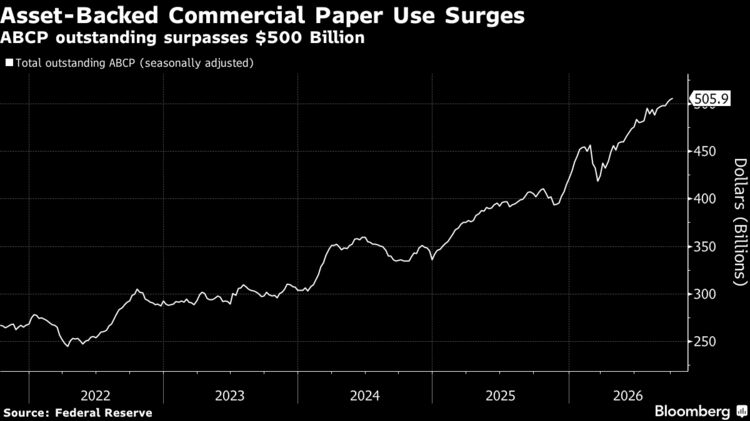
ABCP conduits were originally used to finance assets such as auto loans and trade receivables, and still are. But in the lead-up to the crisis, they also expanded into subprime mortgage bonds and other securitized debt, helping swell the market to about $1.2 trillion.
As fears of a housing downturn spread in 2007, money funds and other investors stopped rolling the paper regardless of the assets in the conduits, eventually causing a run on the market .
“The run-up to global financial crisis had a lot of debt, especially in structured finance activity that was put into the market,” said Matthew Grimes, head of money-market research at Allspring Global Investments and a 35 year industry veteran. “That created a bubble and the bubble popped.”
After the crisis, the market shrank dramatically, falling to about $210 billion by 2015 as riskier conduits were unwound and new accounting and capital rules eroded the appeal for banks to keep assets off their balance sheets.
Nearwater, Guggenheim
But now the market is growing once again, thanks in part to those same rules. Tougher leverage and liquidity requirements have made it more expensive for banks to fund assets directly, driving demand for third-party conduits that can help access high quality assets and finance client positions with less strain on lenders’ books.
That demand has fueled the rise of so-called independent sponsors — non-bank firms that set up and operate conduits tailored to banks’ funding and balance-sheet needs. Among the biggest independent sponsors are Nearwater, Guggenheim and Northcross, according to a report earlier this year from S&P Global Ratings.
In fact, independently sponsored conduits now account for roughly 42% of ABCP outstanding, according to strategists at JPMorgan Chase & Co.
“They approach banks and say, ‘what can we do to solve balance-sheet questions?’” Stewart Cutler, head of origination at Barclays Plc, said during a panel at the Crane’s Money Fund Symposium in June.
At the same time, money-market funds, local government investment pools and insurance firms are drawn to the extra yield ABCP can offer over other short-term assets, as well as the opportunity to diversify their holdings.
Bank Support
Market participants say ABCP is, by and large, much more resilient than it was two decades ago. In many newer structures bank support can cover all outstanding paper if it can’t be roller over, shifting investors’ focus from the underlying assets to the firms standing behind them.
But risks remain. If the market seizes up, banks can suddenly be called on to provide the cash themselves, adding pressure to their balance sheets at the worst possible time. Confidence can also evaporate quickly. Just a few weeks ago Guggenheim had to reassure investors that their cash wasn’t at risk after some clients paused trading in the firm’s products amid probes of founder Mark Walter’s business empire.
Read More: Guggenheim Seeks to Reassure Clients of Commercial-Paper Unit
Despite those risks, demand for the structures remains robust.
“Banks are attracted to these programs because they provide another secured funding channel while also giving them flexibility to manage particular assets, funding needs and balance-sheet constraints in a more tailored way,” said Lisa Singman, a senior vice president at Moody’s Ratings.