When Vice President JD Vance hits the road to drum up support for Republican candidates in next month’s midterm elections, his stump speeches often include the line that the Trump administration has “created 1 million new jobs,” of which “100%” have gone to US citizens. Dig into those numbers, and one gets a sense of why the GOP’s economic message is falling flat.
The 1 million jobs claim is spot on, albeit with qualifications, but represents much slower employment growth than during Joe Biden’s presidency or the pre-pandemic years of President Donald Trump’s first term. The overwhelming majority of the added jobs have gone to women, not exactly Trump’s base. And while there are no reliable statistics to back up or disprove Vance’s claim of 100% of jobs going to US citizens, the reliable statistics that do exist indicate that foreign-born workers have fared better during Trump’s second term than the native born.
What’s at work here is, first of all, the long-established truth that a president’s ability to shape the economy and jobs market is limited. Job growth was already slowing before Trump returned to office, and the sector driving most of the gains then and virtually all since is health care, in which women are greatly overrepresented. But the president’s second-term policy choices don’t seem to be helping.
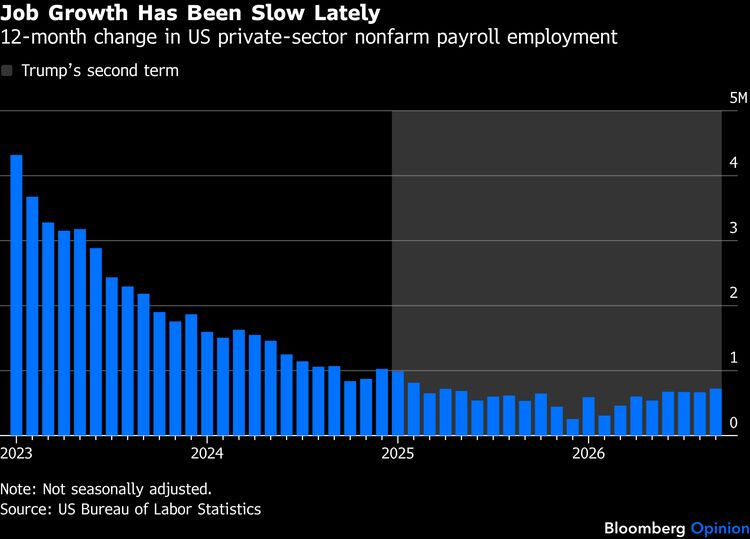
Private-sector payrolls are up by 1,006,000 since Trump returned to the White House in January 2025. But because of the administration’s federal job cuts, total nonfarm employment is only up 776,000. Since that was an intentional policy choice it seems reasonable for Vance to focus on the private-sector numbers. And those gains work out to an average of just 50,300 a month, compared with 282,469 during the Biden administration and 165,514 during the first Trump administration through February 2020. Growth had slowed to 68,250 monthly during Biden’s last 12 months in office, and it has picked up some this year (to an ominous 66,666 monthly over the past six months), but overall it seems pretty weird to brag about such weak numbers.
Then there’s the division between men and women. The Trump administration has made no secret of its aim to shift the economy back toward manly jobs — mining, manufacturing, construction. But since January 2025, 80% of net new private-sector jobs have been filled by women. With men making up most of departures from federal employment, women have claimed almost 92% of net new nonfarm jobs.
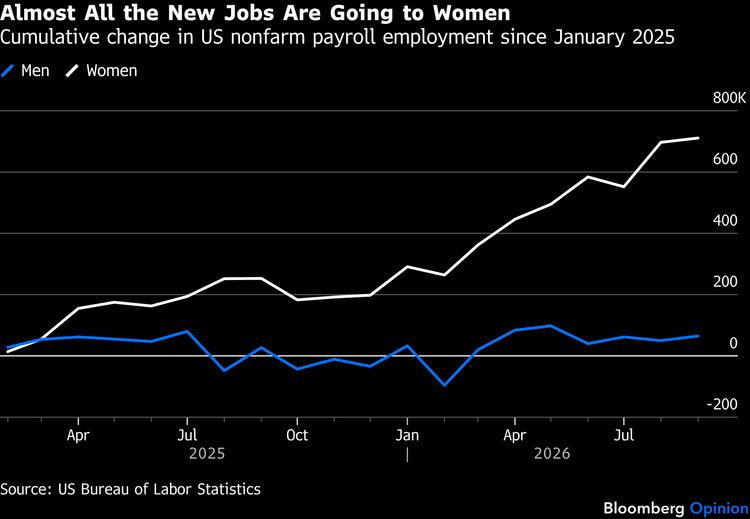
What happened? Non-government health care and social assistance employers added 998,200 jobs in this period, almost equal to the private-sector gain and 222,000 more than the nonfarm total, and 79% of health care and social assistance workers are female. Employment in the rest of the private sector is up by a measly 7,800. And while some slowing of job growth was to be expected as the administration’s immigration crackdown reduced the potential labor force, this was supposed to redound to the benefit of non-immigrants. There’s no indication it has.
To elaborate on that, I’m afraid I need to talk about where US employment statistics come from. Those I’ve cited are from the monthly establishment survey conducted by the Bureau of Labor Statistics, which breaks employment down by gender but no other demographic categories. For information on those, one must turn to the monthly household survey conducted by the Census Bureau. The household survey is optimized to produce percentages such as unemployment rate, and while the BLS does publish employment estimates based on it, there’s a reason why they get less attention than the payroll numbers from the establishment survey — they’re not reliable.
Which brings us to Vance’s claim of 100% of jobs going to US citizens. There is no timely data on employment by citizenship, so he must be referring to household-survey estimates that as of September show a 1.6 million increase since January 2025 in native-born employment and a 589,000 decrease in foreign born. These are genuine government statistics, but they are not, as I have explained in depth in earlier columns , to be believed. The numbers are adjusted once a year based on new Census Bureau population estimates, but those from earlier years aren’t revised — meaning any comparison of numbers more than a year apart is suspect. And between annual adjustments the changes are based on survey responses, which since Trump returned to office seem to have been skewed by deportation-fearing immigrants avoiding the survey. The Census Bureau’s population estimates are derived from other sources, and when last January’s jobs numbers were adjusted to reflect the latest population estimates the boom in native-born employment the administration had been trumpeting turned into a decline of 466,000. I suspect something similar will happen with next January’s employment report.
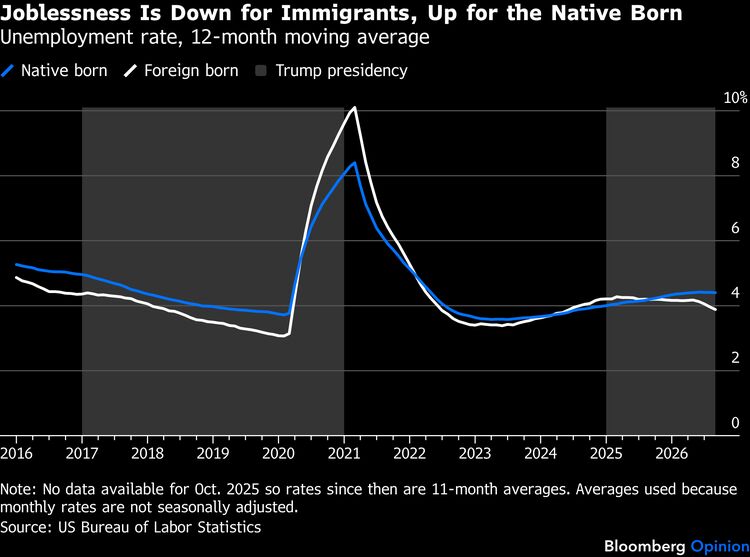
In the meantime, we have the more-reliable percentages to look at, and they don’t back up Vance. The unemployment rate has fallen for the foreign born since January 2025 while rising for the native born.
The best all-purpose labor market measure, the prime-age employment-to-population ratio, shows a similar divergence since January 2025 and especially this year.
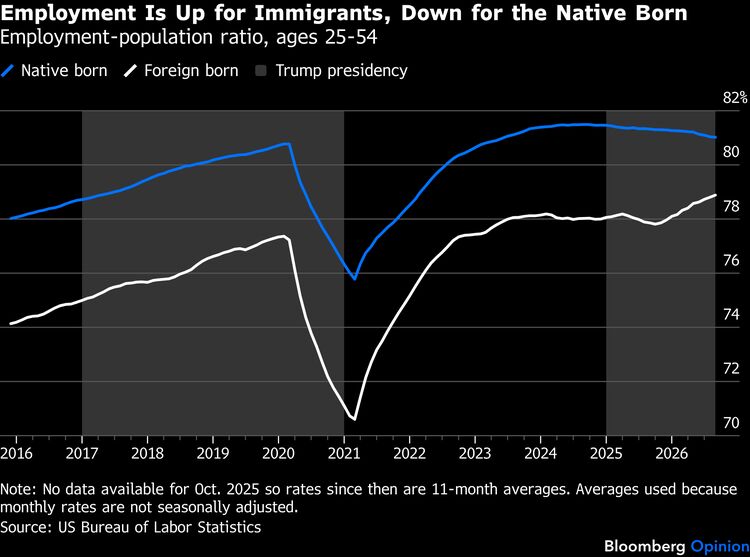
Could the unemployment rate and employment-population ratio for the foreign born also be skewed by non-response? Possibly. If the only immigrants now responding to the survey are those with little fear of being deported (naturalized citizens and green-card holders), that would probably improve foreign-born employment numbers. But there are also simple economic reasons why immigrants would be doing better in today’s job market. Their main competitors for jobs are other immigrants, so a sharp reduction in inflows is likely to benefit those already In the US. Another plus for foreign-born workers is that all the job growth is in health care and social assistance, and 43% of that is in the immigrant-heavy fields of home health care services and social services for the elderly and disabled.
The deteriorating job market readings for the native born are even more likely to reflect reality, as they wouldn’t be skewed by immigrants avoiding the household survey. But why have they deteriorated? The administration’s government-downsizing effort is surely one factor. Most federal jobs aren’t open to noncitizens, so the cuts have disproportionately affected the native born. Native-born Americans also make up the great majority of a labor force that Trump keeps waylaying with growth-reducing actions ranging from high and ever-changing tariffs to war with Iran to the very deportation campaign that was supposed to help the native born. Mike Konczal, vice president for policy and research at the left-leaning Economic Security Project, recently ran through 10 different labor market indicators where deportation advocates expected to see some payoff for the native born and found evidence of none.
So yeah, that’s not really a job market to brag about on the campaign trail.
More From Bloomberg Opinion:
- Healthcare’s Economic Risk Is Too Big to Ignore · : Jonathan Levin
- The News About Incomes That No One Seems to Believe: Justin Fox
- Why Stocks Make Americans Rich But Not Happy : Allison Schrager
Want more Bloomberg Opinion? OPIN <GO>. Or subscribe to our daily newsletter .