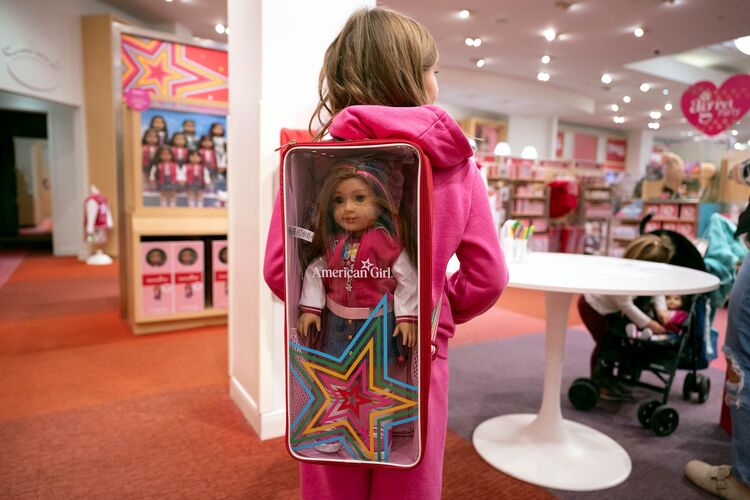
On paper, Pleasant Rowland’s business plan looked absurdly out of step with both prevailing tastes and the rules of the toy industry. It was 1984, the year after Cabbage Patch Kids caused near-riots in department stores across the US, and the toys that succeeded were flashy pieces of mass-produced plastic advertised during Saturday morning cartoons and sold at Toys “R” Us (think Barbie and My Little Pony). But Rowland, a former children’s textbook editor casting about for a midlife career reinvention, thought toy companies were underestimating 9-year-old girls.
Rowland curdled at Cabbage Patch Kids and Barbies while Christmas shopping for her nieces, then 8 and 10 years old. “Here I was, in a generation of women at the forefront of redefining women’s roles, and yet our daughters were playing with dolls that celebrated being a teen queen or a mommy,” she told CNN in 2002 . That disdain, along with a trip to Colonial Williamsburg in Virginia, sparked the desire to create new dolls that would bring history alive for girls. Rowland’s unorthodox vision for a new brand would celebrate a certain version of girlhood, untouched by crushes and makeup. And it would go far beyond dolls.
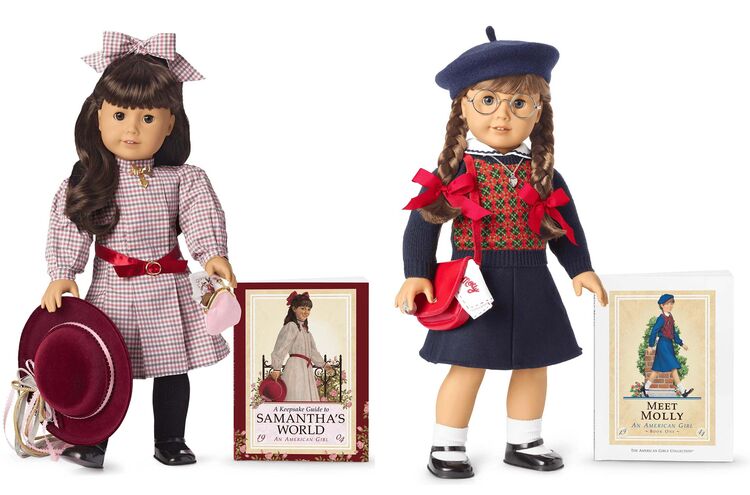
In time for Christmas 1986, Pleasant Company launched with three dolls, each paired with the first book in her own series. Swedish immigrant Kirsten Larson settles in Minnesota with her family in 1854, representing the pioneering Manifest Destiny era. Samantha Parkington is a posh orphan in 1904 Westchester County, New York, raised by her imperious grandmother in a Victorian mansion. Rounding out the trio was Molly McIntire, embodying World War II-era patriotism by planting a victory garden in 1944 Illinois while her father treated wounded soldiers in England. Kirsten, Samantha and Molly were all forever 9 years old, and their stories were meant to emphasize that across history, some things about girlhood remain constant.
As journalist Amanda FitzSimons writes in An American Girl: How a Billion-Dollar Doll and Its Unlikely Founder Changed Girlhood Forever , “You don’t need an MBA to know that Rowland’s undertaking … was wildly ambitious.” Instead of selling directly at chain stores, Rowland opted for catalog orders only. She also skipped commercials and pink packaging. Each elegantly outfitted doll, paired with a paperback book, cost $68, far more than any Barbie.
Yet Rowland’s confidence was not delusional, as FitzSimons details. Within three months of launch, Pleasant Company brought in $1.8 million and was on track to sell out of its first run of 15,000 dolls. The brand now produces America’s second-most popular line of dolls, just behind Barbie. It has achieved, FitzSimons writes, “what a group of business school professors once described as ‘brand gestalt.’”
That brand has encompassed at various times not just the dolls and their books but a magazine, a school curriculum, clothing lines and stores with cafes where you can rent a doll as your dining guest. American Girl inspires intense nostalgia among millennial women (FitzSimons herself owned a Molly doll), and it now appeals directly to that nostalgia with an ’80s doll — Courtney Moore, whose favorite pastimes include going to the mall and watching MTV.
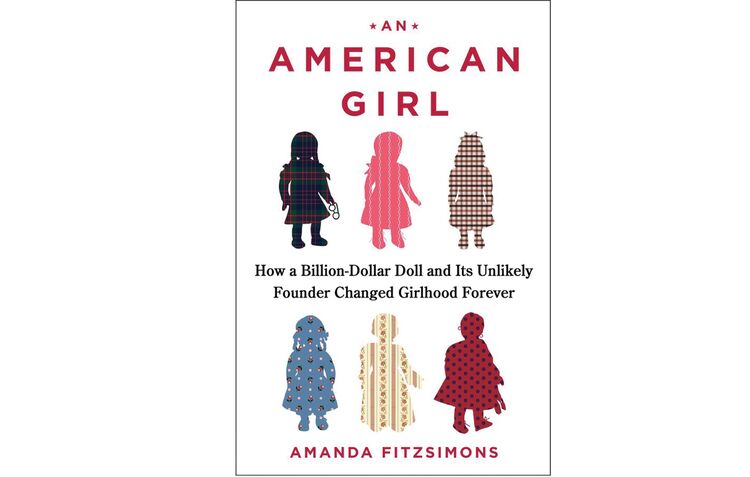
FitzSimons’ clear-eyed analysis of a brand that left a lasting mark on girlhood was written without access to Rowland, who’s increasingly avoided the press. She instead relied on interviews with former Pleasant Company employees and reporting from the time of the founder’s reign. What emerges is a portrait of Rowland as an uber-controlling manager who insisted on having final say over each and every detail, from choosing swaths of fabric to writing all the copy for the first catalog.
Rowland’s “diva-like demands,” FitzSimons writes, were excusable because she seemed to possess a preternatural understanding of just what girls — and crucially, their parents — would want to buy. She addressed parents directly via letters in Pleasant Company catalogs: “I hope the American Girl collection will be dearly loved and played with, and then passed down to other generations of girls tomorrow — a reminder that growing up in America is, has been, and can always be an experience to treasure.” FitzSimons writes that the dolls’ meticulously detailed, heirloom-quality trappings were meant to draw in baby-boomer mothers in dual-income households, who had taste and expendable income and had been galvanized by third-wave feminism to eschew big-breasted Barbies in favor of flat-chested, flat-footed role models like Kirsten.
In addition to creating a brand for the yuppie zeitgeist, Rowland refused to play by the toy industry’s rules, and it paid off. Rather than expand through licensing deals, Pleasant Company deepened its product lines for each doll with “just enough new merch to fill Christmas lists and exceed revenue targets” in each catalog, as FitzSimons puts it.
In 1996, my grandmother gave me a Samantha doll for my 7th birthday. The doll and the book cost $82 ; accessories were sold separately for $20: a plush burgundy hat, a golden brooch with a heart-shaped locket, and a rose velvet purse with an embroidered handkerchief and a reproduction 1904 Indian Head penny. (At Rowland’s insistence, the set originally came with a real 1904 Indian Head, until Pleasant Company buyers exhausted coin dealers’ supplies.) My grandma must have been feeling generous: She also shelled out for “Samantha’s Sweet Dreams Collection,” a $140 set that comprised her four-poster bed and “nighttime necessities” — wood commode, lace-trimmed nightgown, kimono and slippers. I recall coveting Samantha’s other spreads, such as the $240 birthday collection complete with a Victorian lemonade set. No wonder that by 1998, the American Girl brand was generating $300 million a year in revenue.
An American Girl is at its best when FitzSimons delves into the tensions inherent in Pleasant Company’s mission. For whom was “growing up in America” truly “an experience to treasure,” as Rowland had asserted in that letter to parents? Even in the early 1990s, Pleasant Company was getting flack for representing “pricey nostalgia” rather than real American history, as Rebecca Ganzel, guest columnist for the Minneapolis Star Tribune put it. “They tell three lies about our nation’s past: It’s pretty. It’s white. And it’s kind.”
The brand’s overwhelming Whiteness was out of step with the diversity efforts of the doll business at large, FitzSimons writes — Barbie had introduced its first “colored” doll in 1967. It was not until 1993, five dolls in, that Pleasant Company introduced a Black doll: a slave named Addy Walker who escapes from a North Carolina plantation in 1864, her story and look devised by an advisory committee of renowned Black historians that took three years to complete its work. While FitzSimons notes that “the board unanimously agreed that the Black American Girl should be born into slavery,” as “anything else would look almost aggressively beside the point,” Addy’s enslavement endures as the most controversial aspect of her biography. “If a doll exists on the border between person and thing,” wrote the novelist Brit Bennett in the Paris Review in 2015, “what does it mean to own a doll that represents an enslaved child who once existed on the same border?”
And while Rowland, whose first job was teaching elementary school, seemed to care deeply about the educational mission of her brand, she also allowed for inaccuracies and eluded complicated truths in the narrative she was selling. Samantha’s books and catalog copy routinely referred to her time period as “Victorian,” for example, but she lived in the Edwardian era. More damning and consequential was the decision to portray the girls as having independence they would not have actually possessed. As a historical interpreter at Colonial Williamsburg who consulted on the creation of 1774-era Felicity Merriman, introduced in 1991 as the fourth doll, tells FitzSimons of colonial times, “The little girls were more cosseted. They stayed more within their own [confines].”
Then there was the question of how educational the dolls and books really were. FitzSimons cites a 2009 study by a group of business school professors. They asked a 7-year-old girl to describe what she understood about Molly McIntire’s time period, and she replied, “It was a time when how you’d make ice cream is very different than you’d make it now; and when you’d wear a dress, it would look very pretty.” This focus on the materiality rang true to me. What has stuck with me most from my girlhood time with Samantha was not learning about the prevalence of child labor in the early 1900s but the old-timey practice of washing her face with the china pitcher and bowl.
In 1998, Rowland made the shocking choice to sell Pleasant Company to Mattel Inc., the maker of Barbie. When she announced the decision to her staff, one former employee tells FitzSimons, “You could have heard the gasp from the audience across the street. Because Barbie was the enemy.” Rowland’s $700 million sale of a brand she painstakingly built to meet her precise ideals remains a mystery, one FitzSimons is unable to meaningfully account for without access to the founder.
FitzSimons is left to wonder what Rowland makes of what has become of the business. Earlier this year, for American Girl’s 40th anniversary, Mattel announced a “Modern Era” collection. It reimagined the original six dolls with a Gen Z makeover: slimmed-down bodies and contemporary outfits. Yet what Rowland really thinks of the line seems almost beside the point. What matters is the mark (if any) the dolls and their stories will leave on the girls of today.
Kristen Martin is the author of The Sun Won’t Come Out Tomorrow: The Dark History of American Orphanhood .