
Au revoir, Bernard Arnault. The French luxury billionaire recently fell out of Bloomberg’s ranking of the world’s top 10 richest people, the predictable consequence of a 40% price drop in the shares of LMVH Moet Hennessy Louis Vuitton SE this year. Nobody will shed a tear; he’s still worth $131.2 billion. But as the last remaining European on a list now exclusively occupied by Americans, it feels like the start of a new era.
Arnault’s demotion from the podium of bling has of course been driven by luxury’s misfortunes in China and war in the Middle East. But it is also a story about the ballooning net worth of those on the way up: namely, the artificial intelligence crowd. With the sole exception of Warren Buffett, the current top 10 is a clean sweep for US tech bros, from planetary No. 1 Elon Musk to Nvidia Corp.’s leather-jacketed Jensen Huang. This year so far has been the best ever for the roughly 100 tech fortunes among the top 500, with their wealth up $845 billion, according to Bloomberg data. And unfortunately for Arnault, they seem to prefer informal T-shirts and prepping for the apocalypse over buying designer wear.
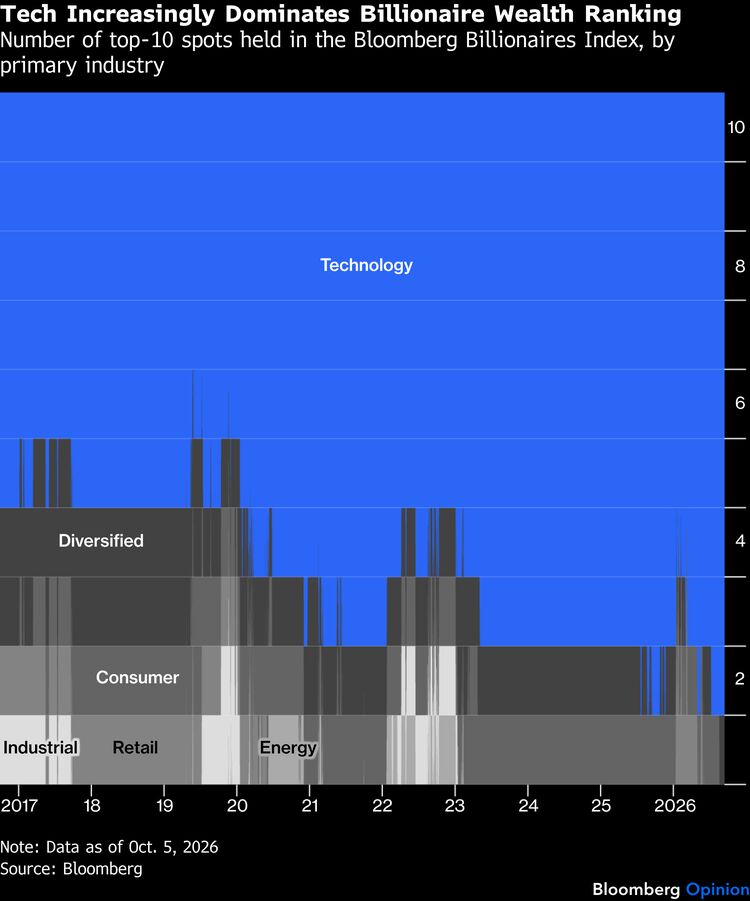
Rich lists can be volatile and bubbly, like the stock market. But looking back over the past 14 years, I’d argue this reflects a more fundamental shift in the global economy. Back in 2012, when Meta Platforms Inc. was a newly public company called Facebook, the top 10 wealthiest included Europeans like Zara’s Amancio Ortega and IKEA’s Ingvar Kamprad alongside Bill Gates of Microsoft Corp. and Larry Ellison of Oracle Corp. Even as Europe’s record jobless rate bore the scars of crisis, retail and luxury tycoons rode a wave of global consumer demand and low inflation.
Since then, technology has become increasingly dominant economically while the globalization trade has reversed — most obviously in the case of luxury, where the art of creating scarcity and forever-out-of-reach prices has met tariffs, generational fatigue and a Chinese consumer who’s cutting back.
According to estimates from the Organisation for Economic Co-operation and Development, the information and communication technology sector grew almost three times faster than the wider economy between 2013 and 2023, during which time the top 10 became almost entirely US tech-centric. And as any reader of the Draghi Report knows, tech is Europe’s weak spot, from research budgets to scale-up funding to going public on the stock market, ASML NV notwithstanding.
To be sure, the speed and scale of the current AI wealth boom is about more than economic fundamentals. If Nvidia’s most expensive GPU costs more than a Birkin bag, it’s also because the company has a market share of 85% and margins of 75%, which is the kind of competitive moat LVMH could only dream of having. The sheer capital burn of today’s tech startups, with SpaceX splurging $40 billion on AI chips, indicates a capitalism either wild or unwell. Former French presidential advisor Alain Minc describes in a new book how AI riches are fueled by control of critical inputs, the network effects of large-language models, stock-market hype and poor governance.
Yet the AI wealth spurt is also driven by a desperate search for productivity gains. Birth rates are falling around the world, turning a market where workers are plentiful and jobs scarce into one where labor is in short supply. That means less growth and more pressure to pull the lever of automation. The OECD estimates that without a lift to productivity, GDP per capita growth could be almost halved from the 1% in the 2006-2019 period to 0.6% on average over the next few decades. This is why the US-Europe tech gap is also an economic one. A Bank of France study last year found that almost all of the productivity gap between France and the US over the last two decades could be explained by a lag in the tech sector .
It’s not all bad. Billionaires with European roots are still being minted, such as Hugging Face’s three French founders. But this usually occurs only after time spent working and raising funds in the US. And if American techies are getting richer, it's with Europeans’ help. Europe is where US cloud companies like Amazon.com Inc. enjoy a 70% market share and where approximately €300 billion ($336 billion) of savings every year flow to the US instead of funding domestic growth. (At least they occasionally return the favor: Jeff Bezos’ yacht was built in the Netherlands and his wedding last year was in Venice.)
In a world where the rich are getting richer, and the very, very rich even more so, there will be a lot of people left behind, from workers whose jobs will be replaced to tax authorities struggling to keep up with a new trillionaire class. The result may be messy, from political backlash to a brutal market correction. But the overtaking of Europe’s richest by the barons of the AI gilded age also points to entire regions missing out due to their dependence on outside tech. With the passing of the billionaire baton from one rent-extracting industry to another, it’s clear that technology is the new luxury good.
More from Bloomberg Opinion:
- LVMH Shares Are Cheap — For a Reason: Andrea Felsted
- FROGS Is the Name of Europe’s Debt Crisis: Lionel Laurent
- AI Giants Face Terrible Case of Chip Indigestion: Chris Bryant
Want more Bloomberg Opinion? OPIN <GO>. Or subscribe to our daily newsletter .