President Donald Trump is working with Vladimir Putin to release Russian diesel supplies into global markets, a move that upends years of sanctions as the White House seeks ways to tame soaring fuel prices ahead of the US midterm election.
Trump announced Friday a series of cargoes beginning this month totaling about 13.5 million barrels, initially. The Kremlin published a statement citing Putin who said Russia was ready “to supply oil and petroleum products to the US and global markets.” The US Treasury also issued a waiver for previously sanctioned Russian fuel.
“That is massive amounts of oil coming into our country, and I want to thank President Putin,” Trump said to reporters at the White House on Friday. “And it’s diesel, which is what we want.”
Following the announcement, Ukraine’s European allies, including the UK and Germany, reiterated their support for Kyiv and for continued sanctions against Russia.
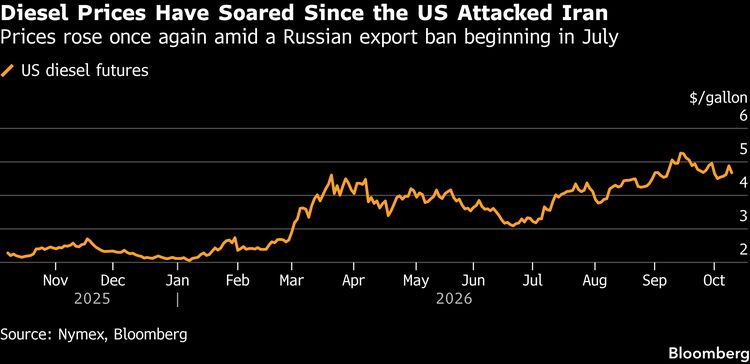
Diesel, the fuel often dubbed the workhorse of the global economy, has been thrust into the spotlight as a massive supply crunch sent pump prices to records and stoked concerns over energy-driven inflation. Ahead of US midterms in November, the Trump administration is making a series of moves aimed at bringing down prices, which have raised costs for farmers and truckers. But the Russia action risks sparking geopolitical backlash without boosting supply enough to lower prices significantly.
US diesel futures fell on the news to trade at about $4.66 a gallon, still at seasonal all-time highs. Since July, Russia has operated under a self-imposed diesel export ban following months of punishing attacks on their refineries from Ukrainian drones. Those attacks have continued through recent days, but Russia is beginning to lift its restrictions on diesel exports immediately, ahead of schedule, Tass reported citing Alexander Novak, the nation’s deputy prime minister responsible for energy.
The Trump-Putin agreement has drawn the ire of Ukrainian President Volodymyr Zelenskyy. Russian attacks on Ukraine have killed dozens in just recent days, European Commission President Ursula von der Leyen said in a post on X earlier Friday. Kyiv has been facing blackouts, with hospitals and schools among Russian targets.
“Gifts to Putin will not bring peace or any benefit to the civilized world,” Zelenskyy said in a post on X. “Russia will ‘repay’ the diesel with further terror and perfidy. Allowing Russia to sell petroleum products is an investment in a war that must be ended, not prolonged.”
European allies pushed back on the move.
Germany “remains committed to the sanctions imposed on Russia and is working with its European partners on further sanctions,” a German federal government spokesman said in a statement. “Support for Ukraine in its defensive struggle remains unwavering.” The UK said it will continue working with international partners to ensure Ukraine has the military and financial support it needs to defend itself.
US Senate Democratic leader Chuck Schumer also criticized Trump’s decision. “Trump is doing a deal with the devil to try to help his flailing political fortunes from the shockingly high diesel prices,” Schumer said in a post on X.
While the US leader has previously called upon Ukraine to halt its attacks on Russian oil infrastructure, the country has instead intensified its strikes on Russian oil assets in a bid to curb the Kremlin’s ability to finance and sustain its war.
“Ukraine will not set Russian oil refineries on fire if Russia does not destroy our energy infrastructure. This is the kind of agreement we are proposing to America, and we believe the United States has enough power to achieve such a compromise,” Zelenskyy said.
Trump was read Zelenskyy’s comments by a reporter at the White House, and the US leader responded: “We are a strong partner.”
“We need oil for the world, and this is diesel, which is what we need. So we’re very happy to get it,” Trump said.
Trump announced a set of initial product releases beginning with 2.25 million barrels in October, 3.75 million in November and 7.5 million “immediately thereafter.” Novak confirmed Russia is ready to supply that amount of fuel, with the 7.5 million barrels released in December.
Trump added that “based on the condition of their Diesel Refineries, Russia will then deliver, within a short period of time, 3,000,000 Tons of Diesel Fuel.” (That’s equal to about 22.5 million barrels.)
There are concerns over whether Russian energy infrastructure is in strong enough condition to meet those goals, said Ryan McKay, senior commodity strategist at TD Securities.
“The biggest concern is the refiners being able to do it,” McKay said.
But even if the promised barrels are released, the impact would be marginal, McKay said. That’s particularly true of the most immediate October release of just 2.5 million barrels — around 10% of the barrels Russia exported per month before Ukraine’s campaign intensified.
“Those barrels could help, but they may not fully materialize, and what does arrive could still be too little, too late,” said Rebecca Babin, senior energy trader at CIBC Private Wealth Group. “The headline may move prices initially, but this is hardly a straightforward solution.”
US retail diesel prices stood at $6.28 a gallon as of Thursday, below record highs above $6.50 set in September.
Zelenskyy has tried to keep Trump on his side as Russia has maintained round-the-clock assaults on Ukrainian civil infrastructure. Ukrainian negotiators were set to meet US envoys Jared Kushner and Steve Witkoff in the US on Friday.
Trump on Friday claimed the releases of Russian supply would help lower diesel prices for American farmers, ranchers and truckers — key voting blocs ahead of November midterm elections in which costs of living, including for energy, are the dominant issue.
Read More: Trump Eases Limits on Dyed Diesel in Bid to Cut Fuel Costs
Polls show Trump at record-low approval ratings and voters largely disappointed in his handling of the economy and war in Iran. The prolonged conflict has crunched energy flows through the Strait of Hormuz, raising fuel prices globally. Trump said earlier this week that he would not strike Iran again until after the November midterms, indicating what he said were productive discussions with Tehran.
Meanwhile, other global restrictions remain in place on Russian fuel supplies. Before Ukraine’s attacks accelerated this spring, the bulk of seaborne Russian exports went to Europe outside the European Union, Africa, Asia and Brazil.
The US last imported diesel from Russia in March 2022, according to Energy Information Administration data.
Read more: Russia’s Oil Product Exports Rise Even as Diesel Shipments Slump
Trump on Friday did not indicate if he discussed any other topics with Putin, such as the recent death of a laboratory worker in Siberia that prompted speculation about pneumonic plague, or about recent US efforts to jump-start peace talks to end the Kremlin’s war in Ukraine.
Russia’s Interfax reported on Saturday that Putin had conveyed to Trump Iran’s proposals for a possible resolution to the conflict in the Middle East, in coordination with Iran’s President Masoud Pezeshkian, with whom Putin spoke to twice on Thursday on the sidelines of a summit in Turkmenistan.