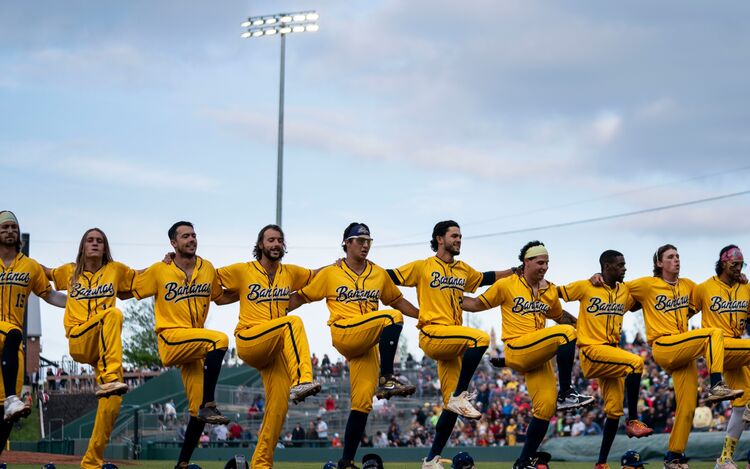
If there’s any doubt about how much people crave a low-drama, fun escape right now, consider the Banana Ball phenomenon — a comic book alternate-reality version of pro baseball. In the Banana Ball Championship League, which is made up of the Savannah Bananas and five other barnstorming exhibition teams and has exploded into a $500 million juggernaut, viral gags are the point. Who wins is secondary.
Rules reward circus spectacle over competition. Outfielders make catches behind their back or as they do a backflip . Umpires twerk . One player, named Stilts, bats and pitches on stilts . And like a cross between the minor leagues and Glee , there are many scene-into-song moments when players translate the on-field action into choreographed dance and musical numbers .
The nonstop theatricality of Banana Ball, its goofiness and over-the-top camp, has made it the hottest ticket in US sports. Traveling the country this year, Banana Ball has sold out MLB parks, National Football League stadiums, even a cruise ship to Mexico. Major League Baseball and other pro leagues around the world are looking to go more “Bananas,” exploring how far they can push their sports into the realm of entertainment without disrespecting their games.
But even as the Savannah Bananas’ league is seemingly breaking every rule, it’s playing with some old, overworked tropes that also reflect the sensibilities of the country right now.
Jesse Cole, the operation’s ringmaster and unrelenting booster, dresses in a banana-yellow suit and top hat. In 2021, he turned a collegiate summer league team from Savannah, Georgia, into its own touring enterprise . He and his wife, Emily Cole, remain the sole owners of the league. Cole reported attendance this summer of 3.4 million for 75 games. While the Bananas get to draw from a new fan base at each stop on that tour, that’s still better than every Major League Baseball team except the Los Angeles Dodgers, who needed 81 home games (and a nearly half-billion-dollar payroll ) to top it.
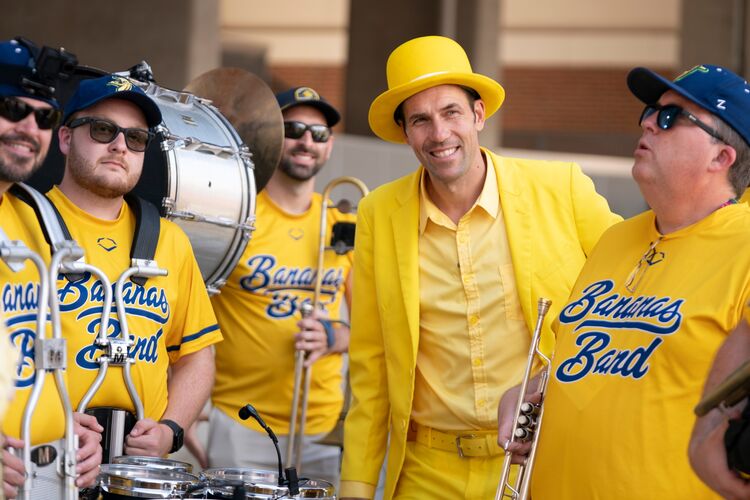
While some MLB teams failed to fill their parks for first-round playoff games this fall, the low-stakes, season-ending Banana Bowl this Saturday between the Bananas and the Texas Tailgaters easily sold out. The organization held a lottery for the 75,000 people seeking tickets at 41,000-seat Nationals Park in Washington, DC. Cole said he’s received 300 bids from around the world to host games for next season.
His creation is an explicit critique of professional sports, and particularly baseball, as humdrum and out of touch with what most spectators want today. Cole told Bloomberg’s The Deal podcast that he came up with the rules for his league by “eliminating all the boring parts of baseball for the average fan,” of which he believes there are plenty, and making every remaining part more fun. (The team didn’t return requests for comment.)
Read more: A Once-Terrible Team Has Become the Best Bargain in Baseball
First, he shortened games to two hours with a running clock, faster than most “real” sporting events — and many movies, concerts or plays. Coaches can’t visit pitchers on the mound; hitters can’t delay by stepping out of the batter’s box. Walks don’t exist. After four balls, the batter and any runners on base advance, and no one can be tagged out until every fielder on the opposing team touches the ball. The plays are called sprints.
@thesavbananasThe ultimate mashup with Kristen Bell and @Derek Klena 🤩 #savannahbananas #frozen #wicked #dirtydancing #kristenbell
♬ original sound - thesavbananas
More significantly, Cole has devised ways to make fans feel like more than spectators. The most participatory rule change: If someone in the crowd catches a foul ball, the batter’s out. As prices for popular events like the World Cup soar, a majority of Banana Ball tickets are capped at $60. The stadiums are packed with children, some of whom are taken onto the field during games to help lead musical numbers.
I recently watched a game that featured a recurring between-innings contest called the World’s Slowest Race — a dozen babies in a row, crying or gazing up at the lights, as their parents called frantically to them a few feet away from a finish line. It was ludicrous, and I couldn’t look away or stop smiling.
The games happen without a quiet moment for reflection or conversation, designed for internet-age attention deficits. With dozens of cameras trailing players, the events are optimized for social media.
At the start of a recent sellout in Cleveland between the Indianapolis Clowns and the Party Animals, the players were introduced with their TikTok handles, cameras capturing them as they perched in the stands among fans before making their entrance onto the field. The Party Animals, who made their debut in 2020, already have more followers on TikTok than any MLB club.
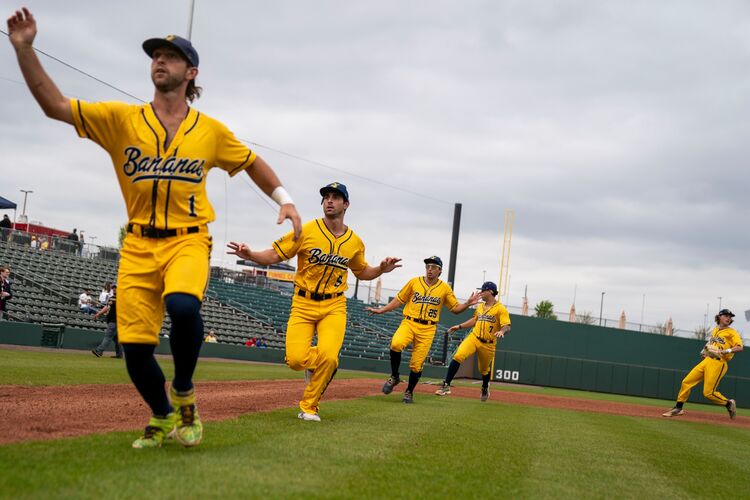
Banana Ball can’t match the drama of watching a big game in a major league sport: the outcome in the balance, the obsessions over strategic Xs and Os, to say nothing of the bounty of stats that feed fantasy leagues and gambling. Yet professional sports leagues are tending to look more like Banana Ball as they chase the same wider appeal.
The addition of a pitch clock in Major League Baseball in 2023 was probably the sport’s most important rule change in decades, cutting average game times to under three hours. Tennis now limits the time between serves, and India’s T20 cricket league owes its popularity in large part to match times no longer measured in days but in hours.
Baseball has in recent years placed cameras in the dugouts after home runs, catching different teams anointing their sluggers with a ceremonial fur coat, a giant gold chain, a trident, a welder’s helmet or a simulated beer bong after they hit a home run.
The US Open this summer encouraged influencers in attendance to post about matches but struggled to keep them quiet during points. In the NFL, defenses now gather in the end zone after almost every turnover for a group pose, though the “No Fun League,” as it’s sometimes called, still has an actual rule violation for excessive celebrations that results in the loss of 15 yards and a potential fine.
To sell his entertainment, Cole has tapped into baseball’s history and lore in ways that are commendable, if expedient. For example, the Clowns, whose current squad is largely but not exclusively Black, are a defunct Negro League team that Cole revived, paying the Negro Leagues Baseball Museum for the rights to use the intellectual property. Cole regularly gives credit to the original Clowns, along with other touring Black teams from the segregated era in the first half of the 20th century, as precursors to Banana Ball, calling them “pioneers, entertainers and ambassadors for joy.”
The actual history is more problematic. The team started as the Ethiopian Clowns, and players in pancake makeup and baggy clown suits were known by concocted African names such as Abbadaba, Tarzan and King Tut. Their on-field antics leaned heavily into derogatory racial stereotypes, an ugly dynamic explored by Josh Levin in the Atlantic . Other Black teams in the 1940s tried to ban the Clowns from Negro Leagues competitions, and Wendell Smith, the renowned Black sports columnist, called them a “fourth-rate ‘Uncle Tom’ minstrel show.”
The mythology of big-league baseball as pastoral and intrinsically American has always involved ignoring certain historical and social realities. Eighty years after Jackie Robinson broke baseball’s color barrier, just 7% of MLB players are Black Americans.
This isn’t the only way Banana Ball skirts an uncomfortable line when it presents its players’ “clowning” as a purely fun escape. Out Sports calls the Party Animals the “ gayest team in baseball .” The Party Animals pitcher winds up in Daisy Dukes shorts and a cowboy hat, while the catcher waits behind home plate in a pink-fringed crop top. One male player came to bat in a bridal veil . During another game, the Party Animals players gyrated shirtless to Rihanna’s Umbrella while being sprayed with the hose used to water the infield.
The joke for anyone watching seems to be that straight male jocks (there are no openly gay Party Animals) are the ones acting campy. Online, you can find people questioning these Magic Mike routines, saying they feel like appropriation, followed invariably by a string of commenters telling the person to get over it or to watch something else. At moments like this, the big tent of the circus doesn’t feel quite so big.
Cole has said he wants to reach a billion fans, and he models himself not after other sports commissioners but Walt Disney or Saturday Night Live ’s Lorne Michaels. And he seems to be reading the zeitgeist quite well: Circus spectacle is everywhere right now, in our politics along with our sports.
Most World Series winners thrill their hometown fans but aren’t altering the game or leaving a mark on the broader culture. Banana Ball is having that impact with each viral video of an outfielder bouncing a fly ball into a teammate’s hat . Fun that captures the imagination of this many people should be taken seriously. But who is and isn’t in on the laughs matters.