By David M. Drucker | Updated on Oct 11, 2026 at 01:00 PM
Imagine the uproar from Republicans: A future Democratic president takes a pot of money authorized to bolster Israel’s security and redirects the funds to another country, for another purpose.
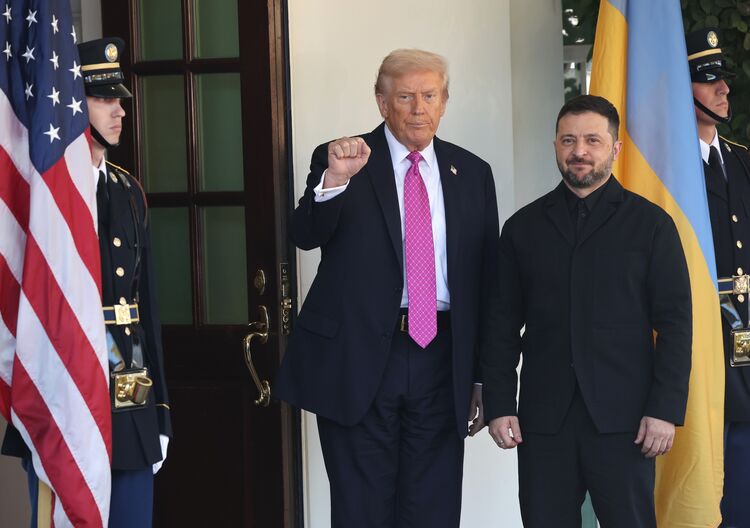
President Donald Trump did the equivalent recently with $52 million of foreign aid, which Congress had appropriated four years ago, under President Joe Biden, as part of a supplemental package for the Ukraine war. Flouting Capitol Hill’s clear directive and consistent with his hostility to Kyiv, Trump instead plans to spend the money on national security priorities he deems more important — in Central and South American partner countries Colombia, Ecuador, Panama and Peru.
New Hampshire Senator Jeanne Shaheen, the top Democrat on the Senate Foreign Relations Committee; and New York Representative Gregory W. Meeks, the top Democrat on the House Foreign Affairs Committee, are protesting aggressively. But their effort to preserve congressional spending authority is missing a key ingredient: Republicans. Teetering GOP majorities in the House and Senate are standing idly by.
Fast forward to the not-so-distant-future, perhaps the administration of Trump’s immediate successor. That president could be a Democrat, especially if number 45 and 47 never digs out of the job-approval-ratings hole he’s dug for himself. Considering the Democratic Party’s growing antipathy to Israel, it’s not out of the question that such a president might reprogram previously approved military and other assistance for Jerusalem. Whatever’s left unspent from $750 million in aid to Israel included as part of a $1.2 trillion defense authorization bill expected to clear Congress by year’s end might be a juicy target.
Congressional Republicans would no doubt howl about separation of powers and the power of the purse. Of course, if the next president is a Republican, the White House will have ample precedent to do to Democrats yet again exactly what Trump has done.
But let’s set aside my hypothetical for now and deal with more pressing ramifications: the intense distrust sure to roil budget negotiations between the Trump administration and a Democratic majority in the House (and possibly the Senate) projected to emerge from midterm elections now roughly three weeks out. Congressional Democrats will no doubt seek to check a White House that hasn’t stopped stretching the bounds of executive authority since Inauguration Day 2025. Given the immense power accumulated by presidents of both parties over the years, attempting to rein Trump in via spending legislation is their best option.
How is that supposed to work, exactly, if the president has already established a complete disregard for legislative branch spending prerogatives?
Trump, during his first term, got comfortable with overriding Congress’ power of the purse when he moved money from one federal account to another to finance a security barrier along the US-Mexico border that Congress expressly refused to greenlight. Some Republicans got big mad; Senator Thom Tillis of North Carolina even published an op-ed in the Washington Post voicing displeasure with this legislative branch humiliation. (Tillis later flip-flopped .)
But at least Trump used Pentagon funds, claiming an urgent national imperative that did, in fact, relate to the Defense Department’s general mission. This time around, Trump has taken disregard for congressional authority a step further. He is both diverting and repurposing the tranche of foreign aid specifically intended for European allies Slovakia and North Macedonia — and explicitly for the purpose of mitigating fallout from Russia’s unprovoked invasion of Ukraine — which has absolutely nothing to do with fighting narcoterrorism in the Western Hemisphere, however laudable that is.
If Trump’s willing to trample on Congress like that repeatedly, any legislative language Democrats insert in appropriations bills to hamstring his administration could be rendered practically meaningless. And that’s a dynamic that could loom over budget talks between the White House and Democratic leaders on Capitol Hill, yielding more damaging government shutdowns; compromise budgeting that fails to address urgent fiscal, social and national security challenges; or both.
To be fair, Trump is not the first president to test the boundaries of congressional jurisdiction over government spending. In the 1970s, President Richard Nixon simply refused to spend money appropriated by Congress, arguing he had a constitutional duty to manage taxpayer dollars efficiently. A few years ago, Biden dubiously invoked emergency powers to justify the forgiveness of student-loan debt with existing funds that Congress had not authorized for that purpose — at least partly because there was insufficient support on Capitol Hill. (Democrats, who agreed with the policy, cheered the Biden administration.)
And Congress does, in fact, sometimes give presidents wiggle room, whether intentionally or not.
The $52 million in foreign aid Trump is reprogramming for alternative purposes in Central and South American nations includes some money for Iraq and Tunisia that does not carry the same mandates on spending as the funds reserved for Slovakia and North Macedonia. Shaheen and Meeks are still demanding the State Department halt the changes, citing imminent needs caused by the Iran war. But the Trump administration appears to possess some flexibility on the deployment of funds originally earmarked for Iraq and Tunisia.
The bottom line, nonetheless, is that Congress, the branch of government the Founders intended as the most influential, is another degree weaker than it had already become, particularly on crucial matters of American foreign policy. To borrow a line Kentucky Senator Mitch McConnell used some years back while criticizing Democrats for undercutting the filibuster: Republicans may rue the part they played in this development, “and [they] may regret it a lot sooner than [they] think.”
More From Bloomberg Opinion:
The US Is Running Out of Weapons . Blame Congress: David M. Drucker
Hegseth Saw the Future of War But Can’t Lead the Way: Andreas Kluth
Ukraine Is In More Danger Than It Seems : Marc Champion
Want more Bloomberg Opinion? OPIN <GO>. Or subscribe to our daily newsletter .