
Four years ago, Americans were reeling from painfully high pump prices and pundits warned the incumbent government would face a protest wave in midterm elections. Sound familiar?
Average prices this year haven’t matched the $5-plus peak in 2022 after Russia again invaded Ukraine, nor have they breached the inflation-adjusted high. Even diesel and heating oil, which have hit records in nominal terms in 2026, fall short of their real peaks from four years ago, according to Department of Energy figures.
Yet there are important, if subtle, differences that make current energy inflation more politically potent for the midterms, which are just three weeks away. The issue today is both broader in impact and yet more focused in its attachment to the White House and several key states.
For starters, it now encompasses residential electricity prices. These began twitching higher in 2022, but this year they have reached their highest level in real terms since the mid-1990s . So-called plug prices have been the new pump prices in several state election campaigns.
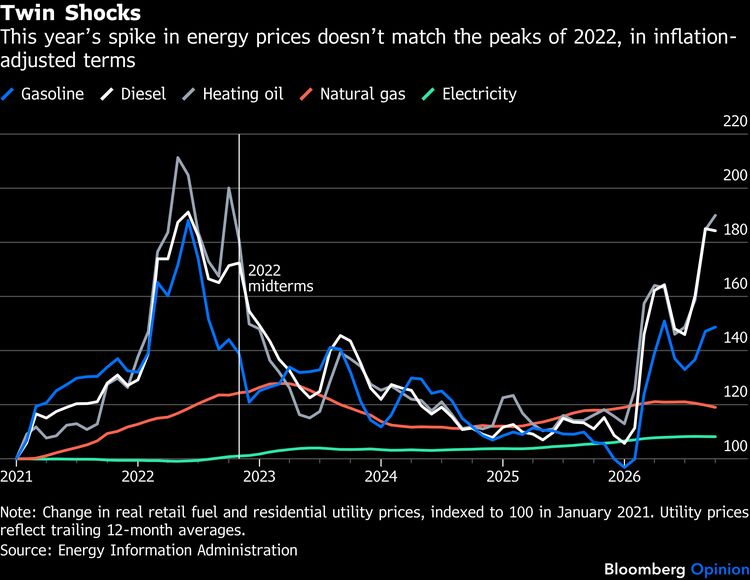
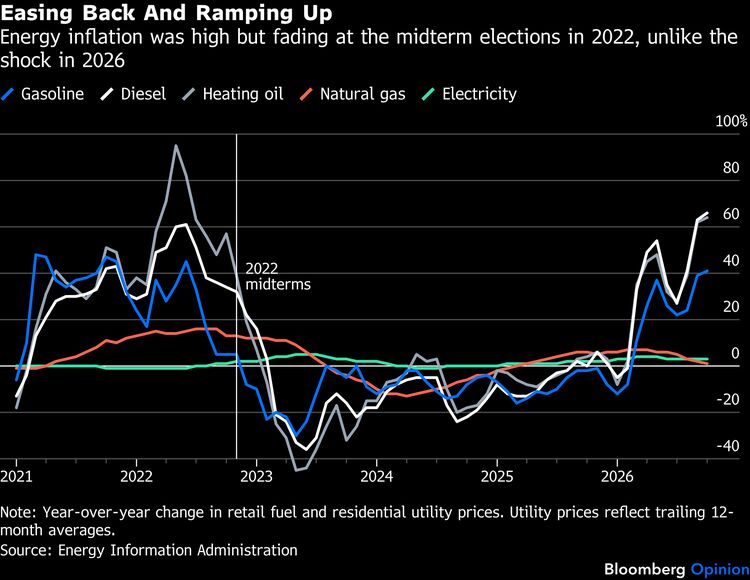
Another difference concerns timing. The energy shock of 2022 peaked in the spring and early summer. Fuel prices, especially for gasoline, had fallen from their peaks by October. This time around, diesel and heating oil prices surged into the fall, and we’ve never had $4-plus gasoline, in nominal terms, this close to November before. Whereas the energy price spike of 2022 compounded an existing post-pandemic upswing, this year’s surge had more of a shock factor, abruptly ending a three-year trend of falling fuel prices.
Thirdly, context matters. President Donald Trump pledged to slash energy costs by half during his first year back; a ridiculous objective made more so by his own actions. The shock of 2022 was owed to an entirely foreign war after all; this one is clearly tied to Trump’s Iran war.
That linkage looks critical.
Energy prices were high up in voters’ minds in the summer and fall of 2022, albeit as one element of wider economic concerns. But the Supreme Court’s conservative majority overturning Roe v. Wade in June 2022 suddenly elevated abortion rights as a key midterms issue. Former President Joe Biden’s net job approval was only 10 points underwater this time four years ago, and, crucially, about half of voters didn’t consider their vote as being about him anyway, according to polling by the Pew Research Center. Democrats lost control of the House but did better than expected.
Trump is clearly on the ballot this year, with roughly two-thirds of voters citing him as a factor in their midterm election choices. His net job approval stands at negative 21 points , with far worse scores on the economy and inflation.
Trump is also very much an avatar for energy inflation. Most obviously, he started the unpopular Iran war, which has clearly boosted fuel prices, and has failed to bring it to a quick, successful conclusion. He also champions the data centers, now drawing a bipartisan backlash , that weave together high electricity prices, resentment of Silicon Valley billionaires and existential dread about artificial intelligence. Nothing comparable to the overturning of Roe v. Wade has appeared thus far to deflect from any of this.
A recent example of Democratic messaging is an ad attacking Mike Rogers, the Republican Senate candidate for Michigan, accusing him of being in “lockstep” with the president on the war and, therefore, sharing the blame for, you guessed it, high gasoline prices.
Michigan is one of several states, also including Alaska, Iowa, Maine and Texas, where energy prices could intersect decisively with close races. Those five states together host 10 of the 43 most competitive House races and, importantly, 5 of the 8 most competitive Senate contests .
Gasoline is a universal concern in the US, but appears especially pronounced in Michigan and Texas. Both host several tossup House races and a tossup open Senate race apiece, too. Both also sport higher per-capita gasoline consumption and lower disposable income than the US average, meaning higher pump prices take a bigger relative bite from wallets there, according to figures compiled by ClearView Energy Partners, a Washington-based analysis firm.
Polling published a month ago by local TV station WDIV and Detroit News indicated about 61% of Michigan voters disapprove of the job Trump is doing. (He won the state in 2024.) The vast majority responding that prices had risen over the past year identified two main culprits: food and groceries, followed by gasoline and diesel.
In Texas, trailing GOP Senate candidate Ken Paxton singled out the Iran war and high fuel prices for dragging down his campaign in leaked audio recordings reported recently by Axios. Affordability is top of mind for Texas voters. Strikingly, one set of polls conducted in February and April — just before and after the Iran war kicked off — found that the share of voters “very concerned” about gasoline prices had jumped from 38% to 61% . And don’t forget about electricity in a state where Republican Governor Greg Abbott, locked in a tight contest himself, recently felt compelled to dial back his full-throated support for data centers in favor of a pause on construction.
In Iowa, hosting several tossup House races and an open Senate contest, gasoline’s share of disposable income is even higher than in Michigan and Texas. Record diesel prices, too, figure large in the big farming state, where per-capita consumption of that fuel is about double the national average. There’s a reason why Senator Chuck Grassley called repeatedly last month for Trump to ban diesel exports . It’s the same reason that Trump has, instead, cut a seeming deal with Moscow that promises symbolic upfront quantities of Russian diesel — a move that undermines sanctions against that country and reeks of desperation.
Diesel also looms large in the other states mentioned. In Alaska, where it is the lifeblood of many far-flung or off-grid communities and more than a quarter of homes mainly use heating oil to fend off the winter, struggling Republican incumbent Senator Dan Sullivan has also called for a ban on exports of the fuel. Troy Jackson, the Democratic challenger in Maine, used a televised debate last week to blame spiking heating oil costs — affecting 50% of the state’s households — on Republican Senator Susan Collins by linking her with Trump and the Iran war .
For an election to revolve around energy, enough voters in enough places must be able to connect the dots from their own wallet to a candidate’s or party’s actions driving prices. This year’s combination of tight margins to flip Congress with a president who has, simultaneously, a tight grip on the GOP but a looser one on the outcome of his war, offers as clear a path as one is likely to get.
More From Bloomberg Opinion:
- If Water Is the New Gold , Better Price It Right: Mark Gongloff
- Trump’s Steel Policy Works . That’s the Problem: Scott Lincicome
- $89K Audi Shows Chinese Competition Is Hitting US : Liam Denning
Want more Bloomberg Opinion? OPIN <GO>. Or you can subscribe to our daily newsletter .