After decades of debate and innumerable false starts, Congress may be on the cusp of a major overhaul of America’s broken permitting system. Few reform efforts of recent years have been so dull — or quite so consequential. Both parties should get on board.
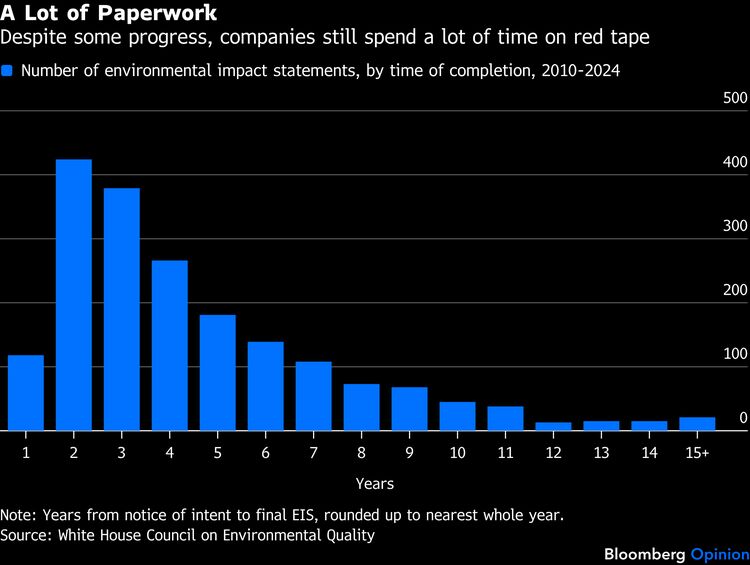
Building just about anything in the US takes too long and costs too much; for projects done on federal land or with federal funding, the problem is acute. Environmental impact statements — required under well-meaning, decades-old statutes — often run thousands of pages, take years to complete and can cost millions of dollars. Obstructive litigation all too often compounds the damage.
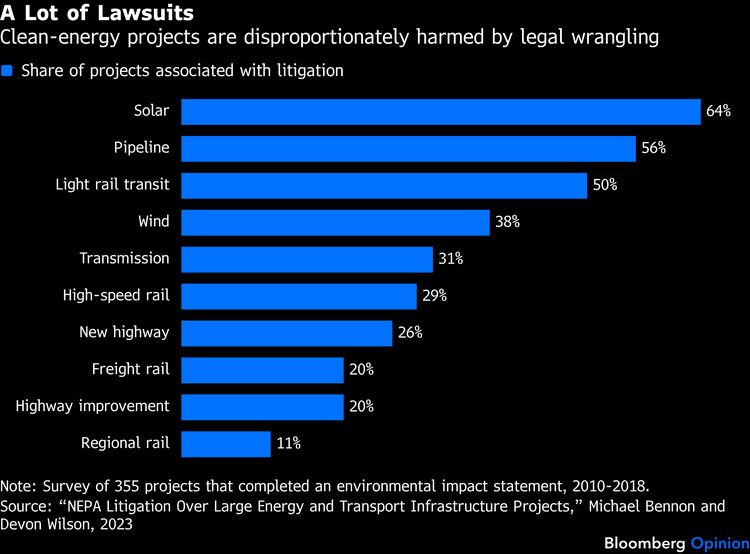
One perversity of this system is that clean-energy projects are disproportionately harmed. High-voltage transmission capacity needs to expand by about 60% by 2030 to meet net-zero targets , for example, yet permitting and planning requirements routinely hold up new lines by more than a decade . One study found that such delays could negate some 80% of potential emissions cuts induced by the Inflation Reduction Act.
More humdrum burdens have become the stuff of legend. Micron Technology Inc. had to secure dozens of permits, produce 22,000 pages of environmental paperwork and scour local trees for endangered bats before beginning work on a chip complex in New York; four years later, it's still mired in lawsuits. A key transmission line between Oregon and Idaho began construction last year — after a mere 19 years of red tape . Then there’s the Cape Wind project, which went through a decade and a half of permitting chaos and dozens of court cases before being abandoned completely in 2017.
Congress has periodically attempted to impose sanity on this system, including two major proposals in 2022 and 2024. Despite some piecemeal improvements, though, politics has generally impeded what should’ve been pragmatic reforms, and a “grand bargain” has remained elusive. A deal recently struck in the Senate, known as the Bipartisan American Affordability and Jobs Act, may finally succeed where those efforts failed.
Although nothing fancy, the bill is an exemplar of common sense and compromise. Among other worthy reforms, it would tighten deadlines for federal environmental reviews; make it harder to stall or cancel development already underway (absent a court order); streamline renewables projects, including geothermal plants; curtail capricious executive-branch actions (like the current administration’s destructive interference with offshore wind projects); and create significant new limits on abusive lawsuits.
Perhaps more important, it would grant the Federal Energy Regulatory Commission power to streamline construction of interstate transmission lines while creating new incentives to modernize the grid and optimize power distribution. (For good measure, it includes a crowd-pleasing requirement for data centers to bear more of the costs.) Of course, solving America’s energy woes will still be a decades-long project. Yet such changes represent real and unexpected progress.
All told, then, this proposal should accelerate the green-energy transition and reduce emissions while giving businesses more predictability, encouraging investment and boosting economic growth. In doing so, it should appreciably slash red tape and rationalize a Byzantine array of federal policy. There’s much to like.
More From Bloomberg Opinion:
- The Energy Catastrophe That Never Happened: David Fickling
- Energy Crisis Calls for Diversification: Michael R. Bloomberg
- $50 Billion IPO Is Good News for US Nuclear Goals : Liam Denning
Want more Bloomberg Opinion? OPIN <GO>. Web readers, click here . Or you can subscribe to our daily newsletter .