“Buy to the sound of cannons, sell to the sound of trumpets.” The ancient stock market maxim resonates in today’s Middle East. While the US and Iran fight, Big Oil is heading into neighboring Iraq.
Baron Nathan Rothschild, the 19th-century British banker who financed the Napoleonic wars, probably never uttered the investment precept many attribute to him. But there are echoes of his philosophy in what we hear today from oil executives: “Look, returns follow risk; and you know, we're not afraid of risk,” Mike Wirth, the head of Chevron Corp., told a recent industry gathering, explaining why he’s negotiating with Baghdad .
Few if any in the audience raised an eyebrow. Yes, Iraq is a risky destination, even more so today with a war raging in the neighborhood. But for the first time in decades, the country offers Big Oil the kind of returns it aspires to.
When the cannons fall silent, Baghdad is likely to emerge as a winner of the regional crisis, attracting billions of dollars from the likes of Chevron, BP Plc, ConocoPhillips and even ExxonMobil Holdings Corp. TotalEnergies SE, the French oil giant, is already a major investor.
With the new contracts Iraq has signed so far, and the ones it’s currently negotiating, the country could boost its output capacity to 5.5 million barrels per day by 2030. Before the war, Iraq pumped about 4.5 million barrels a day. Baghdad has long ambitioned increasing its production to 6 million barrels a day, which would make it second in the Middle East region only to Saudi Arabia.
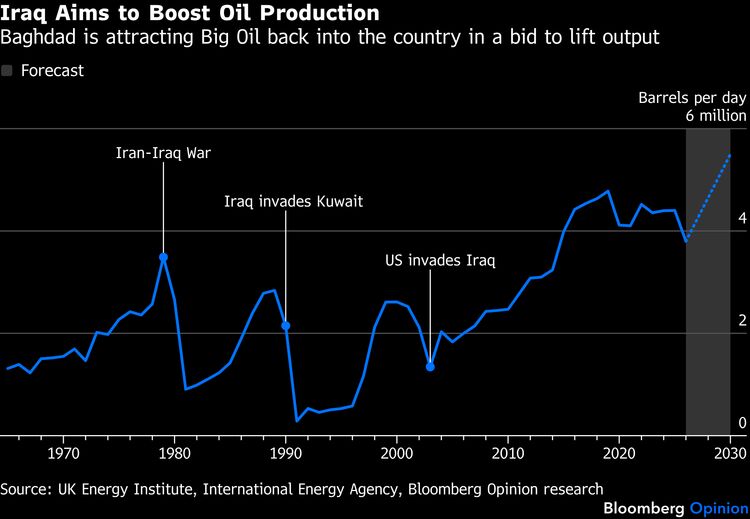
Iraqi Prime Minister Ali al-Zaidi has talked in recent months about increasing oil production capacity to 8 million barrels a day, and even 10 million barrels a day, beyond 2035. Despite the influx of capital, those targets are unrealistic. Still, boosting output by a more sensible 20%-30% would be an enormous feat, more so considering the US-Iran war today.
Left unanswered is a key question for Iraq and OPEC: How would the cartel accommodate Baghdad’s desire for much higher pumping? I see two likely outcomes: OPEC would turn a blind eye to the overproduction, as it did in the past with other members including Algeria and the United Arab Emirates, or Iraq would simply ignore the cartel and ultimately leave it.
Iraq could face hurdles if the Strait of Hormuz remains a war zone. But it does have options to bypass it. Baghdad already ships limited quantities of crude using a bypass pipeline that runs north through Turkey into the Mediterranean, where the oil can be loaded into tankers. The end of the Syrian civil war opens another possibility: a shorter pipeline toward the West, also ending in the Mediterranean.
The petroleum industry has longed for the Iraqi prize for decades. The first opportunity came in 2003 after the US under George W. Bush invaded the country and quickly overthrew Saddam Hussein, who had kept Iraq’s vast geological endowment largely off limits to foreign companies after he reached power in 1979.
But Big Oil never got from Baghdad what it had hoped — and what Bush and his lieutenant Dick Cheney had promised. Rather than the sought-after contracts known as production-sharing agreements, which give exposure to rising oil prices and allow companies to book reserves on their ledgers, they got service contracts, which only paid a small flat rate per barrel and didn’t allow booking the reserves.
Still, many major oil companies signed deals, only to leave the country a few years later after finding the returns didn’t compensate for the risk. Now Iraq is offering a new deal that has more in common with a production-sharing agreement than a service contract. It gives the industry the price upside and allows it to book reserves. “The fiscal terms in Iraq had become more attractive,” Wirth told the Energy Intelligence Forum in London last week. “Economics look better today.”
Three years ago, France’s TotalEnergies became the first oil major to move into Iraq under better contractual terms, with a $27 billion investment over multiple years in both oil and natural gas fields. Patrick Pouyanné, Total’s chief executive officer, has no regrets despite the war. “The Middle East still has the cheapest oil,” he told the same industry gathering.
BP followed suit last year with another contract and it roped ConocoPhillips into the project a few months ago. But the most important arrival is that of Chevron, which has signed a preliminary deal with Baghdad for assets once owned by Russian oil major Lukoil PJSC, with a final contract expected in 2027.
Oil is cyclical; shortages are always followed by surpluses. Today, Iraq is pumping well below its maximum production capacity due to the impact of the US-Iran war. But the world should expect more crude from Baghdad in the very near future.