India is bracing for a third straight day of tensions in its capital, with opposition parties on Monday planning a march to the Supreme Court and a youth-led movement pressing ahead with protests over a contentious revision of voter rolls.
Following a weekend of mass detentions and a heavy security presence in Delhi, opposition parties plan to submit a memorandum to India’s chief justice demanding an end to alleged electoral manipulation, a halt to the voter-roll revisions and the resignation of Chief Election Commissioner Gyanesh Kumar.
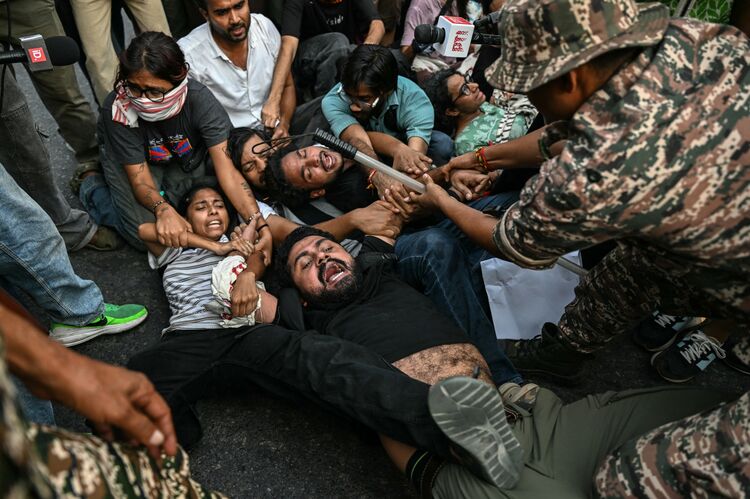
Restrictions across dozens of major roads and intersections will remain in place in the capital on Monday, according to the traffic police. Some metro stations serving six key areas of central Delhi were closed on Monday .
“Youth, all opposition parties, civil society groups, all those who believe in democracy and stand by the Constitution of India, will walk with us,” Rahul Gandhi, opposition leader in India’s lower house of parliament, wrote on X. “All of India will march to the Supreme Court.”
The march is set to begin in the afternoon. Earlier on Monday, Chief Justice of India Surya Kant told Times Now that he had declined the opposition’s request for a meeting. The issues the opposition bloc plans to raise are already before the Supreme Court in several pending petitions. The court is scheduled to hear the cases again on Tuesday.
The Cockroach Janta Party has also vowed to continue protesting until Kumar steps down. Ashutosh Ranka, one of the leaders of the group, said on X that it would seek a date from Delhi police Monday to hold a peaceful protest at Jantar Mantar, the capital’s designated protest site.
Read more: Cockroach Party Leaders Vow to Continue Protests After Release
“They are detaining student leaders and protesters and beating them — if they think this will break our spirit, they are mistaken,” Ranka said at a press briefing on Sunday afternoon. “The fight will continue until every single one of our demands is met.”
We are not leaving until all of our demands are met. https://t.co/M9z7hfSEvt
— Cockroach Janta Party - CJP (@Cockroachisback) October 11, 2026
The government’s curbs this week come after the top court on Sunday ruled that peaceful, unarmed people cannot be detained where prohibitory orders aren’t in force. It also directed the government to ensure uninterrupted internet access and ease restrictions on metro and railway services.
Prime Minister Narendra Modi hasn’t publicly commented on the latest protests. His Bharatiya Janata Party has defended the voter-roll revision and accused opposition parties of attempting to undermine democratic institutions.
“We are not opposed to protests, but you have weaponized street protests because of your electoral defeats,” BJP spokesperson Ravi Shankar Prasad said Saturday.
The controversy was triggered by a late-September investigation by the Indian Express alleging that Kumar ignored concerns raised by two election officials over a contentious revision of voter rolls that resulted in more than 130 million names excluded from draft rolls.
The body has denied the claims, saying its decisions were unanimous. It later also eased some voter-verification procedures, but the changes have done little to quell political pressure on the commission.
The demand for Kumar’s resignation comes ahead of key state elections, including next year’s vote in India’s most populous state of Uttar Pradesh, raising the political stakes for Modi’s ruling party and its opponents.
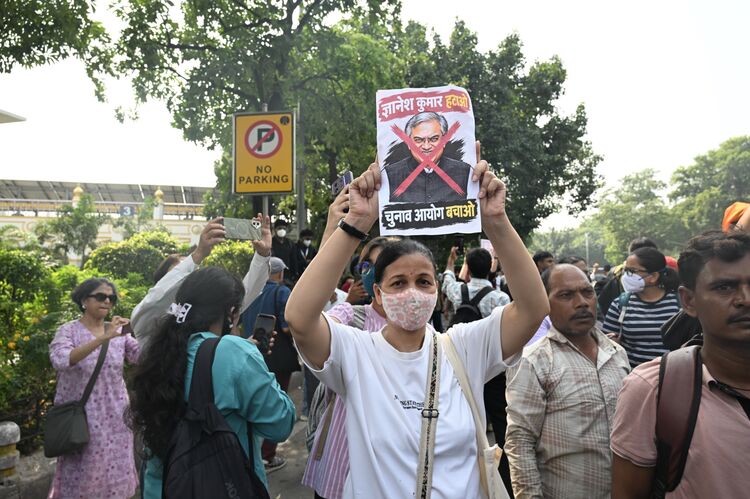
The weekend crackdown — including road closures, disruptions to internet and train services, and the detention of thousands of protesters — has put India’s handling of public dissent under greater scrutiny. The United Nations’ Human Rights Office has urged authorities to respect the right to peaceful assembly.
#India : We are concerned by reports of mass detentions of demonstrators, protest leaders, members of civil society organisations, lawyers and journalists, before and during today’s large-scale demonstrations in Delhi.
— UN Human Rights (@UNHumanRights) October 10, 2026
We call on the authorities to ensure that the right to… pic.twitter.com/ycV2CYB8k7
India’s Foreign Ministry rejected the criticism as “unwarranted interference in the internal affairs of India,” saying authorities had acted in accordance with the law. Delhi Police said last week it had denied CJP permission to demonstrate.
| Read more about India’s Election Commission controversy: |
|---|
| Why India’s Voter Roll Overhaul Is So Controversial: Explainer |
| India Police Detain Protesters, Lock Down Delhi Over Voter Rolls |
| Indian Opposition Leader Detained After Voter Roll Standoff |
The protests are the latest challenge for Modi’s government after thousands of angry students took to the streets in July over exam irregularities, forcing the education minister to resign. The police faced criticism at the time for heavy-handed methods in breaking up the student demonstrations.
The new wave of protests also comes at a difficult moment for the economy, with the government seeking to bolster investor confidence and boost growth. Indian equities have slumped, while the rupee is one of the worst-performing currencies in Asia this year.
On Saturday, the Reserve Bank of India broadened its defenses to steady the rupee, taking some of its strongest measures since the 2013 taper tantrum.